
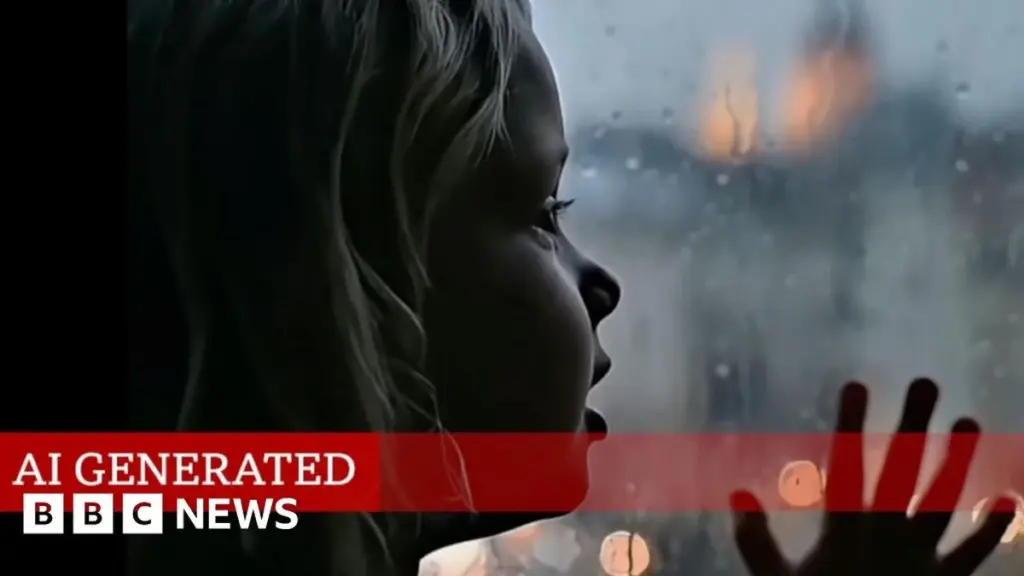
A startling video, appearing to depict the execution of a Hungarian soldier, circulated widely, causing significant shock among viewers. This incident occurred shortly before pivotal Hungarian elections scheduled for Sunday, April 12th. The fabricated clip, created using artificial intelligence, was disseminated across social media platforms by the ruling Fidesz party, led by Prime Minister Viktor Orbán.
The video narrated the sorrowful tale of a young girl yearning for her father’s return from war, transitioning abruptly to a scene showing him blindfolded, bound, and subsequently shot by his captors. This content was aimed at Péter Magyar, Orbán’s primary electoral challenger, who stood to potentially unseat him after sixteen years in power.
The Fidesz campaign has notably advanced unsubstantiated assertions regarding the conflict in Ukraine and Magyar’s political objectives. In some instances, the party has employed AI-generated videos like the one described, even while explicitly acknowledging its fabricated nature. A message accompanying the video stated, “The video is an AI video, but the war is really horrible. Péter Magyar doesn’t want you to see this video. He doesn’t want you to see what an irreversible tragedy it is to join a war.”
Fidesz has propagated the narrative that Magyar, affiliated with the center-right Tisza party, would invite Russia’s war in Ukraine to Hungary’s doorstep if elected. Their claims extended to suggestions that he would utilize pension funds to support Ukraine and implement mandatory conscription.
These allegations have been consistently refuted by Magyar and his Tisza party. Their manifesto clearly states a commitment against deploying troops to Ukraine and no intention to reinstate conscription.
When approached for comment regarding the AI execution video and its dissemination on their social media channels, the ruling party Fidesz did not provide a response.
Campaign Director’s Statement on AI Video
In a video interview shared on Facebook, Támas Menczer, communication director for the Fidesz-KNDP alliance, addressed a query about the AI video. He expressed his belief that “the greatest possible danger is that Hungarian people could die if Tisza wins, because Tisza supports the war, Tisza supports sending money.” Menczer did not, however, offer specific commentary on the video’s AI origins.
Péter Magyar has publicly condemned the video, characterizing it as the Fidesz party having “crossed all limits” and describing the content as “heartless manipulation.”
The Evolving Landscape of Political Disinformation
Zsófia Fülöp, a journalist at Lakmusz, Hungary’s sole independent fact-checking website, noted that while the ruling party’s use of such narratives is not unprecedented, the incorporation of generative AI represents a new development. “It is omnipresent in this campaign, especially in the communication of the ruling party and its media and proxies,” Fülöp stated. “They’ve used it before but now it’s massive.”
Despite these tactics, the Fidesz campaign has not demonstrably influenced voter sentiment, with Magyar maintaining a lead in most opinion polls.
Fidesz’s political allies have also engaged in propagating similar anti-Ukrainian narratives through their social media channels. Last month, the National Resistance Movement (NEM), a pro-Fidesz activist group, released an AI-generated video depicting a fabricated phone conversation between European Commission President Ursula von der Leyen and Péter Magyar, ostensibly discussing financial aid to Ukraine. This video garnered over 3.7 million views.
An accompanying caption read, “When the phone rings and a request comes, then he won’t be able to say no.” NEM did not disclose that the video was AI-produced.
Magyar identified the video as a fabrication, but it had already circulated extensively among pro-government media outlets and Fidesz politicians, including Prime Minister Orbán. In a post, Orbán acknowledged the video’s AI origin but issued a warning that such scenarios could become reality.
Inquiries made to NEM regarding their reasons for posting the AI video and its production were met with no comment.
“State of Hallucination”: Disinformation’s Pervasive Influence
“We’re in a state of hallucination,” commented Éva Bognár, a researcher at the Central European University’s Democracy Institute. “In a way the whole campaign is a disinformation campaign because it’s all based on a complete false narrative that we’re on the brink of war.”
In a separate incident occurring a few weeks prior, Hungarian anti-terrorism police apprehended seven Ukrainian bank employees transiting through the country. They were in possession of $80 million (£60 million) in cash and 9kg (20lb) of gold, transported in cash-carrying vehicles en route to Ukraine.
Ukrainian Foreign Minister Andriy Sybiha accused the Hungarian government of taking the group hostage and seizing the funds. Ukraine’s state savings bank, Oschadbank, asserted that the workers possessed a valid license and that this was a routine transit between Austria and Ukraine.
The Hungarian government, however, alleged money laundering activities and suggested the funds might be intended to “finance pro-Ukraine forces.” Although the Ukrainian bank employees were released without facing charges, the Hungarian authorities have yet to return the seized money and gold.
Pro-government media outlets on Facebook utilized AI-generated images to report on these arrests. One such outlet published hyper-realistic depictions of the arrests, presenting them as factual. Comparisons with official images and videos posted by the Hungarian government’s official Facebook page revealed significant discrepancies, including inaccuracies in the uniforms of the officers and the attire of the Ukrainian individuals.
Facebook’s third-party fact-checking service has classified the post as “partly false.”
Hungary’s diplomatic ties with Ukraine were historically stronger, with the country supporting Ukraine’s bid for EU membership until late 2023. However, relations deteriorated as Orbán maintained close ties with Russian President Vladimir Putin.
A survey conducted by the research institute Policy Solutions indicates that anti-Ukrainian sentiment in Hungary is nearly as prevalent as anti-Russian sentiment. The survey found that 64% of Hungarians hold a negative view of Ukraine’s President Volodymyr Zelenskyy, and 67% express a dislike for Putin.
“One side holds all the cards,” observed researcher Éva Bognár. “Fidesz has infinite resources at its disposal: from public funds, state agencies and offices to a media conglomerate that operates as a propaganda machine, including the public service media.”
Navigating the Media Landscape: Magyar’s Social Media Strategy
Péter Magyar is partially circumventing the complex media environment by leveraging social media platforms. According to 20k, a Hungarian election integrity watchdog monitoring political actors’ social media activity during the election period, Magyar’s posts on Facebook, TikTok, and Instagram achieve double the engagement levels of Orbán’s content.
Magyar’s social media output includes a mix of professional content and informal imagery designed to present him as a younger, more approachable leader. These posts feature him engaged in activities such as partying, playing volleyball, preparing burgers at a restaurant, and enjoying water sports.
However, the Tisza party leader has also employed less overt forms of misleading rhetoric. These include inaccurate statements about the number of Hungarian newborns born outside the country, an attempt to evoke a sense of diminished national pride.
Magyar has also engaged in tactics similar to those used by the ruling party, alleging that it is Fidesz, rather than Tisza, that intends to reintroduce compulsory military service. Apart from a brief mention by two Fidesz politicians in 2016, no evidence has been found to support the claim that the party plans to revive compulsory military service.
Péter Krekó, head of the independent political research institute Political Capital, suggests that Magyar has successfully “exploited… strong public resentment” towards the current government. This sentiment appears to be particularly strong among individuals aged 18 to 40.
A survey conducted by the Median agency indicates that support for Tisza is most pronounced among those under 40, whereas nearly half of individuals over 65 express support for Fidesz.
Despite these demographic trends, Fidesz continues to emphasize its anti-Ukrainian narrative across both traditional media and online platforms. Posters have appeared depicting Zelenskyy and Magyar together under the alarming caption “They are dangerous!”
Krekó predicts that if Fidesz secures victory, similar disinformation tactics will persist beyond the election period. Conversely, if the party does not win, a “more tumultuous relationship between the media and politicians” is anticipated.