
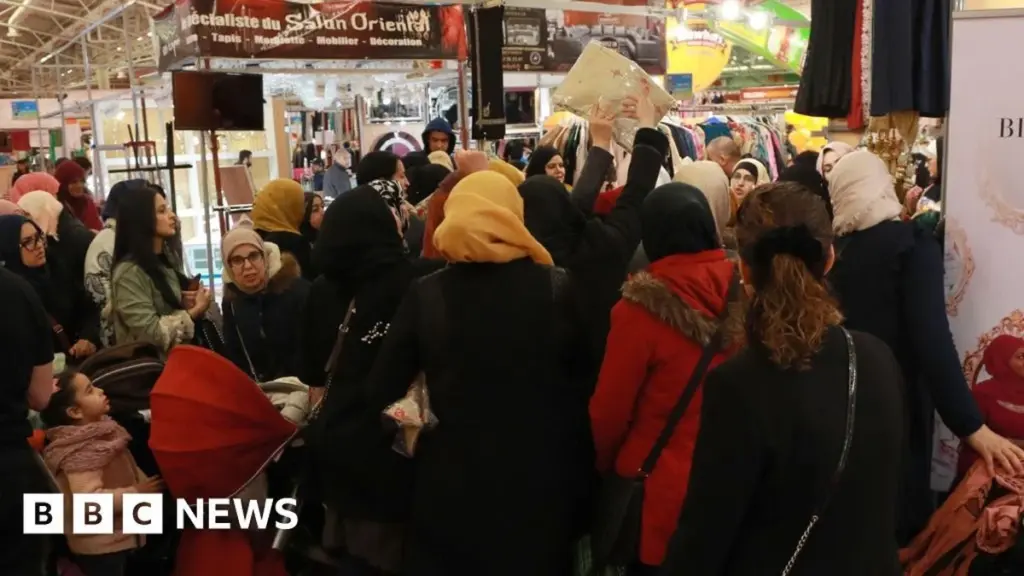
A significant Muslim congregation planned for the northern suburbs of Paris has been prohibited by French authorities. The decision, announced by the Paris police department, cites a heightened risk of terrorist targeting, particularly against the Muslim community.
The four-day “Annual Encounter of Muslims of France,” scheduled to commence on Friday, was expected to draw tens of thousands of attendees from across the European continent. It was slated to take place at an exhibition center in Le Bourget. However, citing the “particularly tense international and national context,” police stated the gathering faced an “important terrorist risk.”
Organizers of the event promptly pursued an emergency injunction to overturn the ban, with a ruling anticipated the same day. This gathering, a blend of cultural and religious conference and trade fair, had been an annual fixture until 2019.
The event is organized by Muslims of France (MF), a group that has faced criticism for its alleged ties to the international Muslim Brotherhood.
In explaining the grounds for the prohibition, the police department referenced a recent unsuccessful fire-bombing attempt in Paris targeting an American bank. This incident, the police noted, underscored the “seriousness of the homegrown threat.” Four individuals, including three minors, are currently facing charges in connection with that incident. Investigators suspect a pro-Iran group may have orchestrated the attack.
Further concerns articulated by the police involved the potential for “small far-right groups” to organize and disrupt the event. This possibility arises within a climate of “political agitation and heavy polarization of debate.” The police also acknowledged that actions against the gathering could be “conducted remotely by foreign influences.” France has previously leveled accusations against Russia and Iran, alleging they have fueled discord through paid provocateurs to execute minor acts of provocation or sabotage.
This ban coincides with France’s announcement of a new legislative proposal, an “anti-separatism” law. This law primarily targets Muslim organizations accused of promoting ideologies deemed incompatible with the Republic’s foundational principles.
Interior Minister Laurent Nuñez elaborated on the new law’s purpose, stating it aims to build upon existing legislation enacted five years prior. That earlier law empowered the government to shut down associations involved in promoting Islamic separatism. “There are still some structures which we have been unable to reach,” Nuñez informed BFMTV. He specifically highlighted “collective childcare” for which current oversight is insufficient, and expressed a desire for increased control. “More generally we want to be able to ban publications which carry appeals to hate, violence or discrimination,” he added.
Sefen Guez Guez, legal counsel for MF, contended during the injunction hearing that the ban constituted a “manifest breach of the right to assemble” and served as a clear attempt to advance the government’s new legislation. However, a lawyer representing the police maintained that the sole objective was the preservation of public order, asserting, “This is not an anti-Muslim or anti-Islam decree.”