
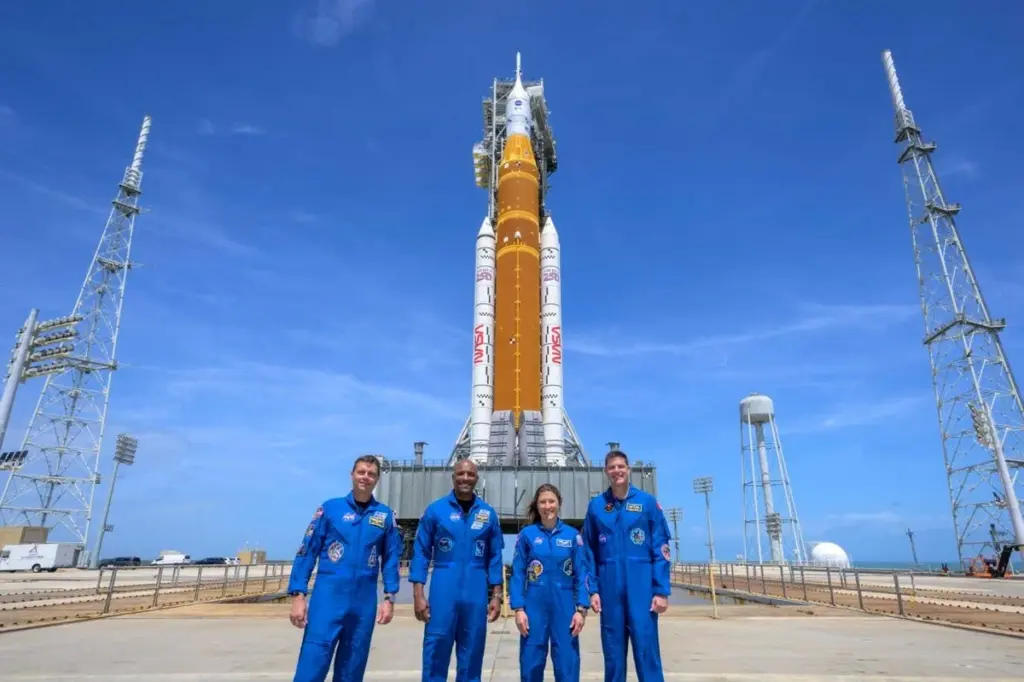
Four astronauts are on the cusp of a unique journey, set to observe the Moon in a way never before experienced by humans. NASA’s Artemis II mission, with a potential launch date as early as April 1st, aims to propel astronauts into lunar orbit, marking the first crewed circumnavigation of the Moon since 1972. This endeavor will grant them views of lunar regions on the far side that have remained unseen by human eyes.
The Artemis II mission was initially slated for a 2019 launch. However, a series of setbacks delayed its precursor, Artemis I, until 2022. Artemis I, an uncrewed flight around the Moon, represented the last operational flight for both the Space Launch System (SLS) rocket and the Orion crew capsule.
Its upcoming successor will replicate a similar flight path. This time, however, the spacecraft will carry a four-person crew: NASA astronauts Reid Wiseman, Victor Glover, and Christina Koch, alongside Jeremy Hansen from the Canadian Space Agency.
Earlier this year, a critical “wet dress rehearsal” in February brought to light specific spacecraft issues. Primarily, minor fuel leaks necessitated the rollback of the rocket from the launchpad to an assembly building. Following repairs to these leaks, the rocket has been returned to the pad and is now prepared for launch. The astronauts are currently in quarantine, finalizing their preparations for the mission’s commencement.
During a press conference held on March 29th, mission commander Reid Wiseman underscored the crucial test flight nature of Artemis II for the SLS and Orion systems. “This is the first time we are attempting this. It marks the inaugural flight with humans aboard,” he stated. “The four of us are ready, the team is ready, the vehicle is ready. However, we harbor no expectation of launching until the vehicle itself signals its readiness.”
Should the launch not occur before April 6th, the subsequent launch window opens on April 30th, with further opportunities anticipated in May and beyond.
Upon liftoff, the rocket will spend two days in Earth orbit before commencing its trajectory toward the Moon. During this orbital phase, the crew will conduct tests of the life support systems. They will also engage in a simulated docking maneuver with an older spacecraft, taking manual control of the Orion capsule. The journey around the Moon and back is expected to span approximately eight days.
During their lunar passage, the mission will provide illumination of previously unseen regions on the far side, including the expansive Mare Orientale crater. “We initially believed—and I certainly did during training—that we had comprehensively explored the Moon. The Apollo missions reached lunar orbit; they observed the entire far side. However, it turns out that approximately 60 percent of the lunar far side, as I understand it, has never been directly viewed by human eyes,” Wiseman explained.
Artemis II represents a significant phase within the broader Artemis program. While the original plan for the program’s third phase included the first lunar landing since the conclusion of the Apollo era in 1972, modifications have deferred this landing to Artemis IV. Consequently, the subsequent mission will remain in Earth orbit, allowing astronauts to practice docking procedures with the lunar lander or landers designated for future missions. Artemis III is currently scheduled for 2027, with Artemis IV and potentially Artemis V planned for 2028.
Successful execution of these missions is envisioned to lead to the establishment of a permanent lunar base, ensuring an ongoing human presence on the Moon. “We are content to contribute our small effort, a minor contribution, and then pass on the mission when we return,” commented Hansen during the press conference.