
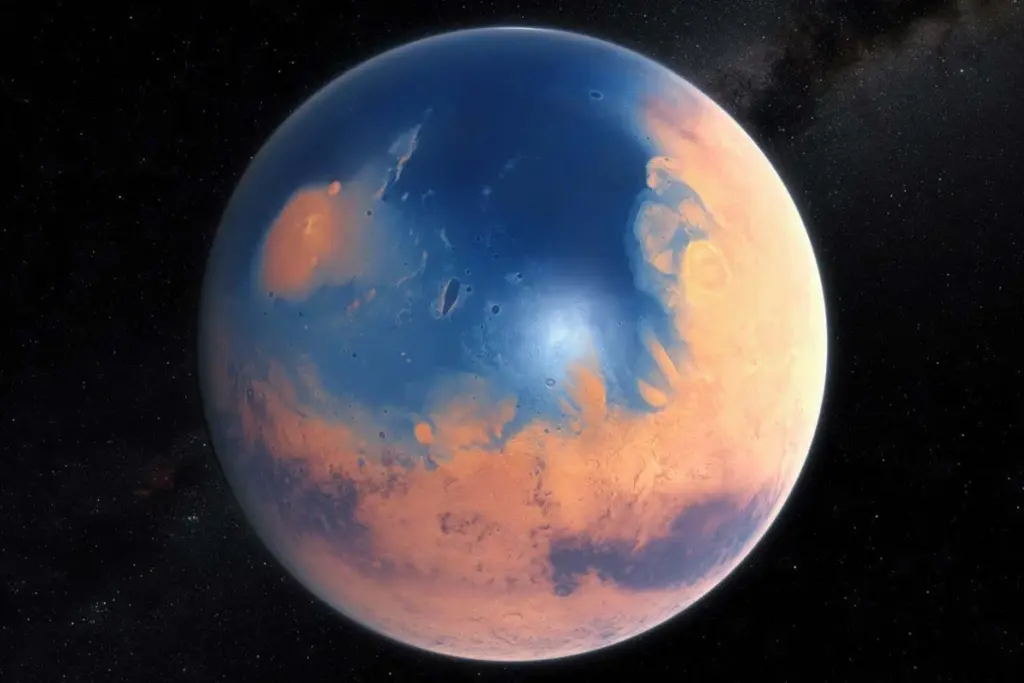
Planetary scientists generally concur that Mars once hosted liquid water on its surface, existing within a considerably more humid atmosphere than its present arid state suggests. However, a comprehensive review of all known sources of water input to the Martian surface, alongside an examination of all potential removal mechanisms, has revealed a significant puzzle: the ultimate fate of that water remains largely unknown.
The era during which Mars is believed to have possessed liquid water, spanning roughly from 4.5 to 3.7 billion years ago, is designated as the Noachian Period. Based on current estimations of water delivery to the Martian surface, sufficient water should have accumulated by the close of the Noachian Period to form a global ocean. This ocean’s depth is estimated to have ranged between 150 and 250 meters.
Yet, when Bruce Jakosky of the University of Colorado Boulder and his team meticulously accounted for all the ways water could have been lost from the surface since that time, their calculations indicated a total loss of only a few tens of meters at most. Jakosky presented these findings at the Lunar and Planetary Science Conference (LPSC) in Texas on March 20th.
The total amount of water currently present near the Martian surface, primarily locked as ice and within hydrated minerals, is equivalent to a global ocean approximately 30 meters deep. “How do you reconcile an initial 150-meter depth, subtract a few tens of meters, and end up with 30 meters? It simply doesn’t add up. There is clearly a gap in our understanding,” stated Jakosky. He further explained that even when considering the lowest plausible estimates for water input and the highest plausible estimates for water removal, the discrepancy persists and is not fully resolved.
Several hypotheses attempt to explain where this missing water might have gone. One possibility is that a considerably larger volume of water evaporated into space from the Martian surface since the end of the Noachian Period than previously assumed. Another is that water remains frozen in undiscovered ice deposits. Misunderstandings regarding the interactions between the polar ice caps and the atmosphere are also being considered. Alternatively, some proposed water sources might interact with each other in unexpected ways, leading to an overcounting of the total water available.
Jakosky suggested that the most probable scenario involves a combination of these factors, potentially alongside other unidentified mechanisms. While this substantial discrepancy may seem surprising, there is consensus within the scientific community that the complete history of water on Mars is not yet fully understood.
Further insights were presented at LPSC by other researchers. One hypothesis suggests that Mars may not have experienced a single, prolonged period of surface water. Instead, there might have been intermittent episodes of rainfall interspersed with periods of drought. Eric Hiatt of Washington University in St. Louis, speaking at the conference, indicated that this perspective implies a hydrologic cycle on Mars fundamentally different from Earth’s, and likely distinct from any terrestrial analogues. His research points to the possibility that Martian groundwater may not interact with the surface and atmosphere in ways previously believed, which could alter assessments of the total water that reached the surface.
In a separate presentation, Bethany Ehlmann, also from the University of Colorado Boulder, proposed that Mars might currently hold more water than has been traditionally accounted for. Collectively, these findings underscore that while significant knowledge about Mars exists, a complete picture of its hydrological history remains elusive.
Resolving the mystery of water on Mars, and consequently its potential habitability at various points in its history, will constitute a considerable undertaking. “How do we move forward on this? We’re not going to achieve it with more models,” Jakosky remarked. “If you ask me, I believe this truly requires boots on the ground.”
Given that both NASA and SpaceX are currently prioritizing lunar exploration, it is plausible that human exploration of Mars lies decades away. Therefore, immediate progress in understanding Martian water is likely to be incremental, relying on data acquired from rovers and orbiters.