
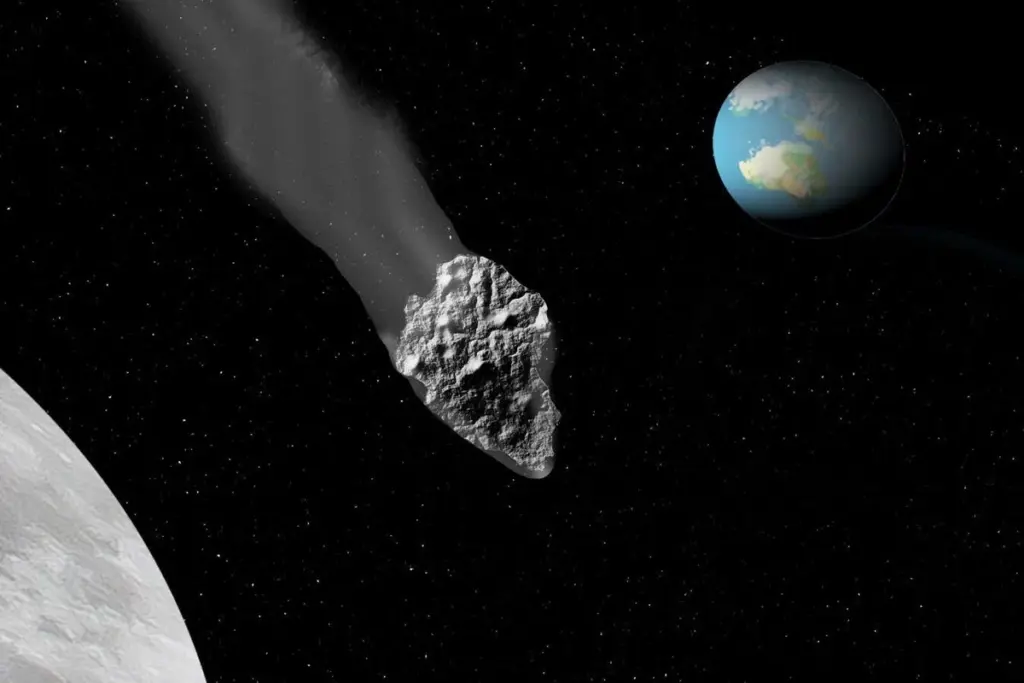
A novel concept proposes deflecting potentially hazardous asteroids by employing a powerful magnet to gently dismantle them. This method aims to circumvent some of the challenges associated with traditional kinetic impactor techniques, which rely on physically striking an asteroid to alter its trajectory. However, this untested approach carries inherent uncertainties regarding its practical efficacy.
The technique, dubbed non-contact orbital velocity adjustment, or NOVA, was presented by Gunther Kletetschka of the University of Alaska Fairbanks at the Lunar and Planetary Science Conference held in Texas on March 17th. Kletetschka’s calculations explored the application of the NOVA concept to asteroid 2024 YR4. This celestial body had briefly been predicted to potentially intersect with Earth or the moon in 2032, though subsequent observations confirmed a safe passage.
Asteroid 2024 YR4, measuring less than 70 meters in diameter, would present a comparatively manageable target for such a diversionary maneuver due to its modest size. The proposed spacecraft would feature a substantial magnet constructed from a superconducting wire coil, extending approximately 20 meters in diameter. Power for this apparatus would be supplied by a nuclear fission reactor. Small thrusters would maintain the spacecraft’s orbit around the asteroid, keeping it at a distance of roughly 10 to 15 meters. This positioning would allow the magnet to exert influence on the iron content within the asteroid.
While a solid iron asteroid could be directly nudged off course by the magnet, most asteroids possess a different structure. They are often not monolithic masses but rather accumulations of smaller rocks loosely bound by gravity, commonly referred to as rubble piles. These structures exhibit minimal tensile strength.
As Kletetschka explained during his presentation, attempting to push a rubble pile asteroid as a cohesive unit is ineffective because “it’s like pushing on one boat among many boats on the ocean.” A kinetic impactor, in contrast, carries the significant risk of fragmenting the asteroid, potentially leading to multiple pieces impacting Earth.
The NOVA spacecraft’s strategy involves orbiting the asteroid and progressively extracting rocks from the rubble pile, capturing them in a magnetic trap located at the core of its coil. Each collected fragment would serve a dual purpose: it would augment the spacecraft’s mass, thereby increasing its magnetic field. This enhanced field, in turn, would facilitate the extraction of subsequent fragments.
In essence, the process would involve gradually reducing the asteroid’s size while simultaneously steering it away from a collision course. The spacecraft would effectively transform into a secondary celestial body, critically, one that humanity could actively direct. Kletetschka’s analysis indicated that a complete deflection of 2024 YR4 would necessitate at least 170 days of continuous operational effort.
Kletetschka acknowledged the theoretical plausibility of this electromagnetic deflection method but highlighted key areas of uncertainty. “This electromagnetic deflection is plausible, but we have critical uncertainties,” he stated. One significant unknown is the precise quantity of iron present within 2024 YR4. While preliminary estimations based on comparisons with similar asteroids suggest an adequate amount, this remains an educated guess. Furthermore, maintaining a spacecraft in such close proximity to an asteroid for an extended operational period presents considerable navigational and engineering challenges, as this scenario has not been previously attempted.
Despite these challenges, Kletetschka suggested that incorporating such a tool into humanity’s planetary defense capabilities would be beneficial. A notable advantage is the inherently low risk of exacerbating the potential threat, unlike methods that could cause unintended fragmentation.