
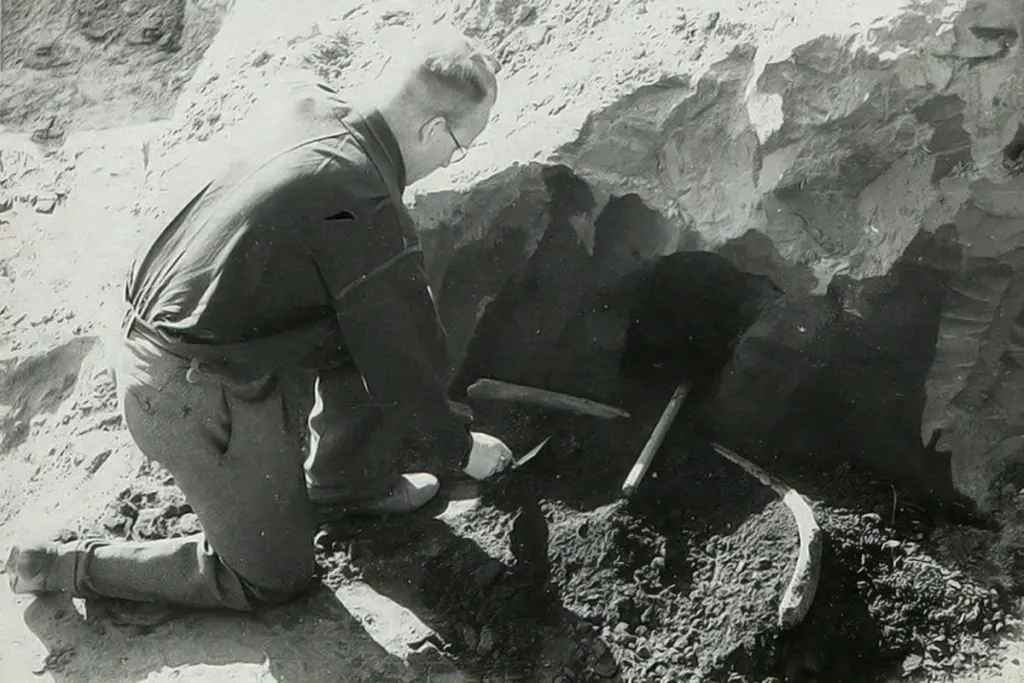
Deep within the Schöningen Research Museum in Germany, a seemingly chaotic collection of old cardboard boxes belies a significant archaeological discovery. These containers hold the finds from Lehringen, a small locale situated 150 kilometers away. The contents, unearthed from an ancient lakebed, pertain to a straight-tusked elephant, identified as Palaeoloxodon antiquus, whose remains are approximately 125,000 years old.
While elephant bones from this era are not exceptionally rare, the particular specimen discovered at Lehringen presented a striking anomaly: a spear, measuring 2.3 meters in length, lodged between its ribs.
At the time of its discovery, this yew thrusting lance represented the oldest complete spear ever found. Prior to this, only a fragment of a spear had been recovered from Clacton-on-Sea in the United Kingdom. The Lehringen spear stands unique as the sole example found embedded within the skeleton of an extinct animal species. Given that Neanderthals were the dominant human species in Europe during that period, the spear initially suggested compelling evidence that they were sophisticated big game hunters rather than mere scavengers. Its potential impact on understanding Neanderthal capabilities was substantial.
However, the circumstances surrounding the excavation presented significant challenges. The operation was led by Alexander Rosenbrock, a local school principal with an interest in amateur archaeology who also managed a museum in the nearby town of Verden. The mining activity that uncovered the elephant’s remains had removed roughly half of the bones before Rosenbrock, accompanied by his daughter and volunteers, could reach the site. Upon his arrival, some bones had already been taken. Critically, Rosenbrock lacked a camera and crucially failed to document the positions of the bones and the spear within the lake deposits. This was followed by a seven-year legal dispute over the artifacts. Rosenbrock ultimately won the right to keep the finds in Verden, a decision that may have contributed to their subsequent obscurity. Rosenbrock passed away in the 1950s before publishing his findings.
Over the subsequent 75 years, the significance of the Lehringen discovery faced growing scrutiny. Questions arose regarding whether the spear and bones had been found together by mere coincidence. While researchers had examined the artifacts on two occasions, they proceeded under the assumption that the elephant bones had previously been cleared of any evidence of butchery.
A Fresh Examination in 2025
The situation began to change in 2025 when Ivo Verheijen, the dedicated bone expert at Schöningen, commenced a detailed examination of the Lehringen finds. Verheijen initially anticipated a limited number of boxes containing the artifacts. “I was told there would only be a couple of boxes,” Verheijen recalled. “But when we got to the museum to collect them, they were in the attic, right under the roof… and there was a truckload of them.”
The archaeological center in Schöningen, where Verheijen works, is located just 300 meters from an excavation site that has been active since the mid-1990s. This site gained prominence for the discovery of ten spears, approximately 300,000 years old, found at the edge of a former quarry. These spears, along with the Clacton and Lehringen specimens, are recognized as the only definitively identified spears from the Lower Paleolithic period, an era spanning from 3.3 million to 12,000 years ago.
Verheijen’s prior experience with ancient elephant remains was considerable; in 2017, his team at Schöningen had unearthed a complete elephant skeleton. This familiarity proved invaluable when he turned his attention to the Lehringen material.
Unpacking the Lehringen Finds
Verheijen retrieved an old soap box from a cupboard. Inside were freshwater shells from the Lehringen dig and a specimen label. Flipping the label over, he revealed it to be a 50 million mark banknote from the period of hyperinflation after World War I. “They only ever printed them on one side,” he explained, illustrating their repurposed use for creating labels. “So good for making finds labels.”
For Verheijen and his colleagues, this project evolved into a form of cold-case investigation. Fortunately, the extensive collection of finds included not only elephant bones and those of other species from the dig, alongside flint tools, but also written records detailing Rosenbrock’s work. These records were later continued by his daughter, Waltraut Deibel-Rosenbrock, after his passing.
It did not take Verheijen long to conclude that the Lehringen elephant had been butchered. “Quite quickly… we found some cut marks that were super clear,” he stated. “It’s almost difficult to imagine that nobody noticed [them].” The animal, contrary to earlier reports from the 1940s, was not old; it died in its prime at approximately 30 years of age. It was likely a male, standing over 3.5 meters tall at the shoulder. This, Verheijen suggests, aligns with the behavior of male elephants, which are more prone to solitary existence, thus presenting a potentially more accessible target for hunters than females.
Evidence indicated that butchery occurred both externally and internally, suggesting the harvesting of organs. This implies the elephant was fresh when Neanderthals processed it. Consequently, it is highly probable that the elephant died with the spear embedded in its side, making the co-location of its remains and the weapon far from accidental.
The humans extracted usable portions of the carcass using simple flint flakes, leaving the remainder for scavengers, as not all bones exhibited butchery marks. The site also yielded bones from bears, beavers, and aurochs, which also appeared to have been butchered for both meat and skin. This collective evidence points to Neanderthals regularly hunting and processing animals at the lakeside.
Verheijen noted that modern elephants, when injured, often seek water. He posits that the speared elephant likely made its way to the lakeside. He further suggests that multiple spears might have been involved, with the humans tracking the injured animal until it succumbed. The fallen elephant then crushed one of the spears beneath it—the one that remained at the scene. The team intends to conduct further examinations of this spear.
Even at its midpoint, the project has already offered one of the most detailed and evocative portrayals of Neanderthal hunting practices ever documented. Verheijen is currently involved in the preservation of the Lehringen bones, with the goal of eventual public display. “This is one of the most important Neanderthal sites in Germany,” he remarked. “Somehow it got forgotten about, but we’re trying to give it the stage it deserves.”
Journal reference: Scientific Reports DOI: 10.1038/s41598-026-42538-4