
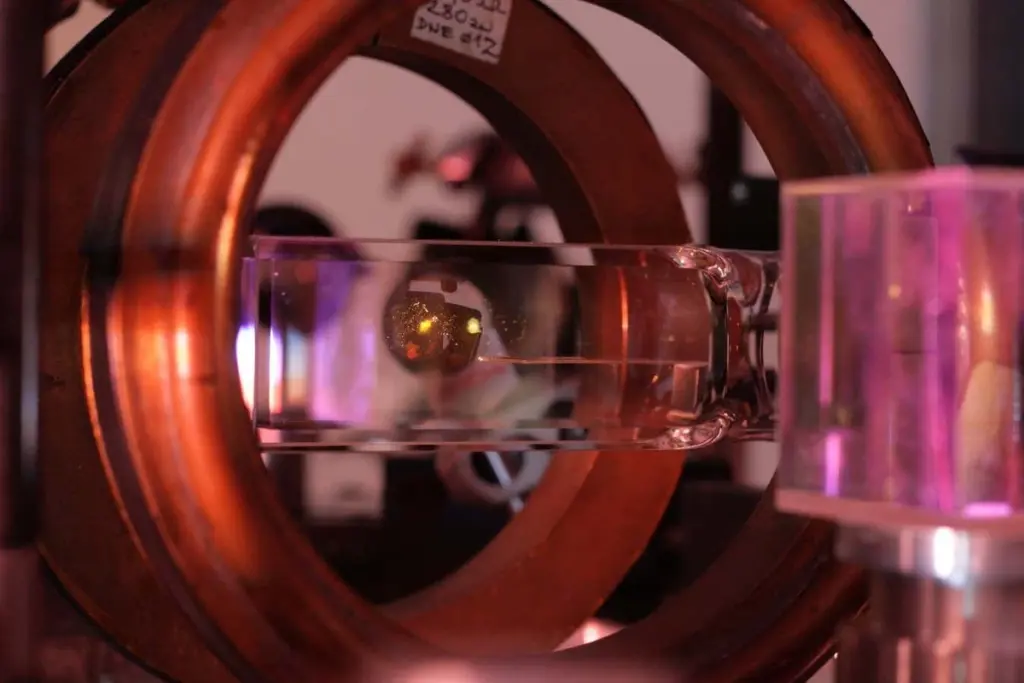
The establishment of a more precise and reliable definition of temperature could stem from a novel quantum device populated by exceptionally large atoms.
While various nations employ Celsius or Fahrenheit for everyday temperature readings, the global scientific community universally utilizes the kelvin unit. Absolute zero, defined as zero kelvin, represents the lowest possible temperature achievable under the known laws of physics, leading to the designation of kelvin as a measure of “absolute temperature.” However, the practical realization of measuring a single kelvin with certainty presents a complex and time-consuming endeavor.
Noah Schlossberger of the National Institute of Standards and Technology (NIST) in Colorado explains the current calibration process. “If you need to perform an absolute temperature measurement, you acquire a commercial temperature sensor. This sensor was calibrated against another commercial sensor, which in turn was calibrated by yet another, and so on. Eventually, one of these sensors was sent to NIST for its calibration.”
Schlossberger and his research team have developed a device that leverages quantum phenomena to measure kelvin. This innovation could potentially eliminate the current reliance on convoluted calibration chains for temperature sensors.
The device takes the form of a compact enclosure, constructed from metal and glass, housing trapped rubidium atoms. The researchers manipulate these atoms to an extreme size by employing lasers to extend the outermost electrons significantly away from the nucleus. Concurrently, they are cooled to approximately half a millikelvin – a temperature roughly 600,000 times colder than room temperature – by an intricate combination of lasers and electromagnetic fields designed to capture and chill the atoms.
This extreme manipulation renders the outermost electrons within the rubidium atoms acutely sensitive to even minor temperature variations. Upon exposure to a slight increase in temperature, these electrons transition into a different quantum state. These precise transitions are the core mechanism that makes the device an effective temperature sensor. Established mathematical models can accurately determine the temperature differentials required to induce these electron jumps, effectively enabling a redefinition of the kelvin scale based on these quantum behaviors.
The International Bureau of Weights and Measures already defines the kelvin in a manner that references quantum constants. Yet, in practice, even institutions like NIST continue to utilize non-quantum instruments for their calibration procedures. The anticipation is that this new device will offer a quantum-based definition of kelvin that bypasses the need for any external calibration.
“Every rubidium atom worldwide is identical, and they will react identically under the same environmental conditions,” Schlossberger remarks. “I could replicate this device on the opposite side of the globe, and it would function identically.” He highlights the particular importance of this consistency for the accurate operation of high-precision instruments, such as atomic clocks, which necessitate extremely low kelvin temperatures to function optimally.
However, this device remains in its prototype phase, exhibiting certain imperfections, particularly in the detection of quantum states. Furthermore, its current size makes it impractical for deployment outside of a laboratory setting, and its construction required over six months. The research team is actively refining the design to enhance its portability and boost its accuracy.
Schlossberger presented the findings of this research on March 16th at the American Physical Society Global Physics Summit held in Colorado.