
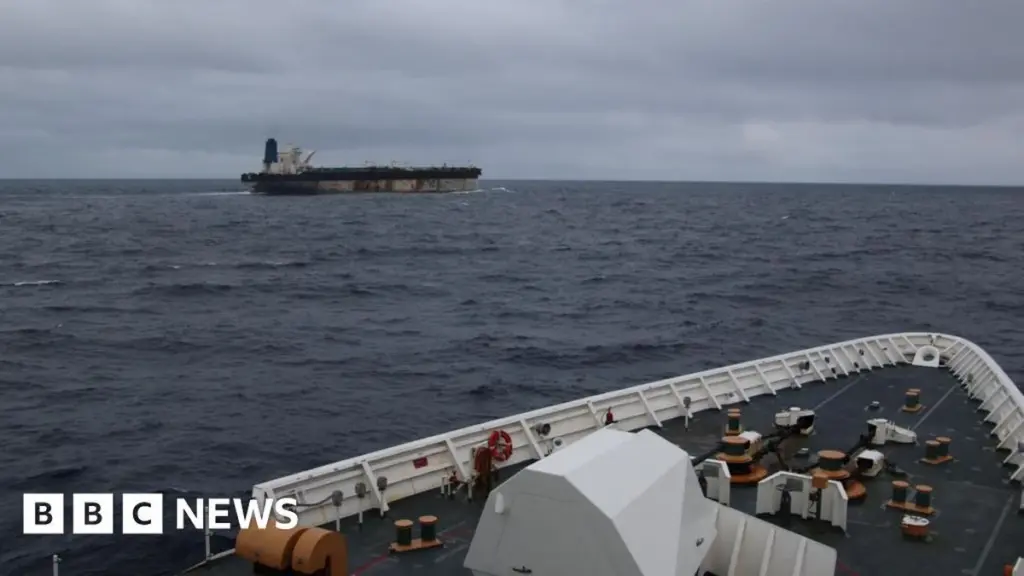
British forces are nearing the final stages of preparation to intercept and detain vessels belonging to Russia’s so-called “shadow fleet.” This action has received official approval from the Prime Minister, signaling a significant military stance against these ships.
Russia has faced accusations of utilizing vessels that sail without a legitimate national flag. This practice is reportedly employed to circumvent international sanctions, particularly concerning oil exports, and to indirectly finance its ongoing military operations in Ukraine.
In January, government ministers identified a legal framework that permits British forces to board sanctioned vessels found within UK territorial waters. Sources indicate that the inaugural operation under this directive is anticipated in the very near future.
Sir Keir Starmer, commenting on the development, stated that this measure would effectively starve “Putin’s war machine of the dirty profits that fund his barbaric campaign.” His remarks highlight the perceived strategic importance of disrupting the financial flow supporting Russian military actions.
Ministers are reportedly keen to underscore the persistent threat posed by Russia. This focus remains despite a notable shift in governmental attention towards the conflict in the Middle East over recent weeks.
The authorization for boarding these vessels was granted as the Prime Minister embarked on a trip to Finland for the Joint Expeditionary Force (JEF) summit. The JEF is a military alliance comprising northern European nations. Sir Keir Starmer is scheduled to address this summit on Thursday.
Naval Vigilance and Training Exercises
In recent weeks, personnel from the Royal Navy have been actively involved in assisting countries such as Finland, Sweden, and Estonia. Their role has involved the monitoring and tracking of ships associated with the shadow fleet.
While no UK military personnel have yet boarded any vessels, senior government officials express a strong desire for this to change. The aim is to move from observation to direct action.
Specialized military units have recently concluded a series of training exercises. These simulations have been designed to prepare for various scenarios, including potential confrontations with armed crews aboard targeted vessels. The training is understood to be complete.
Officials at the Ministry of Defence are reportedly operating under the assumption that the first operational boarding will occur in the immediate future. The specific units involved could potentially include the Special Boat Service and the Royal Marines, with the decision contingent on assessments of expected resistance levels from the vessel crews.
Strategic Targeting of the Shadow Fleet
The government estimates that approximately 75% of Russia’s crude oil transport relies on older, aging ships. To counter this, sanctions have been imposed on a substantial number of vessels, with 544 ships currently identified as part of the shadow fleet.
Advanced ship-tracking technology plays a crucial role in this strategy, enabling the identification of sanctioned vessels heading towards UK waters weeks in advance of their arrival. This forewarning allows for coordinated planning.
Military planners and defence officials are actively monitoring these tracking systems. Their objective is to pinpoint which vessels will be the initial targets for boarding and subsequent detention.
Earlier in the year, British armed forces collaborated with US troops in the seizure of the Marinera oil tanker. American officials alleged that this vessel was in violation of sanctions by transporting oil destined for Venezuela, Russia, and Iran.
Following this, ministers began to thoroughly investigate how British forces could independently initiate similar operations against sanctioned vessels transiting through UK waters. Government legal experts identified the Sanctions and Money Laundering Act of 2018 as providing the necessary statutory authority for the use of military force in such circumstances.
However, an analysis conducted by BBC Verify indicated that a number of sanctioned vessels passed through the English Channel in the weeks after this legal pathway was identified, suggesting potential gaps or delays in enforcement.
The Defence Secretary, John Healey, and the Attorney General, Lord [Hermer], met with their counterparts from the Joint Expeditionary Force in recent weeks. These discussions reportedly focused on clarifying the precise legal ramifications applicable to various hypothetical scenarios.
Political Commentary on the Initiative
Speaking ahead of the JEF summit, Sir Keir Starmer characterized the current global landscape as “increasingly volatile and dangerous.”
He further elaborated, suggesting that “Putin is rubbing his hands at the war in the Middle East because he thinks higher oil prices will let him line his pockets.” This statement links global events to the perceived financial gains of the Russian leadership.
“That’s why we’re going after his shadow fleet even harder,” Starmer added, “not just keeping Britain safe but starving Putin’s war machine of the dirty profits that fund his barbaric campaign in Ukraine.”
A spokesperson for the Conservative Party commented on the situation, stating: “Any effort to keep sanctioned ships out of our waters is important.”
However, the spokesperson also criticized the opposition, adding: “But Labour’s failure to back our armed forces with the resources they need shows he is in denial about the scale of the threats our country faces.” This statement introduces a political dimension to the discussion, questioning the commitment of the Labour party to national defense.