
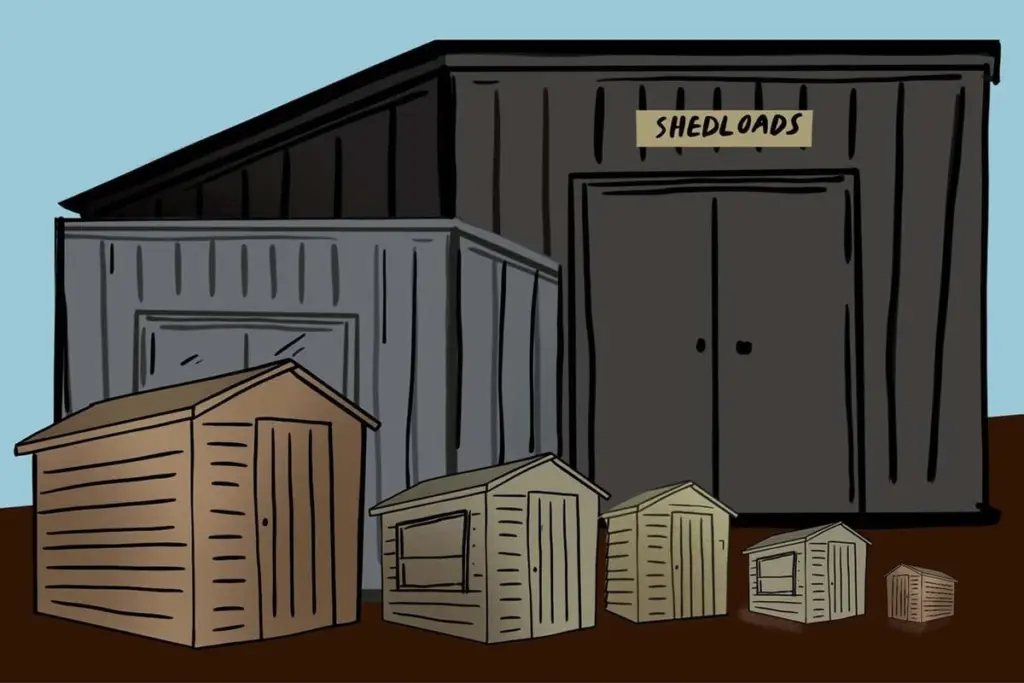
The Elusive “Shedload”
Feedback, New Scientist’s popular section focusing on the lighter side of science and technology, is always keen to receive reader submissions that might amuse its audience. Items can be sent to [email protected].
In a previous exploration of peculiar units of measurement, Feedback briefly mentioned the term “shedload” in relation to traffic disruptions on motorways. The casual remark about the indeterminate size of a shed in this context has since sparked a considerable amount of reader correspondence.
The continuous stream of emails highlights a desire for a term that effectively conveys an unusually large quantity of something, a concept that the word “shedload” seems to inherently capture. Two readers, Bryn Glover and John Newton, independently suggested a possible etymology for “shedload,” linking it to motorway incidents where a lorry might have “shed its load.”
Endogenous Relative Scaling and Physics
F. Ian Lamb proposed viewing a “shedload” as an “endogenous relative scaling (ERS) unit.” This concept posits that the perception of a large quantity is subjective, depending entirely on an individual’s past experiences and circumstances. For example, £1000 might represent a substantial amount for someone living in poverty, while a billionaire might consider the same sum negligible, perhaps spending it on a single meal at an upscale restaurant. Lamb expressed certainty that other units with similar proportional properties likely exist and invited readers to submit any examples they encounter.
Further, the discussion delved into fundamental physics for a potential explanation. William Croydon brought to light the use of “shed” as a unit in nuclear physics. This unit is connected to the measurement of cross-sectional areas, a critical factor in particle physics experiments. When researchers collide subatomic particles, they need to quantify the likelihood of such an impact.
The unit “barn” was introduced, defined as 100 square femtometres, or 10-28 square metres. This size approximates the cross-sectional area of a uranium atom’s nucleus, the target for initiating nuclear reactions. The analogy suggests that this incredibly small area is, in nuclear physics terminology, as comparably “easy to hit” as the broad side of a barn is in everyday experience.
Croydon added that a smaller unit, “shed,” was also historically used in this field, though he admitted his recollection of its precise relation to the barn was “hazy.” Online research confirmed that two smaller derivatives of the barn unit exist. An “outhouse” is defined as one-millionth (10-6) of a barn. Even smaller is the “yoctobarn,” which is 10-24 of a barn, and this is equivalent to a shed. Regardless of any potential confusion regarding its exact scale relative to an outhouse, Croydon’s point remains valid: even a considerable quantity of sheds, as physical units, would be “too small to cause problems on a motorway.”
Finally, Tony Lewis offered a humorous circular solution: “Steve Tees wants to know the size of the sheds involved in the shedloads of xxxx blocking the motorway. I cannot give him the dimensions, but it must be a xxxxload of shed.”
Shakespeare and the Graphite Pencil
Feedback has been revisiting former New Scientist puzzle advisor Rob Eastaway’s book, “Much Ado About Numbers,” which examines the influence of mathematics on William Shakespeare’s work.
Acknowledging a recent surfeit of Shakespearean adaptations, Feedback mentioned an encounter with three Hamlet-related films: Riz Ahmed’s contemporary retelling, Scarlet (a gender-swapped version set in a spectral realm), and the Academy Award-winning “Hamnet.” The author notes the current popularity of stories depicting morally compromised leadership within states in decline.
Eastaway’s book revealed a fascinating detail: “black lead,” more commonly known as graphite, was in use for making writing instruments during Shakespeare’s era. This suggests the possibility that the Bard may have employed a pencil, rather than a quill, for composing some of his witty verses.
This point was highlighted in a Stationery News article under the headline “2B or not 2B?” While the article praised the wit of the title, it also candidly stated that any pencils Shakespeare might have used would have consisted of pure graphite, implying they would have been closer to a “9B” grade than a “2B.”
The “Six Sides of Water” Phenomenon
Reader Joseph Olechno shared a marketing email promoting the purported benefits of “hexagonal water,” which was described as being “10 Times Healthier Than Lemon Water.”
The concept of hexagonal water suggests it undergoes an unspecified treatment that aligns its molecules into hexagonal structures. However, basic principles of molecular behavior in liquids indicate that such ordered arrangements are inherently unstable and would likely persist for only a fleeting moment.
Despite this scientific improbability, the idea of specially structured water appears to hold persistent appeal. A review of past Feedback archives reveals previous discussions of concepts like wine made from hexagonal water, as well as related ideas such as “vibrationally charged interactive water” and “sexy water.”
Feedback’s primary query centers on the choice of hexagons. The author muses that if the goal were to maximize water’s purported magical properties, perhaps arranging molecules into pentagrams would be more effective. Yet, such an approach carries a playful warning: a careless drinker might inadvertently create a Satanic inverted pentagram simply by turning their water bottle upside down.
Share Your Stories
Feedback welcomes reader contributions. Stories can be submitted via email to [email protected], and please include your home address. A selection of this week’s and past Feedback articles can be accessed on the New Scientist website.