
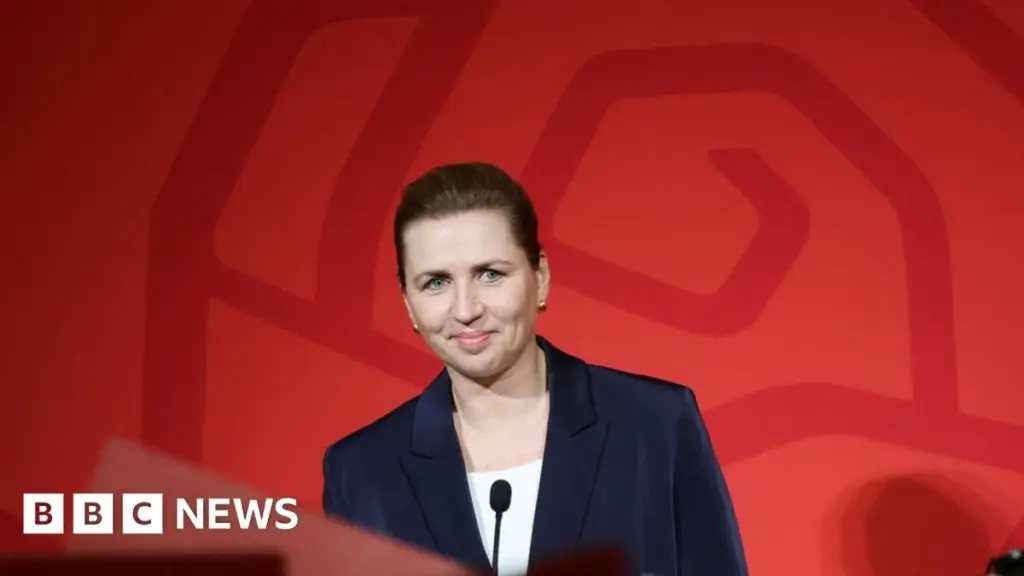
Denmark’s Social Democrats, led by Prime Minister Mette Frederiksen, have emerged as the leading party in the nation’s general election. However, despite securing the highest number of votes, the party did not achieve a parliamentary majority. This outcome, representing the Social Democrats’ weakest electoral performance in over a century, precedes complex negotiations for coalition government formation.
The Social Democrats garnered 21.9% of the vote in the election held on Tuesday. As the incumbent party governing since 2019, they secured 38 parliamentary seats, maintaining their position as the largest single party in parliament. This figure, however, falls short of the threshold required for an independent victory.
During a gathering at the Christiansborg parliament, Social Democratic supporters applauded Prime Minister Frederiksen as she addressed the crowd. “I’m sorry that we did not get more votes. I had also hoped for a better result,” she stated. She concluded her remarks by emphasizing, “But there is nothing today that can make me sad that the Social Democrats have once again become the Danes’ absolute favourite political party.”
Frederiksen still has the opportunity to pursue a third term in office. Yet, Denmark’s political landscape typically favors coalition governments. Consequently, intensive negotiations, potentially spanning days or weeks, are now anticipated.
A total of twelve distinct political parties contested the election, which was characterized by its close competition, resulting in a near dead heat. The “red bloc,” comprising left-wing parties, secured a slight advantage, claiming 84 seats collectively. In contrast, the right-wing “blue bloc” amassed 77 seats.
Neither bloc managed to reach the 90 seats necessary for a majority within Denmark’s 179-seat parliament. The composition of the future governing coalition remains uncertain.
“I have been responsible for this wonderful country for almost 7 years,” Frederiksen further commented. “I am still ready to take on responsibility as Denmark’s prime minister.”
The Kingmaker: Moderates Hold Key to Coalition Building
The Moderates, a centrist party holding 14 parliamentary seats, now possesses significant influence, positioning them as potential kingmakers. All attention has turned to their leader, former Prime Minister Lars Løkke Rasmussen.
Rasmussen recently gained attention for his handling of the Greenland dispute involving the United States and for a viral moment following a meeting in Washington with Vice President JD Vance and Secretary of State Marco Rubio. Pictures showed him with his characteristic pipe in hand.
Speaking to supporters on Tuesday evening, Rasmussen indicated his preference for forming a government that spans the center. “We’re standing in the middle,” he remarked. “We’re ready.”
Conversely, Troels Lund Poulsen, leader of the Liberal Party—the largest party in the blue bloc—has explicitly rejected the possibility of forming another government with the Social Democrats. He urged Rasmussen to align with him on the right. Poulsen stated, “It is possible to get a new direction in Denmark.”
Christine Cordsen, a political correspondent for DR, suggested that the most probable scenario involves a center-left coalition. This would likely include the Social Democrats, Red-Greens, the Moderates, and the Danish Social Liberal Party.
Campaign Dynamics: Domestic Concerns Take Precedence
The election results represent a challenging outcome for Frederiksen. After six years in power, her approval ratings have seen a decline, despite acknowledgment from many Danes regarding her performance in navigating international crises.
The election campaign unfolded in the shadow of repeated calls from then-US President Donald Trump to acquire Greenland, a territory with semi-autonomous status under Danish rule.
Frederiksen, aged 48, had called the election earlier than anticipated. The decision was perceived as a gamble, betting that her enhanced poll numbers resulting from her response to Trump’s Greenland annexation proposals would secure her a third term.
However, the campaign discourse was primarily shaped by domestic issues rather than geopolitical concerns. These included the rising cost of living, the state of the national economy, and welfare provisions. Additionally, concerns regarding high pesticide levels in drinking water, linked to pig farming, and the environmental impact of agriculture also emerged as significant voter issues.