
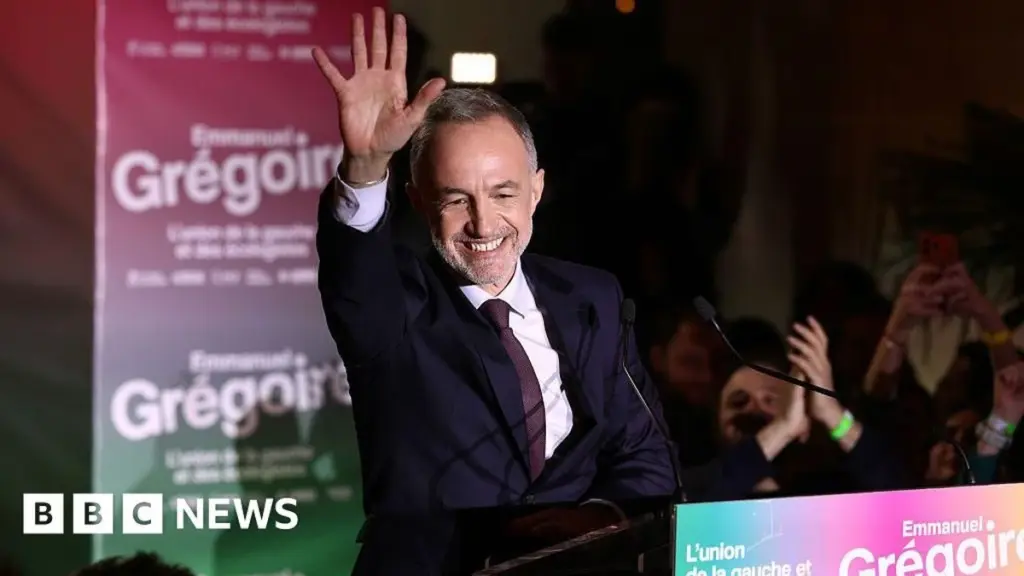
Socialist and allied parties successfully retained control of France’s four largest cities—Paris, Marseille, Lyon, and Lille—in a local election outcome that offered a sense of optimism for mainstream political forces ahead of the presidential elections next year.
While fringe parties on the far-left and far-right did record some gains, notably in Nice for an ally of Marine Le Pen and Roubaix in the north for the France Unbowed (LFI) movement, the broader narrative of the evening focused on the difficulties faced by these groups.
A significant takeaway from the election was the demonstrated failure of alliances between mainstream left-wing groups and the LFI. Instead, voters in long-standing Socialist Party (PS) strongholds, such as Clermont-Ferrand and Brest, gravitated towards the centre and right-wing options.
Conversely, in cities like Paris, Marseille, and Lille, where incumbent Socialists chose to distance themselves from the far-left due to accusations of antisemitism within its ranks, left-wing administrations secured comfortable re-elections. These victories occurred without the necessity of far-left endorsements.
Lyon stood out as a unique case. Its ecologist mayor, Grégory Doucet, did form an alliance with LFI and still achieved victory. This success was largely attributed to a poorly executed campaign by the right-wing challenger, businessman Jean-Michel Aulas.
“My conclusion from tonight’s results is that the LFI wins nothing; and what is even worse, it is the LFI that brings about defeat,” stated Pierre Jouvet, the PS secretary-general. This sentiment highlights a perceived drag effect associated with the far-left party.
Calls for a boycott of LFI had surfaced following the charging of one of its parliamentary assistants with incitement to murder a far-right student in Lyon. Additionally, the party’s prominent leader, Jean-Luc Mélenchon, faced criticism for remarks that appeared to mock the Jewish background of the late sex offender Jeffrey Epstein, further antagonizing opponents.
Despite these controversies, after the initial round of voting a week prior, numerous Socialist and Green candidates opted to set aside their reservations regarding the far-left party. They formed what the right subsequently labeled “alliances of shame,” aiming, as they hoped, to secure electoral wins.
These left- and far-left coalitions proved unsuccessful in other cities as well, including Toulouse, Strasbourg, Poitiers, Limoges, and Tulle. The latter is the electoral constituency of former PS president François Hollande, whose appeals to boycott LFI were disregarded in that location.
Reacting to the outcomes on Sunday evening, Manuel Bompard of LFI drew attention to the party’s first-round win in Saint-Denis, a northern Paris suburb, and its victory in Roubaix on Sunday. He expressed a forward-looking perspective:
“Tonight, we have demonstrated that nothing can stand in the way of a people on the move. Next year, the new France will sweep away the world of [President] Macron and his nefarious policies.”
In Paris, Anne Hidalgo’s successor, Grégoire, secured a victory aligned with pre-election polls, reinforcing the capital’s predominantly left-wing character. Hidalgo herself had implemented notable anti-car policies, which generally found support among voters.
Rachida Dati, a right-wing candidate and former minister under Presidents Nicolas Sarkozy and Emmanuel Macron, emerged as a polarizing figure. Her impending corruption trial potentially influenced voter decisions against her. The backing she received between the voting rounds from the far-right’s Sarah Knafo, following Dati’s withdrawal from the race, also played a role.
The far-right National Rally (RN), currently the most popular party in pre-presidential opinion polls, failed to achieve its targeted wins in Marseille and Toulon. This was partly due to coordinated opposition from other parties. In Marseille, the Republican (LR) candidate remained in the race, thereby fragmenting the right-wing vote.
However, in Nice, Eric Ciotti, leader of the UDR party, achieved a decisive victory over the incumbent Christian Estrosi. Estrosi, a former LR member, had switched allegiance to the centrist Macronite movement. This win was interpreted by the RN as indicative of an emerging right-wing coalition, no longer constrained by reluctance to cooperate with Le Pen’s party.
The RN also demonstrated its influence in smaller provincial towns, securing wins in Montargis, Carcassonne, and La Seyne-sur-Mer. Nevertheless, it did lose the mayoral race in Villers-Cotterets, located north of Paris.
Overall, the most significant beneficiaries of the evening were the mainstream parties across the left, right, and center.
The pro-Macron Renaissance party achieved a victory that boosted morale in Bordeaux. Former minister Thomas Cazenave, supported by centrist and right-wing factions, was anticipated to unseat the incumbent Green mayor.
An important development occurred in Le Havre, a city in Normandy, where Macron’s former prime minister, Édouard Philippe, was declared the winner. Philippe is widely considered a potential centrist presidential candidate for 2027, having previously stated he would only run if elected in his home city.
The elections generally underscored the increasing influence of the far-left in the suburbs and peripheries of major cities. These areas often feature concentrations of immigrant working-class populations and the so-called “intellectual proletariat.”
Similarly, the far-right RN has solidified its presence in provincial areas outside the major urban centers.
Ultimately, it was the mainstream parties that secured the greatest number of victories, providing them with grounds to believe that in any presidential run-off against candidates from the fringes, the center ground would prevail.
A notable concern remains: what if a presidential run-off features two candidates representing the extreme ends of the political spectrum?