
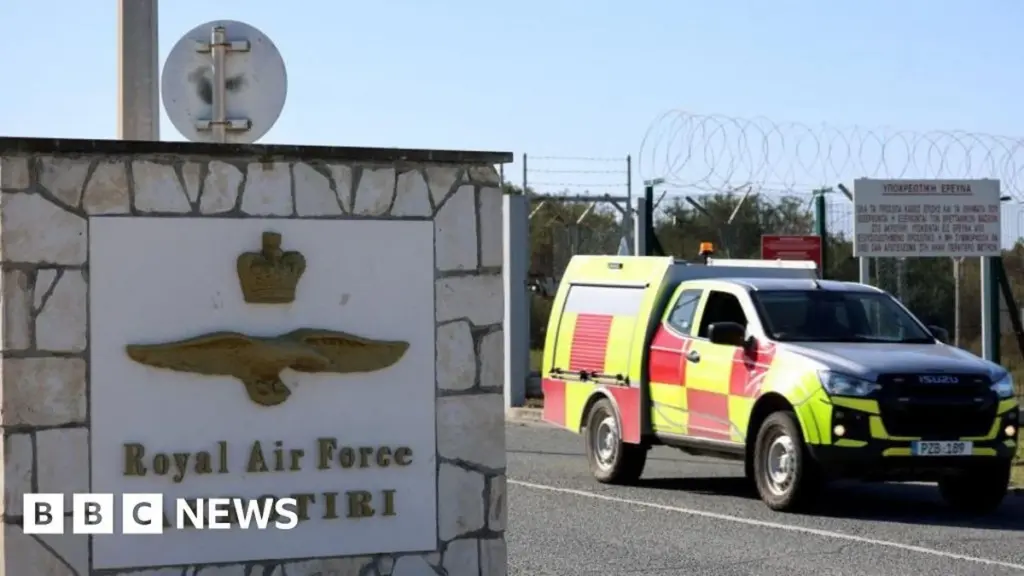
Cypriot President Nikos Christodoulides has asserted that the United Kingdom’s two military installations on the island represent a “colonial consequence.” He emphasized the necessity for discussions concerning their status and future operations, speaking to the BBC shortly before his arrival at an EU leaders’ summit in Brussels. Christodoulides indicated that following the resolution of the situation in the Middle East, Cyprus intends to engage in a candid and open dialogue with the British government regarding these bases.
The legal framework for the UK’s presence stems from the 1960 treaty that formalized Cyprus’s independence from Britain. This agreement granted the UK sovereign rights over the bases located in Akrotiri and Dhekelia. Recently, RAF Akrotiri became a target for drone attacks, occurring shortly after the commencement of the US-Israeli conflict with Iran. This incident has intensified scrutiny of the UK’s reaction to the attack.
The drones are believed to have originated from Lebanon, launched by Hezbollah, a group supported by Iran. Protesters have voiced concerns, suggesting that the British military presence on Cyprus makes the island a potential target. While two of the drones were successfully intercepted, a third impacted Akrotiri, resulting in what was described as “minimal damage.” In response to the drone strike, a British naval frigate has been dispatched and is currently en route to the island.
The two sovereign base areas, situated in the southern and southeastern parts of Cyprus, have not been utilized for US military operations against Iran. Nevertheless, the UK has since granted the United States permission to employ these bases for “specific defensive operations.” Together, Akrotiri and Dhekelia encompass approximately 98 square miles (254 square kilometers) of Cypriot territory and are a significant local employer. President Christodoulides highlighted the presence of over 10,000 Cypriot citizens residing within the British bases, stating, “We have responsibility for those people.” He reiterated, “We have a clear approach with regard to the British bases… I’m not going to negotiate publicly.”
When approached by the BBC for a statement regarding the Cypriot president’s remarks, the UK’s Ministry of Defence referred to comments made by Defence Secretary John Healey in Parliament the previous week. During that session, Healey reported that the head of Cyprus’s National Guard had informed him that “Our military co-operation has never been closer.” Earlier this month, Healey had visited the UK’s air defence team stationed in Cyprus. He noted that the UK’s supportive presence in the region is reinforced by NATO allies, including the United States, France, Greece, and Germany.
In response to the attack on Akrotiri, the UK announced an increase in its military presence. However, it was not until later in the week that HMS Dragon, deployed to bolster defenses in Cyprus, entered the Mediterranean. Two Greek frigates and a French naval vessel arrived off the coast of Cyprus within days of the attack. Spain also deployed a frigate as part of a broader multinational effort to support their European ally.