
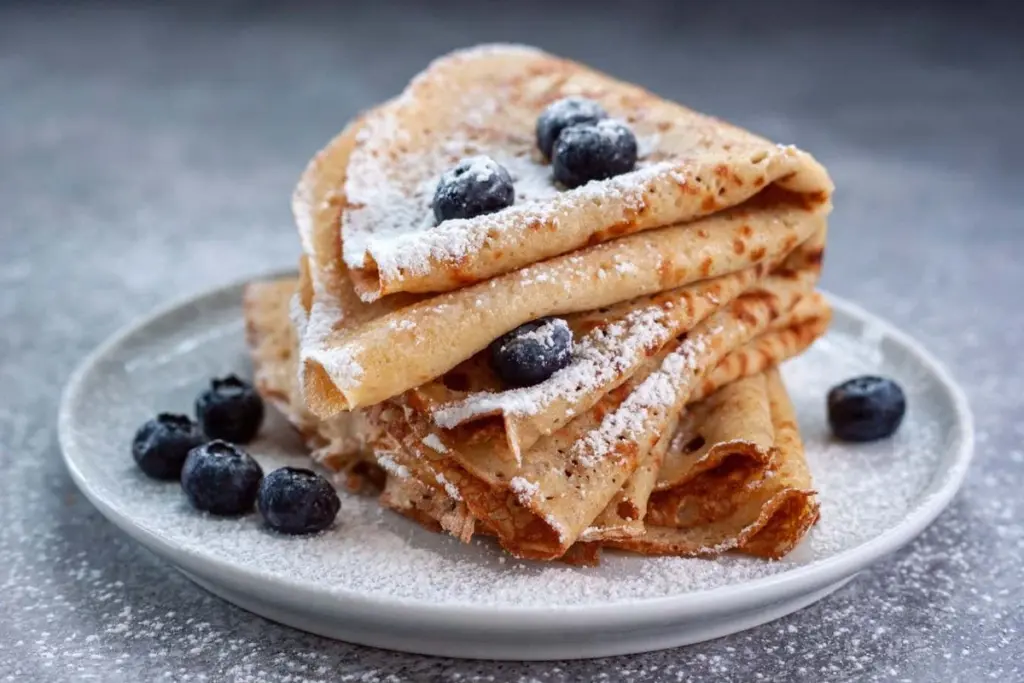
Imagine a thin, flexible disc, perhaps even a tasty one. When you bend it, what keeps it in that folded state? And how often can you repeat this action before the material resists and reverts to its original shape?
A physicist from France, a country renowned for its crêpes, took on this very question. His research revealed that a single numerical value encapsulates all the essential information regarding this phenomenon.
Tom Marzin, working at Cornell University in Ithaca, New York, first contemplated the mechanics of crêpe-folding during a visit to his home region of Brittany, France. This area is particularly known for its thin pancakes. He observed that a small fold would cause the crêpe to flip back, but a larger fold, influenced by friction and gravity, would hold its position. This raised the question: what principles govern this distinct behavior?
Marzin transformed this curiosity into a formal research project. The findings were scheduled for presentation on March 20th at an American Physical Society meeting in Denver, Colorado.
His work departs from the study of origami, which focuses on permanent creases. “What we’re dealing with here is what I call a soft or smooth fold,” Marzin explained. “It’s essentially a contest between gravity and elasticity.”
One method to visualize this interaction involves securing a portion of a pancake to a surface, allowing the remainder to hang freely, and then measuring its sag. Marzin developed a calculation indicating that this outcome can be predicted by a single figure. He termed this the “elasto-gravity length.” This value incorporates the material’s density, its rigidity, and the influence of gravitational force.
Marzin hypothesized that this calculated length would similarly dictate the behavior of other flexible materials in various scenarios. His computer modeling later confirmed this hypothesis.
To validate his simulations against real-world conditions, Marzin conducted experiments utilizing plastic discs, store-bought tortillas, and, naturally, crêpes. His initial attempts at making crêpes himself proved unsatisfactory for scientific purposes.
“I didn’t control the thickness well,” he noted. Consequently, he enlisted his mother in France to assist with the experiments. His instructions included acquiring calipers, rulers, and a selection of crêpes from a commercial brand. These machine-made crêpes, he reasoned, would offer consistent thickness. His mother successfully executed these tasks.
Marzin’s experimental results corroborated that the elasto-gravity length governs all aspects of crêpe-folding. For instance, it determines the proportion of a folded sheet’s area that contributes to the looping portion. This, in turn, dictates whether sufficient flat surface remains to permit an additional fold.
His derived equations accurately predict that a crêpe with a diameter of 26 centimeters and a thickness of 0.9 millimeters can be folded up to four times. In contrast, a 1.5-millimeter-thick tortilla of the same diameter, possessing an elasto-gravity length 3.4 times greater, permits only two folds. “This length captures all the physics underneath,” Marzin stated.