
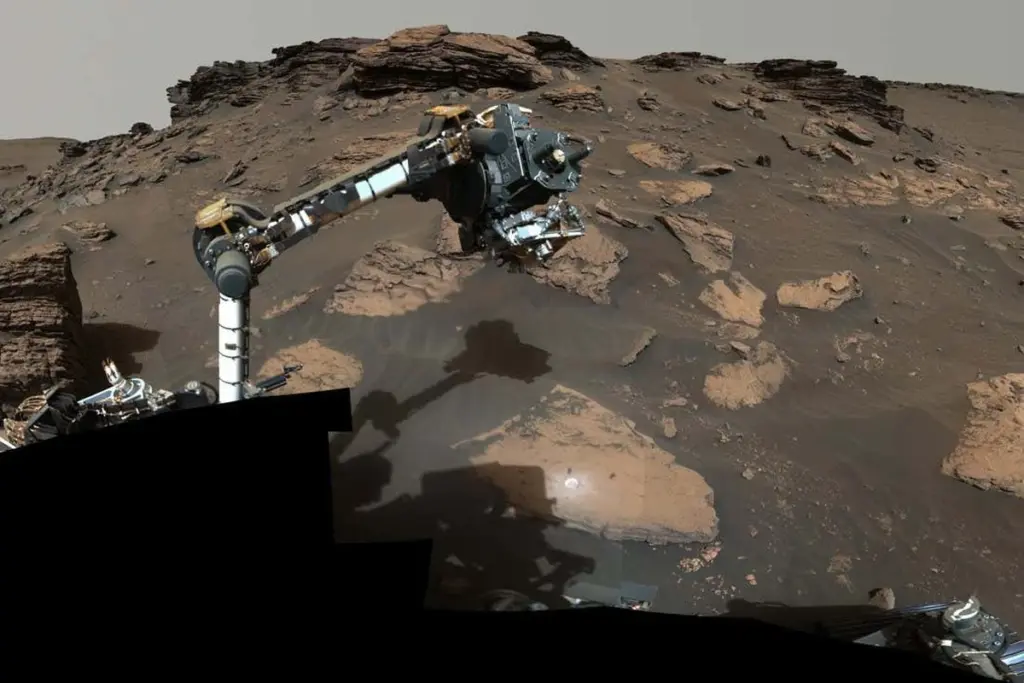
The Perseverance rover has recently identified grains of precious stones embedded within pebbles on Mars. These gemstone fragments are composed of corundum, a mineral also known as ruby or sapphire, with its specific classification dependent on the trace metal elements present.
Ann Ollila, a researcher at Los Alamos National Laboratory in New Mexico, along with her colleagues, first detected indications of corundum. This discovery occurred while utilizing Perseverance’s SuperCam instrument to analyze a rock sample designated as Hampden River. SuperCam employs multiple methods to assess material composition. It utilizes two distinct lasers, capable of either ablating the surface or inducing luminescence, followed by two cameras to examine the resulting light emissions.
In its examination of Hampden River, both of SuperCam’s testing protocols yielded results that closely mirrored laboratory measurements for rubies. This strong correlation suggested the presence of minute corundum grains within the rock.
As the rover proceeded along the periphery of Jezero crater, it moved beyond the initial sample site. The research team subsequently focused on analyzing another pebble, named Coffee Cove. Compositional data gathered from this second sample also indicated the presence of corundum. A third rock specimen, identified as Smiths Harbour, exhibited similar findings. Ollila presented these collective observations at the Lunar and Planetary Science Conference held in Texas on March 16th.
These particular gemstone grains represent a novel find on Mars. Their formation process on the planet is also likely to differ significantly from terrestrial occurrences. On Earth, corundum formation is typically linked to tectonic activity, requiring a very specific environment characterized by low silica content and high aluminum presence. Mars, lacking the plate tectonics common to Earth, presented an unexpected context for such a discovery.
Instead of tectonic processes, the Martian corundum is believed to have formed as a consequence of meteorite impacts. These high-energy collisions would have generated intense heat and pressure, compressing the surrounding dust and leading to the mineral’s formation.
“I was very surprised,” commented Allan Treiman of the Lunar and Planetary Institute in Texas, who was not part of Ollila’s research team. During the conference session, he added, “In retrospect, one might not have been, because there are aluminum-rich outcrops elsewhere on the planet and there are impacts, but I thought it was very shocking to see this.”
Due to the diminutive size of the corundum grains, measuring less than 0.2 millimeters in diameter, it was not possible to definitively determine from images whether they were rubies or sapphires. The visual appearance of these gems to the human eye also remains uncertain.
“I would love to be able to pick one of those up and analyze it and see if it looks red – it’s pretty disappointing that all you can see is this white pebble,” Ollila stated. Despite their unassuming appearance, the grains emitted a bright luminescence when stimulated by the SuperCam’s laser.