
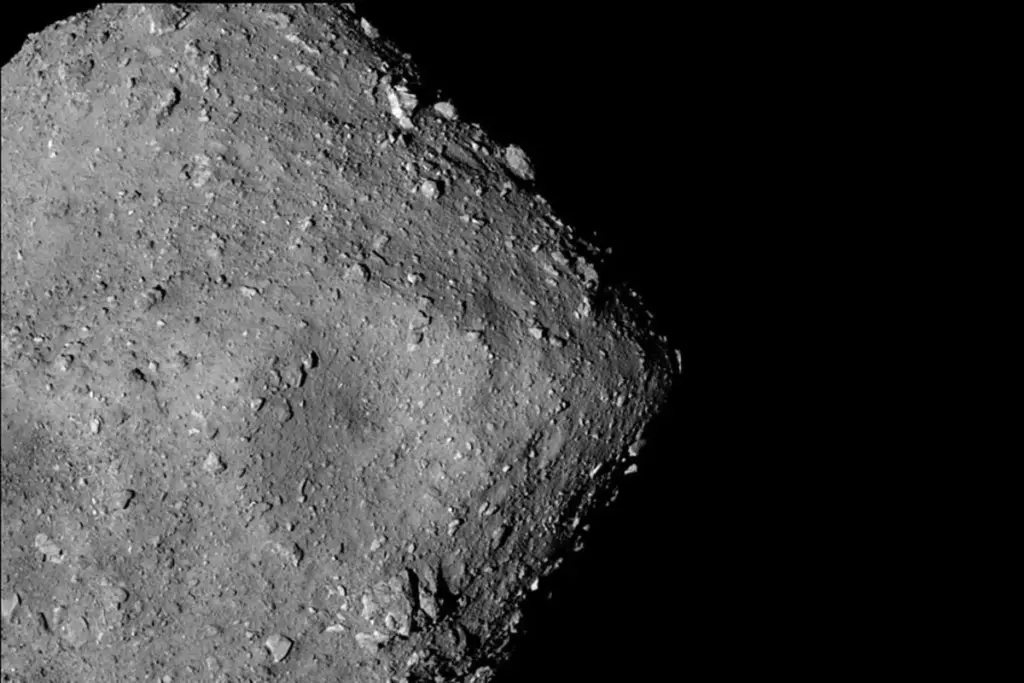
Analysis of samples collected from the asteroid Ryugu has yielded a significant discovery: the presence of all five principal ingredients required for DNA and RNA. This finding reinforces the hypothesis that asteroids may have played a crucial role in delivering the foundational elements for early life to Earth.
Japan’s Hayabusa 2 mission successfully visited Ryugu in 2018. During its exploration, the spacecraft deployed two projectiles, one small and one large, striking the asteroid’s surface. The resulting debris was then gathered by the spacecraft, which returned to Earth with the precious samples in 2020. Researchers have since undertaken comprehensive, detailed analyses of this extraterrestrial material.
Nucleobase Discovery in Ryugu Samples
Yasuhiro Oba, affiliated with Hokkaido University in Japan, alongside his colleagues, meticulously examined two distinct samples. One originated from the asteroid’s exposed surface, while the other comprised subsurface material that had been excavated by the projectile impacts. In both of these samples, the scientific team identified all five fundamental nucleobases. These crucial compounds are the fundamental units that combine with sugars and phosphoric acid to form the nucleic acids essential for all known life: DNA and RNA.
Broader Implications for Astrobiology
The identification of nucleobases within asteroid samples is not an entirely unprecedented occurrence. Similar compounds have previously been detected in meteorites and in samples retrieved from the asteroid Bennu. However, the researchers did observe variations in the relative abundance of the different nucleobases across the various samples from Ryugu. This differentiation suggests that such compounds could potentially serve as valuable markers for tracing asteroids and meteorites back to their original parent bodies within the solar system. Furthermore, this variability might offer insights into the long-term evolutionary processes these parent bodies underwent.
The consistent detection of nucleobases in samples from asteroids like Bennu and now, Ryugu, underscores the potential significance of these celestial bodies in the history of terrestrial life. As Oba states, “Their detection in Ryugu strongly supports their ubiquity in the solar system.” If asteroids across the solar system are indeed rich in the constituent parts of DNA, it is plausible that they transported these vital components to Earth billions of years ago, thereby facilitating the initial development of life.
Potential for More Complex Organic Molecules
Beyond just the basic building blocks, there is a possibility that asteroids such as Ryugu may harbor more complex organic molecules, including complete DNA and RNA structures, rather than solely their constituent parts. Oba suggests, “It is very likely that more complex organic molecules like nucleic acids are formed on asteroids.” Such a scenario would elevate the importance of asteroids even further as contributors to the origins of life on our planet.