
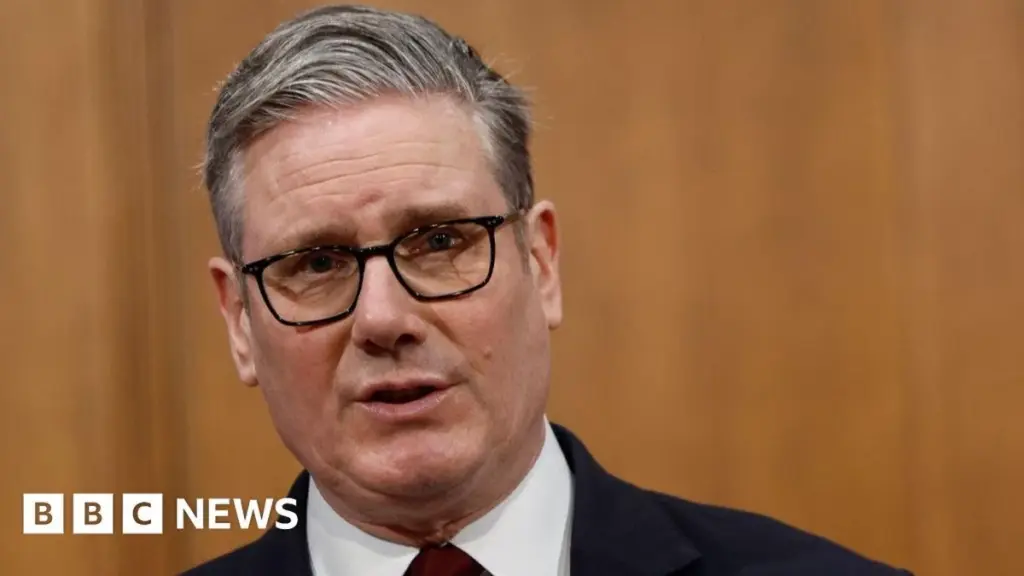
Prime Minister Sir Keir Starmer announced that the United Kingdom is actively working with its international partners to formulate a “viable, collective plan” aimed at reopening the Strait of Hormuz.
This development follows a request from President Trump, who had urged Britain and other nations to dispatch warships to the Persian Gulf. The objective is to safeguard this crucial shipping channel, which plays a vital role in global oil supplies.
Current UK Involvement and Future Decisions
Addressing a news conference, Sir Keir stated that the UK currently has minehunters deployed in the region. However, he clarified that no definitive decision had yet been made regarding specific actions that would be undertaken.
The Strait of Hormuz has effectively been closed to oil tankers since the commencement of the conflict with Iran. This closure has directly contributed to a sharp increase in oil prices.
Iran has issued threats to attack any vessels it perceives as being connected to the United States. Additionally, a significant risk exists from the presence of sea mines within the waterway.
Strategic Importance and International Cooperation
The Prime Minister emphasized the necessity of reopening the Strait of Hormuz to ensure market stability. He acknowledged that this is a complex undertaking.
“Therefore,” Sir Keir explained, “we are collaborating with all of our allies, including our European partners, to assemble a viable, collective plan. The aim is to swiftly restore freedom of navigation in the region and mitigate the economic consequences.”
Sir Keir also indicated that he had been engaged in discussions about the situation with both the United States and countries in the Gulf. He pointed out that any course of action must secure agreement from “as many partners as possible.”
Contrasting Regulations and International Pressure
Unlike domestic consumers whose energy prices are capped, individuals and entities reliant on oil for heating and hot water are not subject to Ofgem regulation. This distinction highlights the broader economic sensitivity surrounding oil prices.
In an interview with the Financial Times, President Trump conveyed a stark warning, suggesting that the NATO military alliance faced a precarious future if its members did not offer assistance.
He reiterated his appeals for allies to contribute to the protection of the Strait of Hormuz, stating, “It is only appropriate that those who benefit from the strait will help ensure that nothing bad happens there.”
The President had previously called upon the United Kingdom, China, France, Japan, and South Korea to dispatch ships to secure this critical maritime route.
Defining the Nature of the Alliance
Sir Keir was keen to clarify that any forthcoming action would not constitute a NATO mission. Instead, it would be framed as “an alliance of partners.”
When pressed on whether he was declining President Trump’s request for the Royal Navy’s commitment to protecting the strait, Sir Keir confirmed that the UK was “examining the options.” He noted, however, that minehunting systems were already operational in the area.
UK-US Relations and National Interest
Regarding the state of UK-US relations, Sir Keir affirmed that the two nations were “strong allies.” He added, “My responsibility is to act in what I consider to be Britain’s best interests.”
German Stance on Military Involvement
A spokesman for the German government stated that the conflict had “no connection to NATO,” defining the alliance’s purpose as territorial defense.
German Defence Minister Boris Pistorius confirmed that Germany would not participate militarily. However, he indicated Berlin’s readiness to support diplomatic initiatives aimed at securing the strait.
“What does Donald Trump expect from a handful of European frigates in the Strait of Hormuz that the mighty US navy cannot manage alone?” Pistorius questioned, underscoring the perceived inadequacy of such a contribution against the backdrop of US naval power.
Previous Decisions and Leadership Principles
The Prime Minister had previously drawn President Trump’s ire by withholding permission for the use of UK bases for initial offensive strikes against Iran. Nevertheless, he subsequently authorized their use for defensive actions targeting Iranian missile assaults.
Sir Keir defended his stance, explaining his reluctance to involve the UK in “the wider war.” He contrasted this with a hypothetical scenario where others might have “rushed the UK headlong into this war without the full picture of what they were sending our forces into and without a plan to get us out.”
He further articulated, “My leadership is about standing firm for the British interest. No matter the pressure.”
Domestic Political Reactions
At the outset of the conflict, both the Conservative Party and Reform UK had criticized the Prime Minister for his initial refusal to permit the use of UK bases for offensive operations.
Conservative leader Kemi Badenoch commented that there “did not seem to have been plans in place” to secure the strait. She pointed out a seemingly ill-timed redeployment of minesweepers from the Gulf shortly before the conflict escalated.
The Liberal Democrats have advocated against deploying UK ships to help secure the strait, urging instead a focus on de-escalating the conflict.