
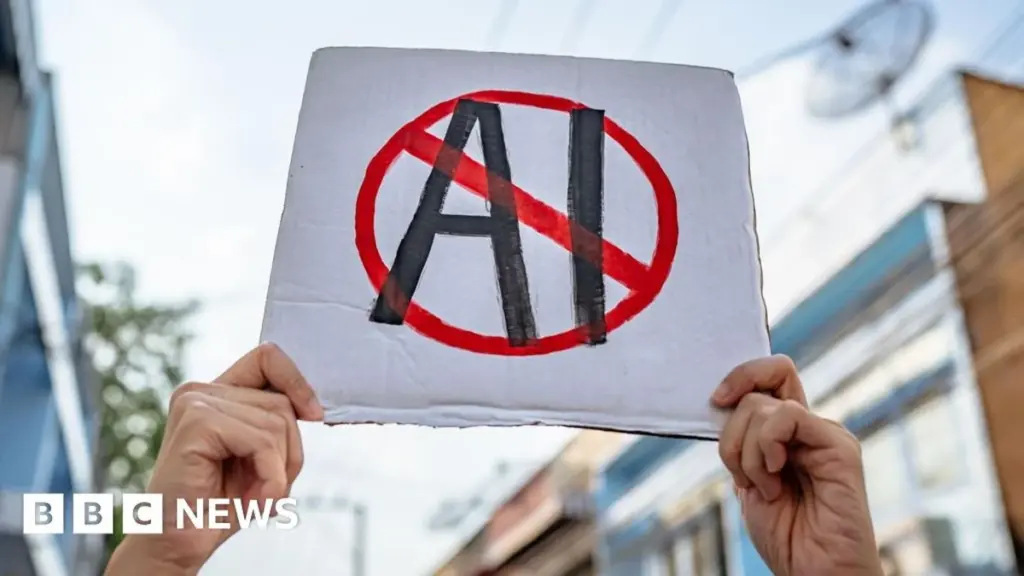
A global movement is underway to establish a recognized label for products and services created entirely by humans. This effort emerges as a direct response to the increasing integration of artificial intelligence, fueling concerns about job displacement and the devaluation of human creativity.
Across various media, including films, advertisements, books, and websites, phrases such as “Proudly Human,” “Human-made,” “No A.I,” and “AI-free” are becoming more prevalent. These declarations signify a growing backlash against the perceived unchecked use of AI technologies.
The proliferation of these initiatives stems from anxieties that the burgeoning field of AI-powered automation may render entire professions obsolete. BBC News has identified at least eight distinct efforts aiming to create an “AI-free” logo with the potential for widespread global adoption, comparable to the recognition afforded to the “Fair Trade” mark for ethically sourced goods.
However, the sheer number of competing labels, coupled with ambiguity surrounding the precise definition of “AI-free,” poses a significant challenge. Experts warn that this fragmentation could leave consumers feeling bewildered unless a unified standard is achieved.
“AI is driving substantial disruption, and the existence of competing definitions for what constitutes ‘human made’ is confusing consumers,” observed Dr. Amna Khan, a consumer expert at Manchester Metropolitan University. “A universal definition is crucial for fostering trust, clarity, and confidence,” she told BBC News.
The Mechanics of AI-Free Certification
The push for AI-free certification systems arises from the increasing deployment of generative AI tools. These tools are being utilized to replace human input and creative output across diverse sectors such as fashion, advertising, publishing, customer service, and music production.
Organizations behind these labeling efforts span from commercial entities to non-profit organizations, with operations based in the United Kingdom, Australia, and the United States.
The operational frameworks of these certification programs vary. Some labels, like those offered by no-ai-icon.com, ai-free.io, and notbyai.fyi, are readily accessible. They can be downloaded, often at no cost or for a nominal fee, without necessitating extensive auditing processes.
In contrast, systems like aifreecert operate on a paid model and implement a stringent vetting procedure to ascertain whether AI was employed in product creation. This process typically involves professional analysts and specialized AI-detection software.
Yet, AI specialists highlight the inherent complexity in achieving industry-wide consensus on what truly constitutes “human made.” This difficulty is exacerbated by the pervasive integration of AI into a vast array of everyday tools and services.
“AI is now so ubiquitous and so deeply integrated into various platforms and services that establishing a definitive meaning for ‘AI free’ is genuinely challenging,” stated Sasha Luccioni, an AI Research Scientist. “From a technical standpoint, implementation is difficult. I believe AI exists on a spectrum, and we require more comprehensive certification systems rather than a simple binary of AI versus AI-free,” she added.
Defining the Generative AI Boundary
A prevailing perspective suggests that the line should be drawn specifically at the use of generative AI – that is, chatbots capable of producing text, code, music, or video in response to human prompts.
Illustrating this approach, the producers of the 2024 thriller *Heretic*, starring Hugh Grant, included a disclaimer in the closing credits stating: “No generative AI was used in the making of this film.”
The film distributor, The Mise en Scène Company, has adopted a similar stance. Recently, they affixed an “No AI was used” stamp to the poster for their latest film, which was largely written, directed, and edited by a single individual.
This distributor has also published its own online classification system, which it hopes will be adopted by others within the industry. Paul Yates, the CEO, commented, “We support the AI industry and believe it’s an exciting time, but we also recognize that as a result of AI content, there’s an economic premium placed on human-made content, and we aim to capitalize on that.”
Navigating AI Disruption in the Arts
The arts sector is particularly susceptible to the influx of AI-generated products, making it a primary focus for the current pushback against AI’s unchecked proliferation.
Entire books and films are now being produced with AI at a significantly faster pace and lower cost compared to traditional methodologies.
Bollywood film studio Itelliflicks explicitly specializes in AI-driven film production and openly advertises this capability. However, there are instances where products relying on AI do not disclose this fact to consumers.
In the publishing realm, the prominent firm Faber and Faber has begun applying a “Human Written” stamp to select titles among its offerings. Author Sarah Hall specifically requested this designation for her novel *Helm*. Hall has also characterized the unauthorized use of books to train AI models as “creative larceny at scale.”
Despite these actions, Faber has not elaborated on its classification criteria for “Human Written” books or detailed its auditing procedures to ensure the absence of AI involvement.
UK company Books by People aligns with the need for a credible standard for indicating human authorship. Co-founder Esme Dennys articulated the challenge: “Publishers are grappling with a new landscape where books can be produced in minutes rather than months or years, and readers can no longer be certain if a book reflects a human experience or a machine imitation.”
This company has already secured commitments from five publishers and has applied its initial stamp to the book *Telenova*, released in November. Books by People charges publishers and requires them to complete questionnaires regarding their practices and author vetting processes. The company also conducts periodic checks of book samples to detect AI-generated writing.
In Australia, a competing firm named Proudly Human employs a similar, albeit even more rigorous, system to verify that authors are not utilizing generative AI. Their auditors conduct checks at every phase of the publication process, including scrutinizing any modifications made from the manuscript to the ebook edition.
The company is poised to announce collaborations with several large publishing houses and has plans to extend its services to the music, photography, film, and animation industries.
Company principal Alan Finkel asserts that systems like his are indispensable, particularly in light of perceived failures in industry-led efforts to analyze and label AI-assisted content. “A certification of ‘human origin’ is necessary, but self-certification is insufficient, hence our comprehensive verification process to ensure the material is genuinely of human origin,” he stated.