
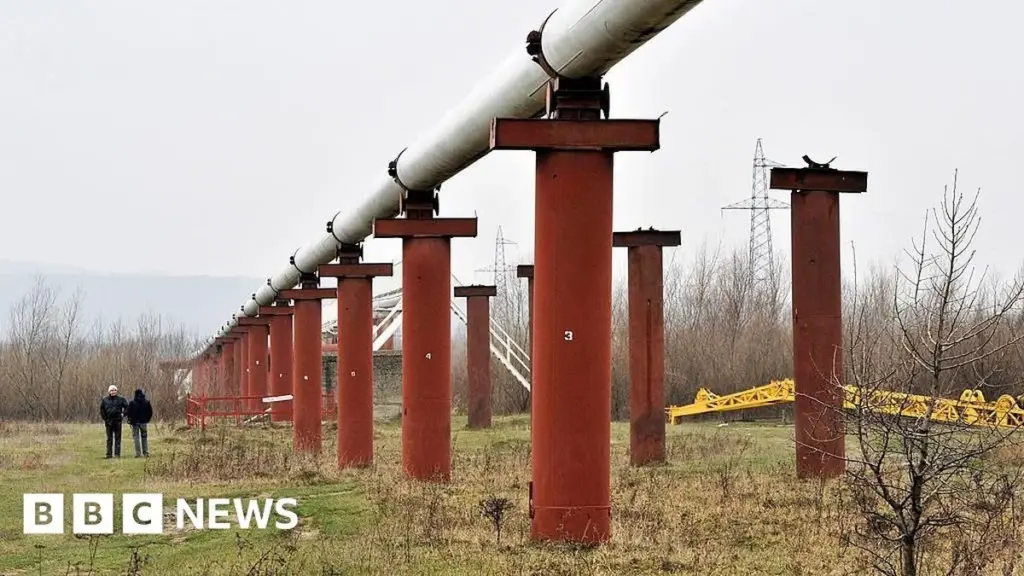
Ukrainian President Volodymyr Zelensky has leveled accusations of “blackmail” against European allies, stating they are pressuring Kyiv to reopen a key pipeline crucial for transporting Russian oil to Hungary and Slovakia.
Zelensky articulated that allowing the flow of Russian crude oil through Ukraine into the European Union would essentially equate to lifting economic sanctions previously imposed on Moscow. This stance highlights his government’s firm position on maintaining pressure against Russia amidst ongoing conflict.
Pipeline Damage and Political Leverage
According to Ukrainian officials, the Soviet-era Druzhba oil pipeline sustained damage from Russian air strikes in January. Repair work has reportedly not yet commenced, creating a bottleneck that has become a point of contention.
Hungary, heavily reliant on Russian energy, has strategically leveraged this situation. The country is currently obstructing new EU sanctions against Moscow and withholding a significant €90 billion ($103 billion; £78 billion) loan intended for Kyiv, making the pipeline’s reopening a prerequisite for moving forward.
Hungarian Prime Minister Viktor Orban has reportedly made his opposition to Ukraine a central theme in his campaign leading up to the April elections. His party has been trailing in opinion polls, suggesting that this stance could be an attempt to galvanize support.
EU Appeals and Zelensky’s Principle
The European Union has officially urged Zelensky to expedite pipeline repairs and grant permission for inspectors to assess the damage. Some within the EU express concern that Zelensky’s continued resistance could inadvertently benefit Orban in his bid for re-election.
However, speaking to journalists in Kyiv, including representatives from the BBC, Zelensky affirmed his principled opposition to permitting the transit of Russian oil through Ukraine while the EU maintains sanctions on its sale elsewhere. He questioned the consistency of the EU’s approach.
“We either sell Russian oil or we don’t. Because [the EU] are forcing me to restore Druzhba,” Zelensky stated. He posed a rhetorical question: “How is this different from lifting sanctions on the Russians? Why can we in one case tell the United States that we oppose lifting sanctions, while on the other hand forcing Ukraine to resume oil transit through Druzhba – and at a political price that effectively pays for anti-European policies?”
Broader Sanctions Context and Opposition
Zelensky’s remarks coincide with a period where the United States has relaxed some sanctions that previously prohibited other nations from purchasing Russian oil. This adjustment was intended to alleviate the energy supply challenges exacerbated by the conflict involving Israel and Iran. This US decision has drawn criticism from several European leaders.
“If we have decided to restore Russian oil supplies, then I want them to know that I am against it. And there is no need to accuse me of blocking anything. I am not blocking it,” Zelensky asserted. He continued, “I am saying openly: I am against it. But if I am given conditions that Ukraine will not receive weapons, then, excuse me, I am powerless on this issue. I told our friends in Europe that this is called blackmail.”
He further emphasized that the EU’s €90 billion loan for Ukraine had received unanimous approval from all 27 member states and should therefore be implemented without further delay.
Ukrainian Drones as “Ukrainian Oil” Amidst Middle East Conflict
Addressing the escalating conflict in the Middle East, Zelensky drew a parallel, referring to Ukraine’s interceptor drones as “Ukrainian oil.” He expressed readiness to finalize a $50 billion joint production agreement with the United States for these drones.
Zelensky indicated that the US has initiated contact multiple times regarding such a deal, suggesting significant interest from Washington. He noted that following the recent outbreak of war, several countries, particularly those in the Gulf region, have sought Ukraine’s assistance in defending against Iranian-designed drones, which are produced at a lower cost.
Ukraine holds a prominent global position in both the production of affordable interceptor drones and in developing effective strategies for their deployment against frequent Russian aerial attacks. “For us, this is like oil,” Zelensky told reporters. “The production of modern drones and Ukraine’s relevant expertise is our today’s Ukrainian oil.”
He stressed that Ukraine would seek both financial investment and technological transfer in exchange for any such agreements. He recalled that Ukraine had proposed a joint drone production initiative with the US the previous year, though it did not reach an agreement at that time. “We were ready then, and are still fully ready now. We would welcome such a shared use of experience. That is why we made this proposal,” he stated.
The Ukrainian leader detailed that since the conflict involving the US and Israel escalated, the US has approached Ukraine on several occasions. “There were several requests – either for assistance to a particular country or for support for Americans. Our military is in contact at various levels. We received letters, calls, and requests across all military institutions,” Zelensky reported.
Concerns Over US Focus Shifting to Middle East
Zelensky also voiced concerns regarding the potential risks Ukraine faces due to the war in the Middle East. “We do not want to lose the Americans; we speak about this openly,” he stated. “The United States is, without question, currently more focused on the Middle East… There may be delays in delivering certain weapons or reductions in the volume of critical defensive supplies for us.”
He reiterated his opposition to the US’s 30-day waiver on sanctions for Russian oil already in transit. “We do not support such a policy. I believe that lifting sanctions on Russia will not help the world; it will only help Russia.” Zelensky elaborated: “We certainly do not support relaxing the sanctions policy. And overall, this war in the Middle East does not help us, here and now, although we have no illusions about the Iranian regime and we absolutely do not support it – and that is putting it mildly.”
According to US Treasury Secretary Scott Bessent, the US’s temporary sanctions waiver was anticipated to remain in effect until April 11th. Vladimir Putin’s economic envoy, Kirill Dmitriev, has commented that the sanctions relief demonstrates Russia’s integral role in global energy market stability, suggesting that further easing of these restrictions is “inevitable.”