
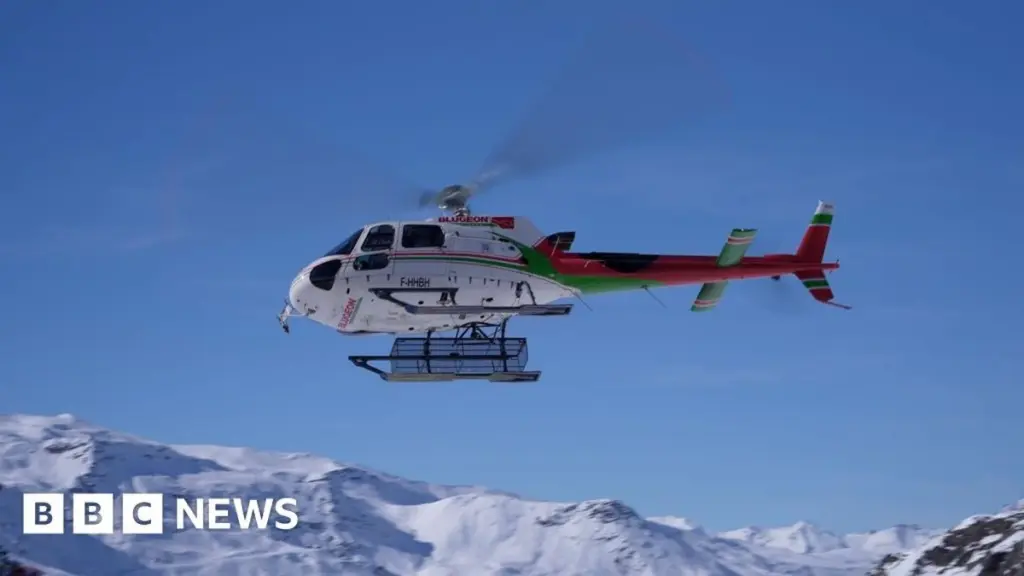
From a helicopter hovering above the Alps, recent avalanche activity is visibly etched onto the landscape, appearing as scars and indentations.
This season has seen a stark increase in avalanche deaths, with over 100 fatalities reported across the mountain ranges according to the European Avalanche Warning Services. This figure represents a level not observed in eight years.
As the helicopter navigates around a jagged ridge, glimpses of skiers are visible below, either lining up at ski lifts or descending various prepared slopes. The immense beauty of the Tarentaise region, a French Alps valley system, is apparent, covered in dense snow.
Frédéric Bonnevie, a mountain patroller with 32 years of experience, notes the impact of climatic shifts on winter conditions. “As with all around the world, the climate is changing,” he states. He highlights shorter winters and the necessity to seek higher altitudes for optimal snow conditions.
This season’s snow cover, while thick, has also been unstable. This instability is a significant factor contributing to the alarming rise in avalanche fatalities in the Alps.
Bonnevie explains that while ski piste conditions can be managed, the same cannot be said for areas off-piste. It is in these uncontrolled environments that skiers have encountered severe dangers.
Stéphane Bornet, director of Anena, a French association focused on snow safety, suggests that many victims are frequent visitors to the mountains. These individuals may possess considerable technical skiing skills but lack a deep understanding of the mountain environment itself.
He further points out that some individuals were not equipped with essential safety gear, such as avalanche transceivers for location tracking or shovels. Bornet indicates that basic route research was also often neglected.
The statistics regarding transceiver use are considerable. Emergency services report a roughly 70% survival rate for avalanche victims equipped with a transceiver, with the initial 16 minutes after burial being critical.
Without a transceiver, rescue operations become more complex and time-consuming, potentially requiring numerous personnel and extensive equipment, which consequently lowers the survival rate to approximately 20%.
Pierre Boulonnais, who has patrolled the slopes of Val Thorens for 17 years, expresses the grim reality: “Most of the time when we’re coming, it can be too late.” His weathered appearance and deep connection to the mountains underscore his expertise in snow conditions.
“That’s why you need to have all the rescue equipment on you, and to be in a group, but sometimes you can just be in the wrong place at the wrong time,” he adds, emphasizing the element of unpredictability.
While discussing this, Boulonnais demonstrates digging a shallow pit off-piste. The physical exertion required, even for a short trek through soft powder, is significant, necessitating constant movement to avoid sinking.
After allowing time for recovery, Boulonnais articulates the distinctions between wet and dry snow. He uses a metal ruler to measure the soft upper layer, approximately 60 cm (2 feet) deep, before encountering the more compact, denser snow beneath, a stratification not visually evident.
Bornet explains the immense pressure involved: “If you are trapped under just 50cm of snow of this density, you already have more than a quarter of a tonne on top of you.”
Avalanche incidents have garnered significant attention in French media. Recent reports include the recovery of two female skiers buried in La Chapelle d’Abondance after their vehicle was found in a parking area. In Isère, 64 individuals required helicopter evacuation when their village became cut off, a situation described by a local as akin to being in the “depths of Siberia.”
Discussions have arisen regarding the influence of climate change, with some calls for foreign visitors and those deemed “reckless” to contribute to rescue expenses.
Among the millions of tourists visiting ski resorts annually, British visitors constitute a quarter. For those disembarking at high altitudes, such as 2,800 meters (9,200 feet), recent events are clearly a concern.
Bella, a visitor, admits to feeling apprehensive due to avalanche reports on social media. “There are lots of avalanche stories on our social media, so we’re just feeling a bit twitchy,” she says, though she also feels reassured by a current avalanche risk level of 3/5, down from 5/5.
Rescue professionals, however, maintain that the overall risk of avalanches remains elevated.
In Switzerland, a train was recently derailed when an avalanche struck its side, though no casualties were reported.
Diego Gonçalo captured footage of the aftermath of an avalanche in St Anton, Austria, where a cloud of snow descended into the valley, resulting in three fatalities. He recalls the collective amazement at the sight, noting the initial silence followed by the arrival of emergency services.
“It’s amazing what nature can do and then you realise it can kill you and you can’t do anything. You feel so small in such a situation,” Gonçalo reflected on the experience.
While high numbers of avalanche deaths are not unprecedented, and there is a general agreement that climate change plays a role, the precise extent of its impact is still under examination. Fluctuating temperatures are demonstrably affecting snowfall patterns, timing, and location.
Bonnevie elaborates on this variability: “We had a lot of snow at the end of October, then not enough over the Christmas holidays. So when we had a lot of snow in January, there was a high avalanche risk.”
An off-piste instructor with 25 years of experience observed a shift in traditional practices. Previously, skiers would wait several days after snowfall for conditions to stabilize. Today, he notes, there is a tendency to venture out immediately to maximize limited ski breaks.
Bonnevie concurs with this observation, stating, “The new generation want to be the best, the biggest and the quickest.”
Rescuers believe that a combination of changing weather patterns and human complacency contributes to the increased fatalities. For officials like Bornet, addressing human overconfidence presents a more manageable challenge than altering global weather phenomena.
“You have to keep in mind that the mountains are a magnificent playground, a field of adventures,” he advises.
“Let’s make sure your memories are positive ones.”