
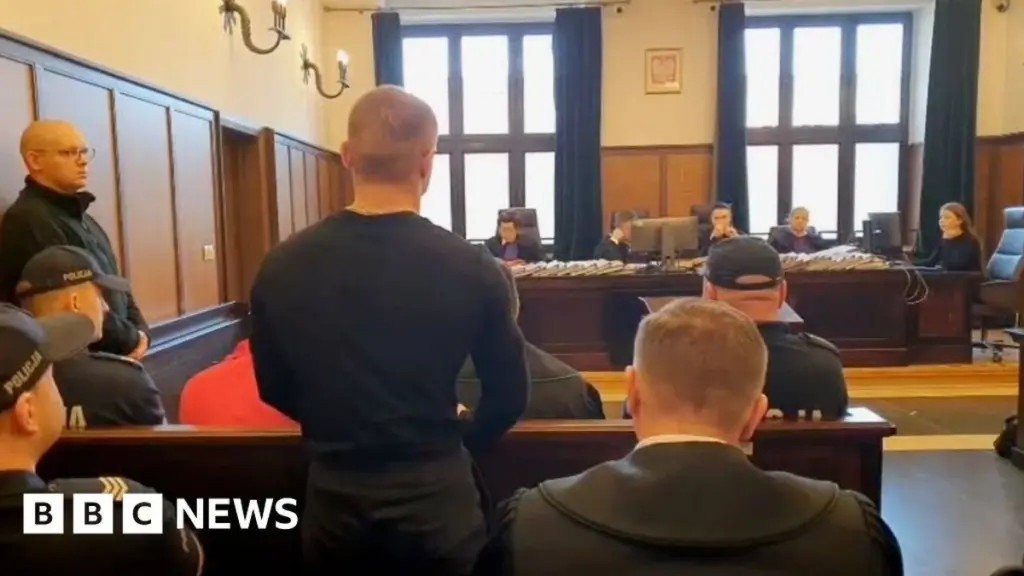
The trial commenced in the Polish capital, Warsaw, focusing on five men suspected of involvement in orchestrating the dispatch of liquid high-explosive packages to both the United Kingdom and Poland. Authorities allege these actions were carried out on behalf of Russian intelligence services.
These individuals, identified as citizens of Ukraine and Russia, face charges related to participating in a terrorist act during the summer of 2024. This period saw three of the suspicious parcels ignite while in transit, a critical detail in the unfolding proceedings.
One package reportedly burst into flames immediately prior to its scheduled loading onto a DHL cargo flight bound for the UK. This incident highlights the escalating nature of the alleged plot.
This particular scheme involving disguised explosive packages is understood to be one facet of a broader pattern of sabotage assaults targeting Europe. Officials have consistently linked these attacks to Russia since the commencement of its full-scale invasion of Ukraine.
On Friday morning, four of the individuals facing charges were brought before the court. They appeared in distinctive bright orange prison attire, with their movements visibly restricted by chains binding their ankles and wrists, underscoring the gravity of the charges.
Within the confines of the relatively small courtroom, each of the accused was seated, flanked by police guards. The prosecutor proceeded to deliver a comprehensive account of the alleged conspiracy. To ensure comprehension, his statements were translated into Russian for the defendants.
Evidence suggests the men assumed distinct roles within this operation. The entire endeavor, according to investigators, was coordinated via the messaging application Telegram, with handlers directing activities from Russia.
Details of the Incendiary Devices
The improvised explosive devices were reportedly constructed using a liquid explosive ingeniously concealed within tubes of face cream. Ignition mechanisms were further embedded within massage cushions, a sophisticated method designed to evade standard security screening protocols.
The prosecutor articulated that the group’s ultimate objective was to trigger a catastrophe. This was to be achieved by initiating a fire aboard an aircraft, thereby aiming to “intimidate large numbers of people.”
During this initial hearing, Vladislav D., a Ukrainian national referred to as such in Poland, was the sole suspect addressed directly to testify. The other defendants, in contrast, were observed to be smirking and engaging in conversation with their guards throughout the proceedings.
Vladislav D. did admit to handing over four boxes containing cosmetics and cushions to an “unknown man” in Vilnius, Lithuania. However, he vehemently denied any affiliation with Russian intelligence services.
Speaking to the court, he stated, “I did not act in the interests of Russia, or against Poland and others. I do not admit that I carried out an act of sabotage.” He subsequently elected not to respond to any further questions.
Nevertheless, the prosecution presented his prior statements. These provided a detailed narrative of his alleged involvement in activating the ignition devices before passing them on for mailing.
At the time of these previous statements, Vladislav D. claimed he was acting under duress. He asserted that his handler, known by the moniker “Warrior,” had threatened him, apparently possessing information concerning his relatives in Ukraine.
Broader Investigation and Future Proceedings
In total, twenty-two suspects have been apprehended across both Poland and Lithuania, the countries from which the parcels were dispatched using courier services such as DHL and DPD.
Alexander Suranovas, the individual reportedly paid to send the packages, informed the BBC that he had no awareness of any explosives being concealed within them. He also revealed that at the time of his arrest, he had already been contracted to send an additional “three or four” parcels on a monthly basis.
His own trial, alongside that of four other suspects in Lithuania, is scheduled to commence next month. The proceedings in Warsaw are slated to continue in mid-April.