
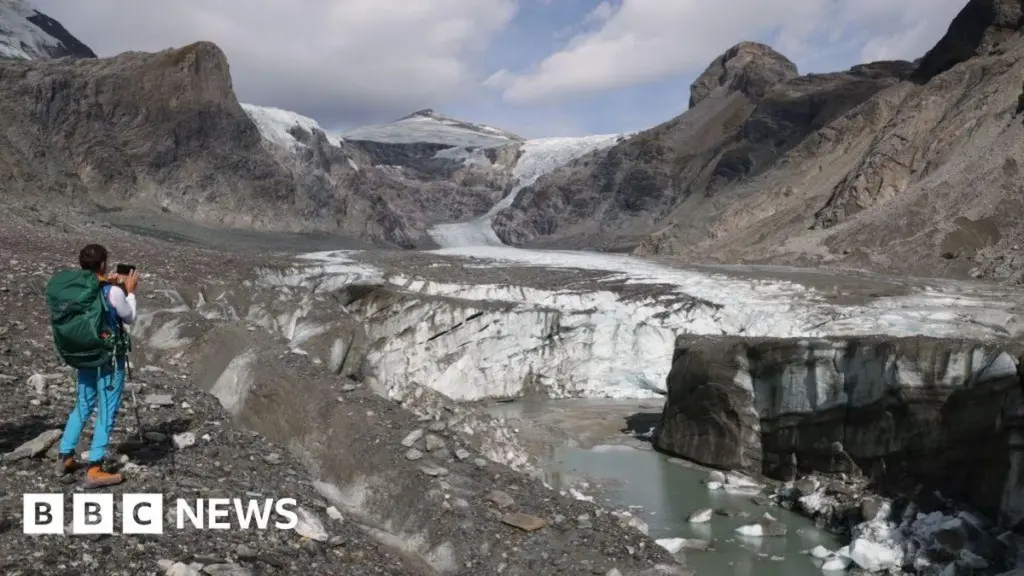
Scientists are issuing stark warnings about the state of Austria’s glaciers, reporting that they are not merely receding but are undergoing structural disintegration due to the ongoing effects of climate change.
The most recent assessment of the nation’s glaciers, compiled by the Austrian Alpine Club, indicates a persistent and dramatic reduction in their length, surface area, and overall volume.
Signs of Structural Breakdown
“Many glaciers are now experiencing more than just a shortening of their extent,” explained Andreas Kellerer-Pirklbauer, a researcher at the University of Graz. “We are increasingly observing them entering a phase of structural disintegration.”
He further elaborated on the visible manifestations of this process. “The landscape is becoming characterized by increasingly frequent occurrences such as newly exposed rock faces, sections of ice breaking off, and glacier tongues collapsing inward upon themselves.”
Annual Report Highlights Widespread Shrinkage
The Austrian Alpine Club’s annual report details the findings of its monitoring efforts over the past year. Out of 96 glaciers that were measured across Austria, a significant majority – 94 – showed a decrease in size.
Among the most severely impacted was the Alpeiner Ferner glacier in Tyrol, which experienced a shrinkage of 114.3 meters. The Stubacher Sonnblickkees in the province of Salzburg also suffered a substantial loss, receding by 103.9 meters in length during the same period.
Austria’s Largest Glacier Faces Fragmentation
Even Austria’s largest glacier, the Pasterze in Carinthia, continues its downward trend. According to the report, there is a high probability that the glacier’s tongue will break off in the coming years, a event that would result in the glacier splitting into two distinct parts.
Climate Change Identified as Primary Driver
The report unequivocally attributes this ongoing trend to climate change. It specifically pointed to a recent warm winter, characterized by minimal snowfall, and an exceptionally warm early summer, noting that June was nearly 5°C warmer than the historical average.
Data from high-altitude monitoring stations confirmed this warming trend, indicating that temperatures were, on average, 2°C (36°F) above the long-term annual average.
Unfavorable Conditions for Glacial Survival
Gerhard Lieb, who co-manages the glacier monitoring service with Andreas Kellerer-Pirklbauer, described the recent weather conditions as “extremely unfavorable for glaciers.”
“Many glaciers are now losing such significant amounts of mass that brief periods of cooling, like the one observed in July 2025, have minimal impact on their overall state,” he stated.
Broader Alpine Impacts
The scientists emphasized that the effects of climate change are particularly pronounced within the Alpine region. They noted that progressively warmer temperatures are directly contributing to an increase in extreme weather events and a rise in natural hazards.
“Alpine infrastructure is increasingly exposed to risk. Furthermore, as glaciers recede, the landscape is undergoing profound and irreversible transformations,” the report explained.
Nicole Slupetzky, Vice-President of the Austrian Alpine Club, underscored the immediate reality of these changes. “Climate change has been a persistent factor in the Alps for a considerable time, and we are currently experiencing its tangible consequences,” she commented. “The critical question is no longer whether we can preserve the glaciers in their historical form. Instead, our focus must shift to mitigating the repercussions for human society.”