
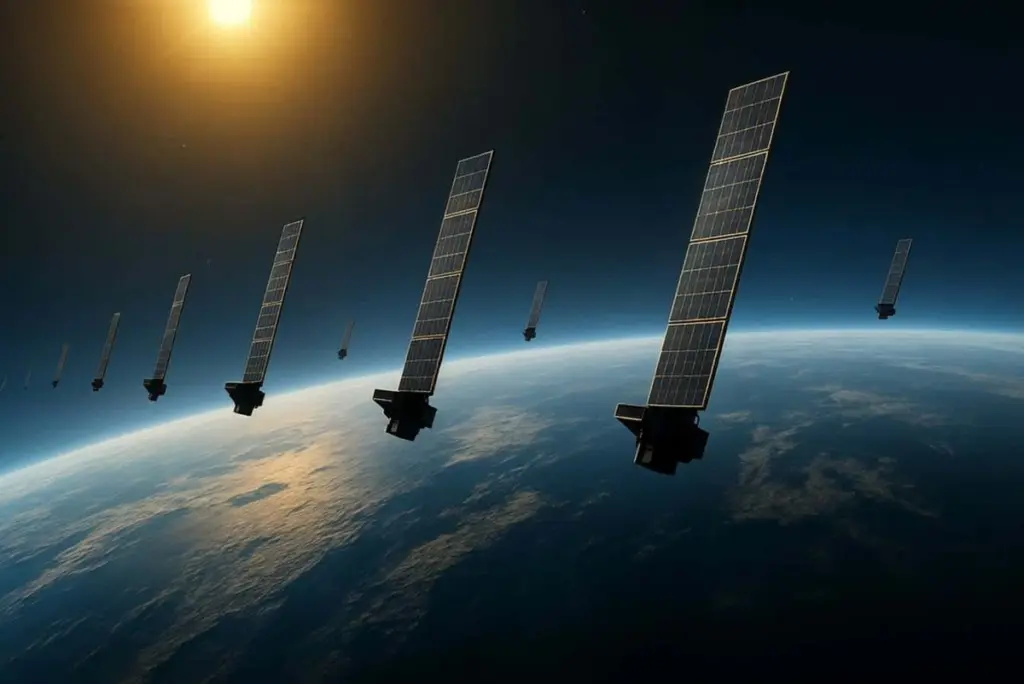
Starlink’s satellite constellation furnishes dependable internet connectivity nearly everywhere on Earth, presenting a distinct advantage on the modern battlefield. However, its operation by the controversial billionaire Elon Musk introduces a significant risk for militaries, which could abruptly lose access. This vulnerability has prompted a global effort among nations to develop their own independent satellite internet solutions.
The Starlink network comprises nearly 10,000 satellites, providing internet access across most of the planet through compact ground-based dishes. While the company reports over 10 million civilian subscribers, its services are also utilized by military forces. Contemporary warfare relies heavily on data transmission, with intelligence, video feeds, and drone control instructions exchanged continuously.
Unlike traditional radio communications, which adversaries can easily jam, Starlink’s signals are directed vertically from ground stations to satellites, offering considerable robustness. The affordability of its receivers allows them to be distributed to small military units and even integrated into remotely operated ground and aerial drones.
In an era of escalating global tensions and a national drive for sovereignty in critical technologies, from semiconductor manufacturing to nuclear defense, dependence on a foreign service like Starlink for troop coordination is increasingly viewed as precarious. This concern is amplified by its association with a figure as unpredictable as Elon Musk.
Both Ukrainian and Russian forces have employed Starlink since the 2022 invasion; reports indicate Russia has used it to guide attack drones. However, in February, the company enforced access restrictions to registered users, effectively denying Russian troops the service. This action reportedly had substantial consequences for Russia’s military coordination capacity, providing Ukraine with a short-term strategic advantage. No other nation wishes to face a similar predicament.
Nations are actively pursuing alternatives. The European Union is developing its own system, known as Infrastructure for Resilience, Interconnectivity and Security by Satellite (IRIS²), which is planned to launch around 300 satellites and become operational by 2030. China is also constructing the Guowang network, intended to comprise 13,000 satellites, though it currently possesses fewer than 200, alongside the Qianfan constellation, which remains in its initial phases. Russia’s planned Sfera constellation has experienced development delays.
Individual European nations are also exploring independent satellite internet capabilities. Germany is in discussions to establish its own network, currently in the conceptual stage. The United Kingdom maintains an interest in the satellite internet provider Eutelsat OneWeb, having previously supported its predecessor through bankruptcy due to the technology’s strategic importance. The British startup OpenCosmos is concurrently developing a comparable system, notably with funding from the U.S. intelligence agency, the CIA.
Anthony King, a researcher at the University of Exeter, notes the striking reality of a private communications company wielding such significant global influence, capable of granting or withholding military advantages. He anticipates that affluent superpowers will eventually catch up. “Of course, the Chinese will have one, and do have one [of current lesser size], so they will have secure satellite digital communications in any future conflict,” King stated.
Ascending Costs and Sovereign Ambitions
Although Starlink operates as a private entity, Barry Evans from the University of Surrey points out its substantial strategic funding from the U.S. government. He also highlights the existence of Starshield, a more secure, militarized version of the service.
“You’ve got governments relying on an individual, which is one of the things that worries Europe,” Evans commented. “
“[Musk] turns it off in various countries at various times. There’s a lot happening and, for the UK, it’s quite worrying because we don’t have the funding, really, to launch our own system.”
Evans explains that both Russia and China lag significantly behind Starlink. SpaceX’s sole ownership of Starlink and its associated rocket company provides a distinct advantage, enabling more cost-effective and self-scheduled satellite launches.
Establishing these extensive satellite networks involves more than an initial investment; it necessitates ongoing, substantial maintenance and the continuous deployment of new satellites to replace aging units or those depleted of orbital fuel. The United Kingdom, lacking its own launch infrastructure, would inherently depend on other nations to some degree, even if it were to develop its own satellite constellation.
Ian Muirhead, who served over two decades in military communications, recalls that armies initially relied on radio before adopting what was essentially a temporary mobile network during combat for long-distance communication. Following the Cold War, the downsizing of military forces rendered this approach prohibitively expensive and complex, leading to a shift towards satellite communications. However, this reliance was placed on a limited number of proprietary satellites, requiring costly and cumbersome ground equipment. Starlink, conversely, offers enhanced capabilities at considerably lower costs and reduced complexity, particularly for terrestrial operations.
Muirhead also notes Starlink’s strategic benefit in the context of potential space-based warfare. “Because there are lots of them, they can’t just destroy a satellite and call it done – they’re always overhead,” he observed.
SpaceX did not respond to a request for comment.