
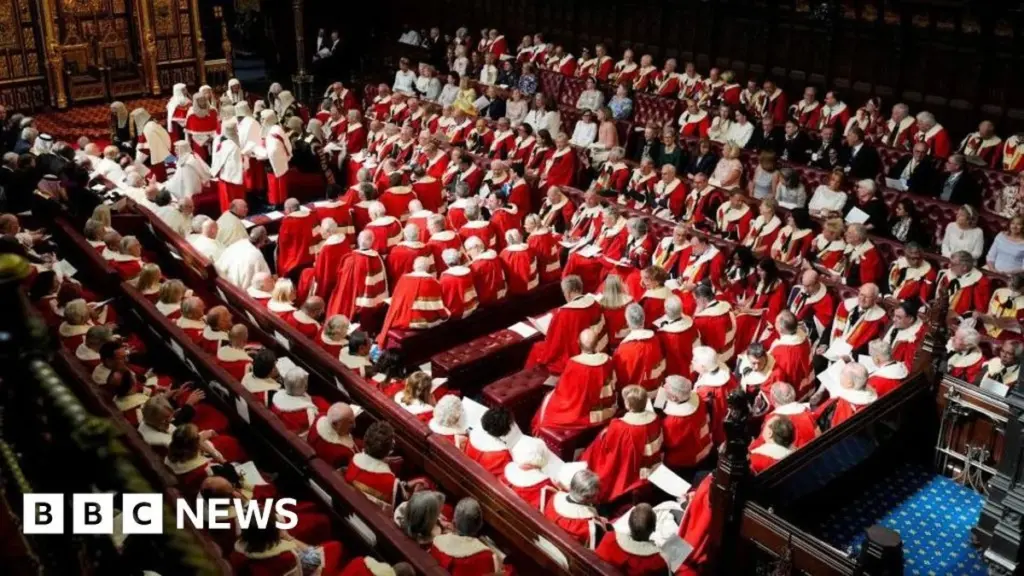
A significant shift in the United Kingdom’s parliamentary landscape is underway, with dozens of hereditary peers set to lose their seats in the House of Lords. This follows the successful passage of a bill that draws to a close a parliamentary tradition spanning centuries.
The House of Lords (Hereditary Peers) Bill received assent after ministers reached a compromise, resolving a lengthy dispute with those opposing the reform. This legislative move effectively eradicates the final remnants of a system where individuals held seats based on inherited titles.
The majority of hereditary peers were removed in 1999 under the Labour government. This latest bill eliminates the remaining 92 individuals who inherited their positions. Lords Leader Baroness Smith heralded the legislation as fulfilling a manifesto pledge to end the right of all hereditary peers to sit and vote in the upper house.
Baroness Smith emphasized that the change was not a reflection on individual contributions but on a fundamental principle established over 25 years ago: that parliamentary membership should not be determined by inherited titles. She noted that despite this agreement, hereditary peers continued to hold seats while significant reform stalled. A path forward, she asserted, was essential.
Addressing concerns about representation, Baroness Smith confirmed the government’s intention to offer life peerages to Conservative and crossbench members. This offer made it likely that some individuals with hereditary titles would continue to serve in the Lords. Consequently, the Conservative party withdrew its opposition to the bill.
Reports indicate that ministers have proposed offering 15 hereditary members of the House of Lords the opportunity to become life peers. Agreement has been reached that this arrangement will involve the Conservatives facilitating a number of retirements among their existing life peers. The prime minister will ultimately decide and announce the final allocation of life peerages for the Conservatives and any other parties.
Up to 92 hereditary peers are expected to leave the House of Lords at the conclusion of the current parliamentary session, anticipated in May. Lord True, the Conservative leader in the Lords, acknowledged the government’s mandate to end hereditary membership. He confirmed the party would cease its opposition, stating his belief in de-escalating parliamentary stalemates, even if the compromise was met with reluctance by some.
In a further aspect of the compromise, the government intends to increase the number of salaried ministers within the Lords. This addresses a situation where some ministers have served without pay due to existing legal restrictions. Baroness Smith pointed out that interim measures had been in place for the past 25 years, dating back to the initial removal of hereditary peers under Prime Minister Tony Blair’s government.
Discussions are ongoing regarding further reforms, potentially including a mandatory retirement age and minimum participation requirements for peers. For centuries, hereditary peers possessed the right to legislate and debate in Parliament, a right typically passed down through families. While historically most were male, some titles have been inherited by women, such as the Countess of Mar, who retired in 2020.
In 1999, Tony Blair famously described the presence of hereditary peers as an “anachronism.” While over 600 were removed, 92 were retained due to what was intended as a temporary arrangement. One of the departing hereditary peers, the Earl of Devon, expressed regret over the bill, highlighting his family’s 900-year tenure in the Lords. He also noted the brevity of the notice period provided.
The Earl of Devon suggested that his departure, and that of other hereditary peers, would be felt within Parliament and by the public. He asserted that hereditary peers should be “proud to sit here as embodiments of the hereditary principle dating back a millennium.” He added that he would miss the institution and expressed a desire to return, but “only on merit and not by dint of my hereditary privilege.”
The Lord Speaker offered thanks to the hereditary peers for their service. Lord Forsyth of Drumlean commented on the sadness of bidding farewell to colleagues, many of whom contributed significantly to debate, scrutiny, and the institutional memory of the House, irrespective of views on the constitutional change. He stressed that acknowledging their contributions transcended party politics, focusing instead on recognizing the value of service and commitment.
Dr. Jess Garland, director of policy and research for the Electoral Reform Society, stated that “no place in a modern democracy for people influencing our laws due to an accident of birth.” She characterized the removal of peers who received their legislative positions solely through birthright as a long-overdue reform. Dr. Garland concluded that “no part of Parliament should be a gated community from which the public are excluded.”