
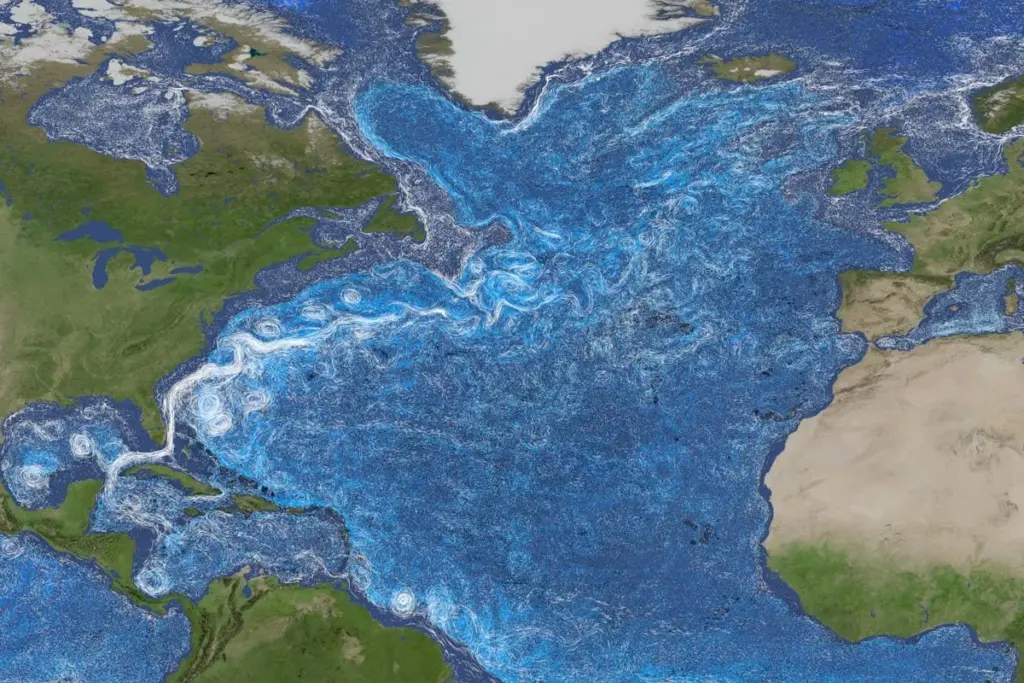
A discernible shift of the Gulf Stream towards the north provides further indication that the oceanic current system responsible for Europe’s relatively mild climate is undergoing a decline. This phenomenon is particularly concerning as modeling suggests that a sudden displacement of the Gulf Stream could herald an imminent and severe collapse of the broader ocean circulation.
The Atlantic Meridional Overturning Circulation (AMOC) describes the movement of warm, saline surface water originating from tropical regions and flowing towards northwestern Europe. Upon reaching these cooler latitudes, the water cools, becomes denser, and sinks, initiating a return journey southward along the ocean floor. The Gulf Stream itself is a critical component of this circulation, tracing a path from the Gulf of Mexico up the eastern coast of the United States before veering eastward into the Atlantic Ocean off the coast of North Carolina.
Current scientific projections anticipate a reduction in the AMOC’s strength. This is largely attributed to the influx of freshwater from the melting Greenland ice sheet into the North Atlantic. This dilution of the dense, saline AMOC waters is understood to impede the rate at which it sinks and subsequently flows southward. While some research posits that this weakening is already in progress, direct, conclusive evidence remains elusive for scientists.
A recent modeling study conducted by René van Westen and Henk Dijkstra at Utrecht University in the Netherlands has illuminated a potential consequence of a weakening AMOC. Their research indicates that this decline would cause the Gulf Stream to alter its course, extending its path along the U.S. coastline further to the north before its eastward turn into the Atlantic. This adjustment in oceanic flow patterns has significant implications for regional climate stability.
Crucially, the study’s findings are supported by satellite data suggesting that the Gulf Stream has indeed shifted approximately 50 kilometers northward over the past three decades. “This is something we can measure,” van Westen commented, adding, “So it is very likely that this reflects that the AMOC is indeed weakening.” This tangible observed change lends weight to the modeling predictions.
Historical analyses estimating AMOC flow rates based on past sea temperatures indicate a weakening of about 15 percent since 1950. However, direct monitoring of its actual flow has only been conducted using moored instruments since 2004. This relatively short observational period is insufficient to definitively distinguish between natural variations and a sustained trend in the observed changes.
Consequently, researchers are exploring alternative methods to assess the AMOC’s status, with the Gulf Stream’s path emerging as a key focus. Van Westen explained their motivation: “Therefore, we are trying to come up with some alternative approaches, such as the Gulf Stream path.”
The model developed for this study utilizes a finer resolution, representing the world in 10-kilometer pixels compared to the more common 100-kilometer pixels. This high-resolution approach enables the researchers to precisely track subtle shifts in the “bulge” where the Gulf Stream carries significant water masses. The behavior of this bulge is influenced by the Deep Western Boundary Current, a component of the AMOC that transports cold, salty water southward along the seabed. This current typically flows parallel to the North American coast beneath the Gulf Stream, exerting a southward pull. As the AMOC weakens, so too does the Deep Western Boundary Current, leading to a gradual northward displacement of the Gulf Stream’s curve.
In a startling discovery within the simulation, the model depicts the Gulf Stream abruptly jumping more than 200 kilometers northward within a mere two-year period, observed 392 years into the simulated future. This dramatic shift is followed by a complete collapse of the AMOC just twenty-five years later. Previous investigations have demonstrated that such a collapse would have severe climatic consequences for Europe, with potential for extreme cold snaps; London might experience temperatures of -20°C (-4°F), and Oslo, Norway, could face conditions as low as -48°C (-54°F).
It is important to note that this modeling scenario is an idealized representation and does not predict an AMOC collapse precisely 400 years from now. However, it strongly suggests that a sudden redirection of the Gulf Stream could serve as a critical early warning signal for an impending AMOC shutdown. This potential indicator is significant as it is the only known prior warning sign identified to date. While it might be too late to prevent an AMOC collapse once such a shift occurs, Europe could potentially mitigate its impact by implementing measures such as improving housing insulation and identifying more southerly regions suitable for food production.
“There is now a very proper early warning indicator that actually goes off,” van Westen stated. “You can measure this very easily.” This simplified, measurable indicator offers a significant advancement in understanding potential climate tipping points.
Yet, uncertainties persist regarding the real-world timeframe between a Gulf Stream shift and a subsequent AMOC collapse. Projections for when the AMOC might cease functioning vary widely, ranging from decades to centuries.
Oceanographer Dan Seidov, formerly with the US National Oceanic and Atmospheric Administration, has voiced a note of caution. He suggests that freshwater input from Greenland could affect the AMOC at a different rate and location than depicted in the model. “How, when and why it may or may not happen is the big question,” Seidov remarked. “If it happens as is prescribed in the model, then the Gulf Stream can be a precursor and provide a warning signal.”
While the correlation between an abrupt Gulf Stream shift and an AMOC collapse requires validation through additional modeling efforts, this study provides compelling evidence that the AMOC is indeed experiencing a slowdown. Stefan Rahmstorf at the University of Potsdam in Germany commented on this finding: “This slowing is occurring earlier than in the global warming scenarios.” He further posited that current climate models may be underestimating the severity of the problem, and thus, the potential timeline for reaching an AMOC tipping point.
Journal reference: Nature Communications Earth & Environment DOI: 10.1038/s43247-026-03309-1