
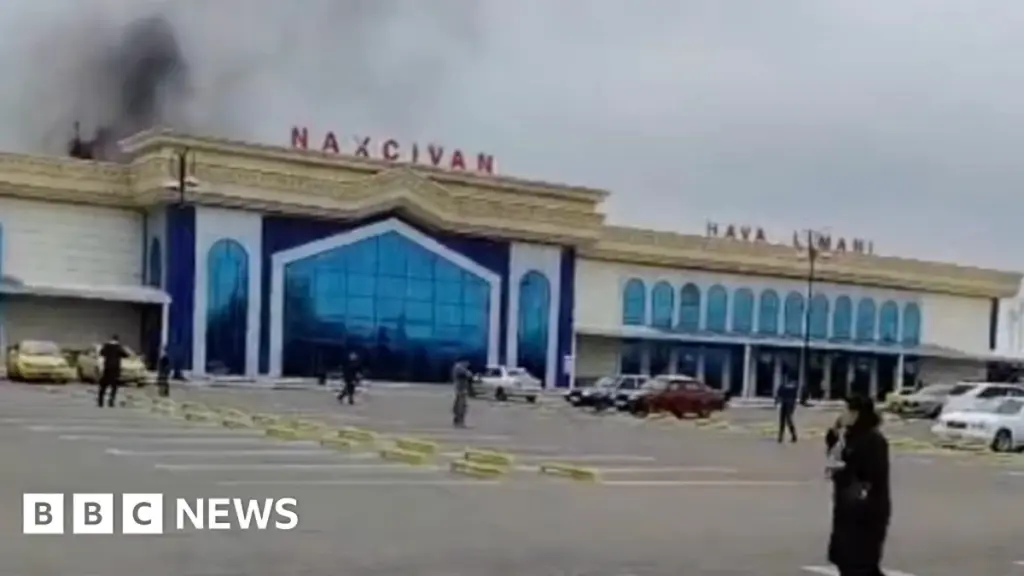
The escalating conflict in the Middle East has reportedly extended to Iran’s northern frontier, with Azerbaijan asserting that Iranian drones targeted its Nakhchivan exclave on Thursday.
Initial reports indicated that the airport terminal in Nakhchivan sustained a direct hit. Subsequently, a drone detonated near a school, resulting in civilian injuries, and another airborne drone was successfully intercepted and downed.
Azerbaijan’s President Ilham Aliyev vehemently denounced the incident, labeling it an “act of terror.” He issued a formal demand for an explanation and apology from Tehran, concurrently ordering Azerbaijan’s armed forces to a heightened state of readiness.
President Aliyev also made pointed remarks regarding Iran’s ethnic Azerbaijani population, a demographic issue of considerable sensitivity for the Iranian government.
Iran has categorically denied any involvement in the strikes that occurred on Thursday. Tehran has instead proposed that the attack might have been a fabricated operation orchestrated by Israel.
Azerbaijan, a nation of strategic importance situated on the Caspian Sea and sharing borders with Russia, Iran, Armenia, and Georgia, now finds itself increasingly drawn into a broader regional confrontation.
The Nakhchivan exclave, an Azerbaijani territory geographically separated from the mainland and bordering Iran, Turkey, and Armenia, is particularly vulnerable during periods of geopolitical instability.
The drone incident prompted President Aliyev’s most forceful public criticism of Tehran since he assumed the presidency.
He described the Iranian forces responsible for the strike as “ugly, cowardly, and disgusting,” an exceptionally blunt personal condemnation from a head of state.
However, his response extended beyond verbal denunciation. Aliyev declared that “independent Azerbaijan is a place of hope for Azerbaijanis living in Iran.”
Baku had consistently refrained from adopting such a stance previously, recognizing the delicate nature of the issue for Tehran.
Iran is estimated to be home to 20 to 25 million ethnic Azeris, constituting its largest minority group. This population is primarily concentrated in the northwestern regions, adjacent to the Azerbaijani border.
The Islamic Republic has historically viewed the identity and political leanings of its Azerbaijani citizens with extreme caution. Tehran perceives any suggestion of Azerbaijani identity transcending its borders as a potential threat to its internal cohesion.
Aliyev’s recent pronouncements, speaking of Iranian Azeris in such openly supportive terms, appear to represent a deliberate strategic calculation.
Iran is currently experiencing significant pressure, not only from ongoing regional conflicts but also from internal dissent and political uncertainties. Aliyev’s message can be interpreted as a warning to Tehran: any attempt to exert military or diplomatic pressure on Azerbaijan could elicit a response from Baku, potentially impacting Iran’s domestic stability.
Iranian Azerbaijanis have long voiced grievances regarding the denial of fundamental cultural rights, including the right to education in their native language.
Several Azerbaijani activists, journalists, and campaigners for language rights are presently incarcerated in Iran. They face charges that include “propaganda against the regime” and “conspiracy against national security.”
This community also holds political significance. This week, exiled crown prince Reza Pahlavi has been actively encouraging Iranian Azerbaijanis, among other ethnic minorities, to resist the current government.
Iran’s current president, Masoud Pezeshkian, is himself of Azerbaijani ethnicity. Furthermore, the late Ayatollah Ali Khamenei, who died following what have been described as US-Israeli strikes on Saturday, was also reported to have Azerbaijani ancestry.
Throughout history, some of Iran’s shahs were also ethnic Azerbaijanis.
Notably, Shah Ismail Khatai, one of the state’s most impactful rulers, utilized Azerbaijani as the primary language within his court during the 16th century. This historical detail underscores the significant influence Azerbaijani culture once exerted on the Iranian state.
Despite this historical connection, ethnic Azerbaijanis in Iran have not seen improvements in their access to education in their own language.
Political divergence between Iran and Azerbaijan has become more pronounced, despite their shared Shia Muslim identity. Tensions notably increased following Azerbaijan’s military successes in the 2020 and 2023 Karabakh wars, conflicts where Turkish and Israeli-manufactured weaponry played a role.
Iran views Azerbaijan’s robust defense relationship with Israel as a substantial security concern.
Iranian officials and media outlets have consistently alleged that Azerbaijan aids Israeli intelligence operations along Iran’s northern border. Azerbaijan denies these accusations.
The strategic ties between Azerbaijan and Israel extend beyond defense. Israel is a major beneficiary of Azerbaijani oil exports, and the two nations maintain close political and intelligence-sharing partnerships.
For Tehran, this collaboration lies at the core of its suspicions regarding Baku.
Azerbaijan, conversely, has long expressed resentment over Iran’s political and military backing of neighboring Armenia. Baku interprets this as direct interference in a conflict it considers central to its national security interests.
This historical context of mutual distrust provides a significant backdrop to Thursday’s escalation, influencing Baku’s interpretation of all actions originating from Tehran.
Iran has voiced opposition to the establishment of a direct land link connecting Azerbaijan to its Nakhchivan exclave. Tehran has consistently objected to any scenario where Armenia might grant Azerbaijan a land corridor to this territory.
Azerbaijan serves as a crucial energy supplier, with its crude oil reaching international markets via a 1,768-kilometer (1,100-mile) pipeline. This pipeline traverses from Baku on the Caspian Sea, through Georgia, and terminates on Turkey’s Mediterranean coast.
This vital artery transports over one million barrels of oil daily, providing Europe with a significant supply route that bypasses both Russian and Iranian territory.
The pipeline also supplies a considerable portion of Israel’s oil needs.
Consequently, the pipeline is perceived as a potentially significant target for Iran. Any threat to its operational integrity could trigger widespread security concerns and destabilize energy markets.
Both Iran and Azerbaijan have stated they do not seek an escalation of hostilities.
President Aliyev has affirmed that Azerbaijan “will not participate” in military actions directed against Iran. Similarly, Tehran continues to disavow responsibility for the drone attack.
However, Aliyev’s decision to openly refer to Azerbaijan as a “place of hope” for Iranian Azeris introduces a new and potentially volatile element into the diplomatic landscape.
Aliyev has previously highlighted his role as the sole foreign leader to visit an Iranian embassy to offer condolences following the death of Ayatollah Khamenei. He also noted his personal response to a request to assist in evacuating Iranian embassy personnel from Lebanon.
He now contends that Iran has retaliated for these gestures with drone strikes on Azerbaijani soil, an act he regards as a profound betrayal.