
Feedback, a popular segment in New Scientist that offers an amusing yet insightful perspective on recent science and technology news, invites readers to share items they find particularly entertaining. Contributions can be sent via email to [email protected].
A Bear-Sized Unit of Measurement
Following a previous instance where golden retrievers were utilized as a unit to quantify ice mass, Feedback has observed a surge in reader submissions detailing unconventional and often surprising units of measurement. These examples highlight how abstract concepts can be grounded in tangible, yet sometimes peculiar, comparisons.
Craig Downing, who identifies himself as a reader who always starts with the back pages of the magazine, shared an anecdote from his hometown of Ottawa, Canada. The Rideau Canal, which runs through the city, freezes each winter and transforms into the world’s largest natural skating rink by area. Maintaining this expansive ice surface requires constant snow removal to ensure a smooth skating experience.
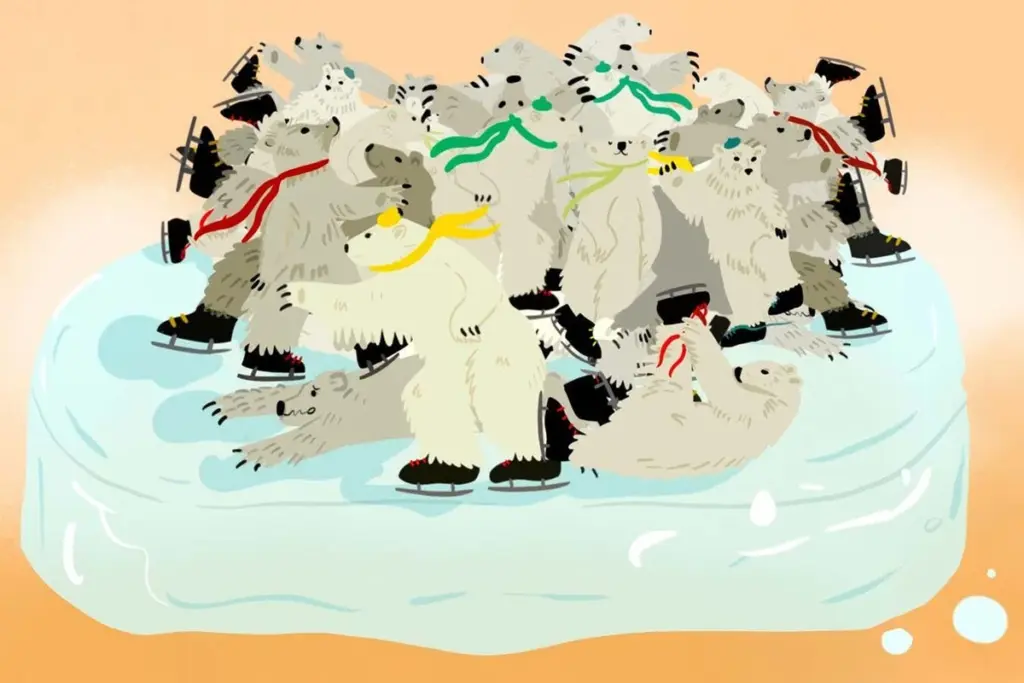
Downing was sent an email from the National Capital Commission, the entity managing the canal’s operations. The message stated: “For every 1 cm of snowfall, our crews move 125,000 kg of snow off the Skateway. That’s equivalent to 450 polar bears!”
This comparison left Downing perplexed. His usual frame of reference for snowfall involves more common imagery such as “shovel loads” or “driveways filled up to your knees.” The unusual metric is further complicated by the absence of polar bears in or around Ottawa, limiting his direct experience with this formidable Arctic predator.
An examination of the provided figures reveals that, on average, a polar bear would need to weigh 277.8 kilograms (approximately 612 pounds) to make the commission’s statement accurate. However, a crucial detail that must be considered is the sex of the bears. Through diligent fact-checking, Feedback consulted the website of the charity Polar Bears International. This resource indicates that adult male polar bears typically weigh between 350 to 600 kg (775 to 1,300 lb), while adult females usually range from 150 to 290 kg (330 to 650 lb). Exceptional cases, such as a male bear estimated at 800 kg (1,700 lb) by Canadian researchers, also exist.
Based on this information, it is indeed possible to equate the snow moved from the Rideau Canal to 450 polar bears, provided these are considered to be on the larger side of female animals. If the comparison were made using male polar bears, the number would decrease to approximately 357 creatures, and they would need to be on the smaller end of the male weight spectrum.
The Ambiguity of “Shedloads”
This lack of precise specification affects many of the unconventional units that appear in public discourse. Steve Tees wrote to express his frustration with the common phrase “a shedload of xxxx” used to describe traffic disruptions on motorways. He questioned the need for a standardized definition of the size of a ‘shed’ when such comparisons are made.
The Science Behind a High-Pitched Shriek
Certain sounds are particularly irritating to the Feedback team. Beyond the familiar grating of fingernails on a chalkboard, other bothersome noises include loud chewing and teeth brushing, fundamentally any sound made by another person, it seems. The high-pitched screech produced when adhesive tape is peeled from a surface is particularly notorious, to the point where it is cited as a primary reason for Feedback to avoid do-it-yourself projects.
Understanding the underlying cause of such phenomena might offer a path to tolerance. Research published in the journal Physical Review E has explored the physics of peeling Scotch tape. According to reporter Karmela Padavic-Callaghan, scientists utilized high-speed cameras and microphones to record the process of tape being rapidly removed from a glass pane. Their observations revealed “micro-cracks travelling through the tape at supersonic speeds and eventually creating a shockwave that we then hear as a high-pitched screech.”
Feedback eagerly anticipates a follow-up study that might propose a method for peeling tape without generating this infamous noise.
The Case of the “Unaffected” Retraction
Feedback has developed a keen interest in retracted scientific papers. The reasons for these retractions vary, from nonsensical graphics generated by artificial intelligence to manipulated images or implausible study designs. Each instance provides an opportunity for learning.
A particularly noteworthy retraction, considered a strong contender for a prominent position amongst such cases, appeared in Pharmacology Research & Perspectives on February 13th. This paper, originally published in 2022, concerned ivermectin, an antiparasitic medication that gained significant attention after being lauded as a potential cure for COVID-19, among other conditions.
The study in question suggested that ivermectin might also be effective in treating liver cancer. Feedback suggests that this particular claim, in itself, served as an immediate ground for suspicion.
The retraction announcement, notable for being made “by agreement” between the authors and other relevant parties, follows a pattern of lengthy explanations that seem to prolong the process. Initially, it states that “the Corresponding Author was not personally involved in the submission process, did not sign the Open Access Agreement, and did not review or approve the final version of the manuscript prior to submission.” This alone raises significant concerns.
Furthermore, the journal’s investigation “uncovered evidence of duplication of several images and figures from previously published articles.” This finding clearly indicates serious ethical breaches.
The announcement concludes with the authors’ assertion that “the conclusions of the article are otherwise unaffected.” This statement left the Feedback team in a state of bewildered contemplation. It is difficult to reconcile the claim that the conclusions remain “otherwise unaffected” when the lead author had no involvement in the final manuscript approval, and several of the study’s images were demonstrably sourced from other publications.
The Feedback team’s interpretation is that the conclusions are indeed “unaffected” in the sense that the paper is not being taken any less seriously post-retraction than it was prior to its publication, due to the fundamental issues identified.
Do you have a story for Feedback? You can send your submissions via email to [email protected]. Please include your home address. This week’s and past Feedback columns are available on the New Scientist website.