
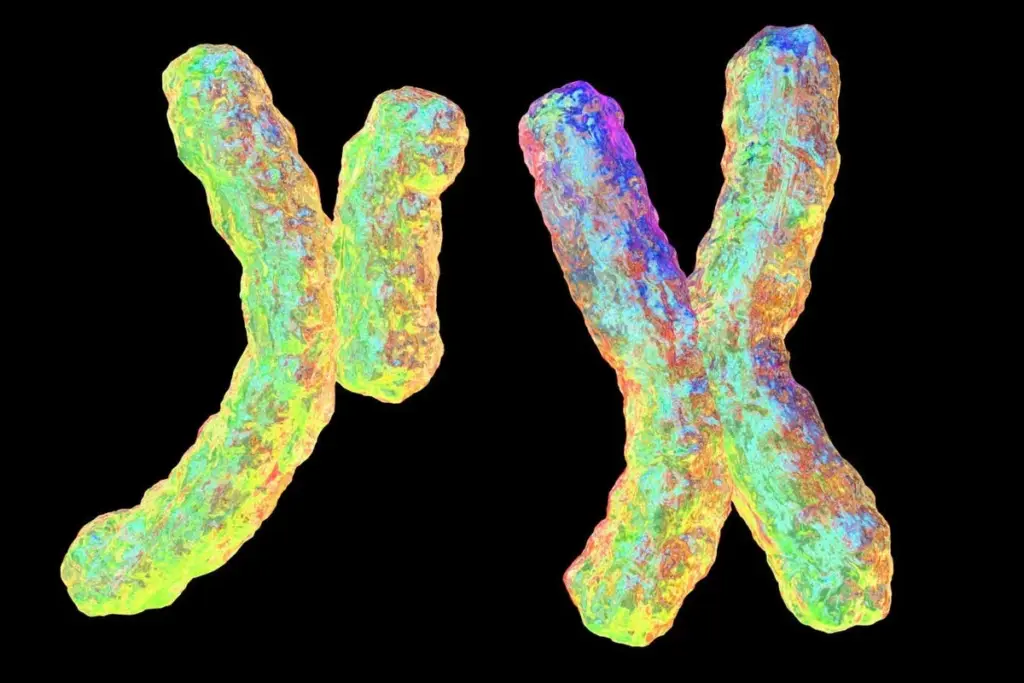
While unusual family structures with predominantly one sex are often attributed to chance, a detailed examination of a Utah family tracing back to the 1700s suggests a potential biological explanation for such occurrences. Researchers have identified evidence pointing towards a “selfish” Y chromosome that may influence the birth of female offspring.
“This represents a particularly significant family to study,” stated James Baldwin-Brown from the University of Utah. “Although the concept of selfish genes, similar to what we’re investigating, has been observed in numerous organisms, their investigation within humans has proven challenging.”
In the majority of mammalian species, male individuals possess both an X and a Y chromosome. The process of cell division in the testes, which leads to the formation of sperm, typically results in half of these sperm carrying an X chromosome and the other half carrying a Y chromosome. This biological mechanism theoretically establishes a 50:50 probability for the conception of either a male or a female offspring. However, certain genetic variations within chromosomes can confer an advantage, enabling them to distort this ratio and increase the likelihood of either male or female births. Some of these “selfish” chromosomes operate by interfering with the ability of other sperm to navigate towards an egg, while others are known to eliminate any sperm that do not carry them, though the precise means by which they achieve this remains elusive. “This is a question that has been posed for a century, and we are still actively seeking answers,” commented Nitin Phadnis, also affiliated with the University of Utah.
In some instances, a genetic conflict can arise between selfish X and Y chromosomes. These chromosomes compete to manipulate sex ratios in their favor, simultaneously thwarting the survival strategies of their counterparts. Given that chromosomes exhibiting such sex-ratio distortion have been documented across a wide array of animal species, it is reasonable to infer their existence in humans. Nevertheless, pinpointing currently active selfish chromosomes in people presents considerable difficulty. “Even if a family consistently has a high number of male births, perhaps five, six, or seven in a row, the statistical probability of this occurring by pure chance remains quite elevated,” Baldwin-Brown explained.
To establish that a skewed sex ratio is demonstrably not due to random variation, it is necessary to examine data spanning multiple generations. Baldwin-Brown, Phadnis, and their research team recognized the potential of the Utah Population Database, which contains extensive records for millions of individuals. For their specific study, they focused on a dataset comprising 76,000 individuals.
The researchers employed two distinct statistical methodologies to analyze the collected data. Both approaches independently identified the same family as a notable statistical outlier. Over a span of seven generations, 33 male individuals inherited the identical Y chromosome. Among the 89 children born to these men, a significant imbalance was observed: 60 were male, while only 29 were female.
Due to the anonymized nature of the data, the research team has been unable to perform direct genetic analyses. “It would be highly beneficial to de-anonymize these samples and be able to approach these individuals to request permission to sequence their sperm, thereby gaining insight into the underlying mechanisms,” Baldwin-Brown expressed. “However, this presents a substantial ethical and logistical hurdle, requiring extensive documentation and considerable financial investment.”
Sarah Zanders, from the Stowers Institute for Medical Research in Missouri, conveyed a degree of optimism that the team might have indeed identified a selfish Y chromosome. However, she cautioned that the current data sample size might still be too limited for definitive conclusions. While her own research on microorganisms has revealed notable divergences in sex ratios exceeding statistical expectations, these findings have often proven to be transient “noise” that dissipates with larger sample sizes.
Zanders also raised the possibility of infidelity playing a role, noting, “While I am not a specialist in human behavior, my understanding, derived from observation, suggests that instances of misattributed paternity may have occurred.” Baldwin-Brown confirmed that his team has indeed factored this potential into their considerations. “We maintain that we have a substantial amount of reliable and robust data,” he stated.
The Link Between Aging Fathers and Disease-Causing Mutations
Research indicates that older fathers are more prone to transmitting disease-causing mutations to their offspring. This increased risk is attributed to the accelerated proliferation of mutant cells within the testes as men age.
Clinical Significance and Future Research
The identification of selfish Y chromosomes extends beyond purely academic curiosity, according to Phadnis. These genetic elements could potentially contribute to the surprisingly prevalent rates of infertility observed in men. Phadnis explained that any biological mechanism designed to eliminate half of all sperm would inherently compromise fertility. Furthermore, studies conducted on animals have demonstrated that selfish chromosomes can result in infertility in certain individuals.
The research team intends to proceed by analyzing sperm samples to ascertain any skewed ratios of sperm carrying either X or Y chromosomes.
The specific focus on selfish Y chromosomes in this recent study was motivated by two primary factors. Firstly, Y chromosomes are readily traceable through male paternal lineages. Secondly, alternative explanations for an increased prevalence of female offspring, such as lethal mutations or selfish X chromosomes, also exist, making the specificity of the Y chromosome investigation valuable.
The concept of “selfishness” in genetics is not confined to X and Y chromosomes. More broadly, any segment of DNA that can enhance its own probability of being inherited beyond the standard 50% threshold is categorized as a gene drive, with numerous varieties discovered in the animal kingdom. Notably, advanced gene-editing technologies like CRISPR have been utilized to engineer artificial gene drives, with potential applications ranging from controlling the spread of malaria to managing pest populations.