
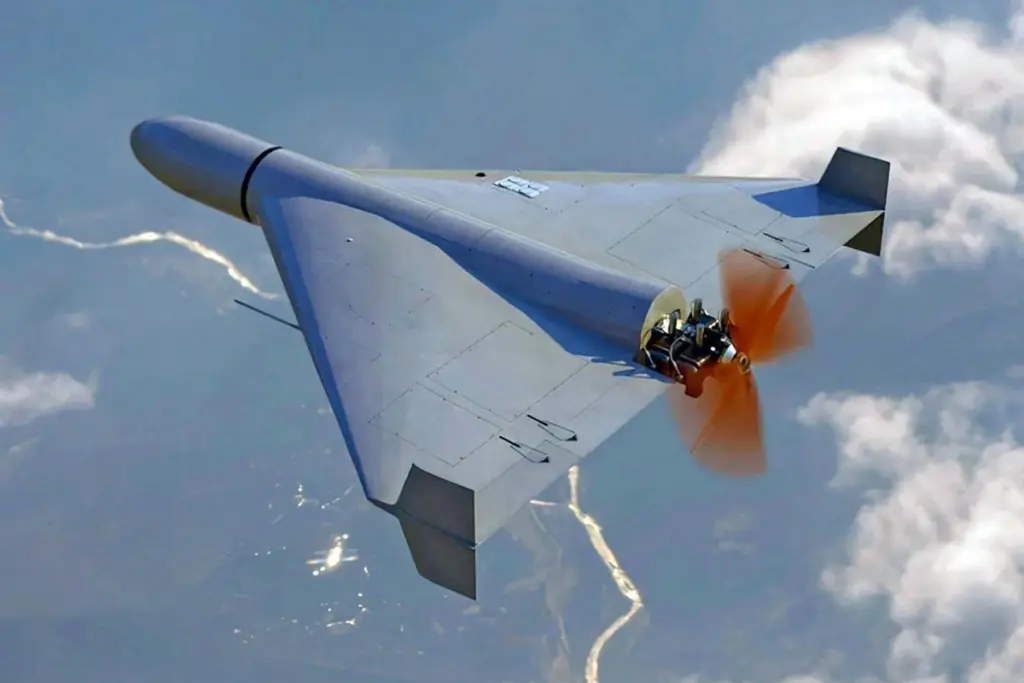
Iran, through its Shahed Aviation Industries, initially conceived the relatively straightforward Shahed 136, an attack drone. Now, ironically, the nation finds itself confronting American replicas of this very weapon deployed against it in ongoing conflicts. This raises a pertinent question: why would the United States military, possessing an arsenal of costly, advanced, and high-technology armaments, resort to manufacturing rudimentary drones powered by engines typically found in motorcycles?
Design and Deployment of the Shahed 136
The Shahed 136, measuring 2.6 meters in length, possesses the capacity to transport payloads weighing up to 15 kilograms. Its operational range extends to approximately 2500 kilometers. It navigates at a modest speed of around 185 kilometers per hour, a pace considerably slower than that of cruise missiles or aircraft equipped with bomb loads. However, its significant advantage lies in its exceptionally low production cost, estimated to be as little as $50,000 per unit.
Currently, hundreds of these Shahed drones are employed daily by Russia in strikes within Ukraine. Their widespread use necessitates comprehensive air defense systems, incorporating fighter jets, machine guns, missiles, and interceptor drones, all aimed at neutralizing them before they reach their civilian or military objectives. Forces in Yemen, specifically the Houthi movement, have also incorporated these drones into their operations.
The United States’ Reverse-Engineered Response
In a retaliatory measure for recent strikes by the US and Israel, Iran has been utilizing Shahed drones alongside other military hardware in attacks across the Persian Gulf region. In response, the US military has deployed its Low-cost Uncrewed Combat Attack System (LUCAS) for the first time in combat against Iran. Developed by Spektreworks, an Arizona-based company, LUCAS is essentially a reverse-engineered imitation of the Shahed 136. This development signifies that Iran’s original design is now being turned against its own forces.
The LUCAS system features a modular design, allowing for the integration of reconnaissance or communication equipment, or the attachment of a warhead for ground assaults. Spektreworks markets this drone as the FLM 136, a name that appears to acknowledge the Shahed 136, from which its design was evidently cloned.
Reports suggest that the US military achieved its reverse-engineering of the drone after acquiring units from Iranian-backed militias operating in Iraq and Syria. Following this, the system underwent successful test launches from a US Navy vessel in the preceding year.
Historical Parallels and Economic Implications
Anthony King, associated with the University of Exeter in the UK, draws a parallel between these inexpensive and relatively unsophisticated attack drones like the Shahed and the “doodlebugs” of World War II – specifically, the V-1 flying rockets that Nazi Germany deployed to bomb the United Kingdom. Such weaponry, he notes, is economical and straightforward to mass-produce. Their deployment in sufficient numbers can overwhelm an adversary’s defenses, straining even highly sophisticated air defense networks to their limit or consuming substantial resources, rendering prolonged conflict unsustainable. This depletion of defensive capabilities subsequently leaves the adversary vulnerable to further assaults.
“You’re knocking them out of the sky with ordnance that’s way more expensive not just than the Shahed, but sometimes it’s more expensive than the thing that the Shahed is actually hitting,” King explains. He points out that in numerous instances, the target struck by a Shahed drone is less valuable than the Patriot missile used for its interception. The emergence of these crude yet effective remote systems, he argues, fundamentally alters the economic dynamics of warfare in a notable way.
Interestingly, there is evidence to suggest that Iran’s original design for the Shahed 136 may have been influenced by a Cold War-era device. A collaborative project between Germany and the United States in the 1980s aimed to develop a similar craft capable of striking Soviet radar installations or absorbing enemy air defenses to protect other aircraft. This initiative resulted in the Dornier design known as “Die Drohne Antiradar,” which translates directly to “the anti-radar drone.”
The Evolving Landscape of Aerial Warfare
Ian Muirhead, affiliated with the University of Manchester in the UK and possessing 23 years of military experience, asserts that Shahed drones will not supplant crewed aircraft or highly advanced missiles. However, he acknowledges their increasingly significant role in combat and observes that Western militaries are drawing lessons from the conflict in Ukraine and subsequently adopting comparable weaponry. “A lot of modern weapons are extremely complex and expensive, and if you’re having large-scale conflicts like this, having lots of cheap, expendable weapons – particularly if you don’t have big armies any more – is more effective,” Muirhead states. “If you can send a thousand of them, you can overwhelm defences with cheap munitions.”
“It’s just economics: if it costs you 10 times more for your defence than it is for your attackers, you’re never going to be able to outpace the other side,” he concludes, highlighting the fundamental economic considerations driving the adoption of such technologies.