
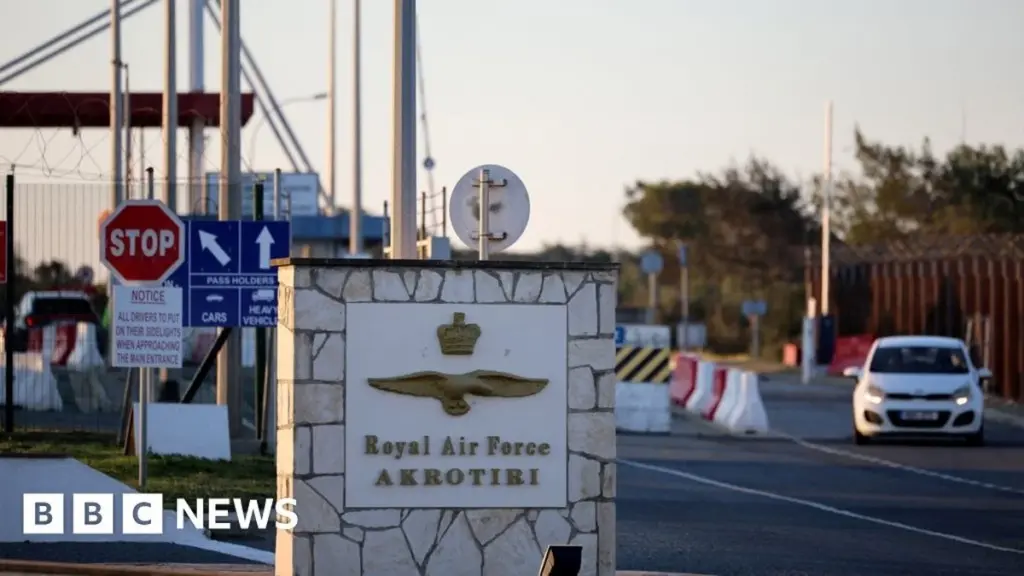
Cyprus reported the interception of two unmanned aerial vehicles (UAVs) on Monday, which were reportedly heading toward RAF Akrotiri, a British military base on the island. This development followed a separate overnight drone strike on the same base, which resulted in no injuries and minimal damage.
The security alerts on Monday led to employees at the base receiving messages warning of an “ongoing security threat.” Sirens were also heard in the vicinity. As a precautionary measure following Sunday’s attack, the UK’s Ministry of Defence had announced plans to relocate family members to alternative accommodations.
During the day, Prime Minister Sir Keir Starmer mentioned that the UK had agreed to a request from the United States to utilize British military bases for defensive strike operations. Cypriot government spokesman Konstantinos Letymbiotis confirmed via a post on X (formerly Twitter) that the two drones intercepted on Monday were indeed en route to the British base.
Details of the Sunday Night Attack
The initial attack occurred on Sunday around midnight local time, which equates to 22:00 GMT. Cypriot President Nikos Christodoulides later identified the aircraft involved as an Iranian drone. In the aftermath, the Sovereign Base Areas Administration confirmed its intention to implement a “temporary dispersal of non-essential personnel” from RAF Akrotiri.
Security Measures and Public Advisories
On Monday, base personnel were instructed to remain away from windows and seek shelter behind furniture. Separately, an alarm was triggered at Paphos Airport after a suspected drone was observed in the airspace, prompting evacuation orders. The U.S. embassy in Cyprus also issued a warning regarding a potential drone threat within the Paphos region.
The Sovereign Base Areas Administration stated its collaboration with the Republic of Cyprus and local authorities to assist Akrotiri residents considering temporary relocation. In a related development, EasyJet announced the cancellation of all flights into and out of Cyprus on Monday.
International Response and Investigations
Ursula von der Leyen, President of the European Commission, indicated she had been briefed on Sunday’s incident by the Cypriot president. She affirmed that while the Republic of Cyprus was not the direct target, the EU stands unequivocally with its member states against any such threats.
UK Foreign Secretary Yvette Cooper informed BBC Breakfast that the government was still ascertaining the specifics of the drone incident, with the Ministry of Defence examining details such as the origin, locations, and timings. Cooper remarked on the seriousness of Iran’s actions, citing drone and missile strikes across Gulf partners in areas not involved in any conflict with Iran.
The Cypriot government spokesperson indicated that official representations would be made to the United Kingdom concerning the handling of Sunday’s incident. Concerns appeared to focus on information sharing between local authorities and residents in the broader Akrotiri area.
Broader Regional Context
The ongoing conflict escalated on Saturday morning with a significant attack launched by Israel and the U.S. against Iran’s leadership and military infrastructure, reportedly resulting in the death of Supreme Leader Ayatollah Ali Khamenei. Iran’s response involved firing ballistic missiles and drones at U.S. assets and allied nations across the region, including Israel, Bahrain, Kuwait, Qatar, the United Arab Emirates, and Jordan.
UK Defence Posture and Previous Incidents
Defence Secretary John Healey had stated earlier on Sunday afternoon that British troops and civilians in the Middle East were at risk due to Iran’s “indiscriminate attacks.” He also noted a separate incident where two ballistic missiles were fired towards Cyprus, though he expressed confidence that the island was not the intended target.
A Cypriot government spokesman later confirmed that Sir Keir Starmer had assured President Christodoulides during a phone call that Cyprus was definitely not a target. On Sunday, an RAF Typhoon jet operating from Qatar successfully downed an Iranian drone during a “defensive air patrol,” according to the Ministry of Defence. This marked the first instance of a UK fighter jet intercepting an Iranian drone since the initiation of U.S. and Iranian strikes.
Earlier, a UK counter-drone unit stationed in Iraq had neutralized an Iranian drone approaching a coalition base where UK service personnel were present. Sir Keir acknowledged that the UK had learned from past events, referencing “mistakes of Iraq,” and reiterated the UK’s non-involvement in the initial strikes on Iran, stating it would not participate in offensive action.
The decision to accept the U.S. request to utilize British military bases was based on the principle of “collective self-defence” among allies and the protection of British lives, with Iran being accused of pursuing a “scorched-earth strategy.” The BBC understands that the U.S. is likely to employ RAF Fairford in Gloucestershire and Diego Garcia in the Indian Ocean for operations targeting Iranian missile sites.