
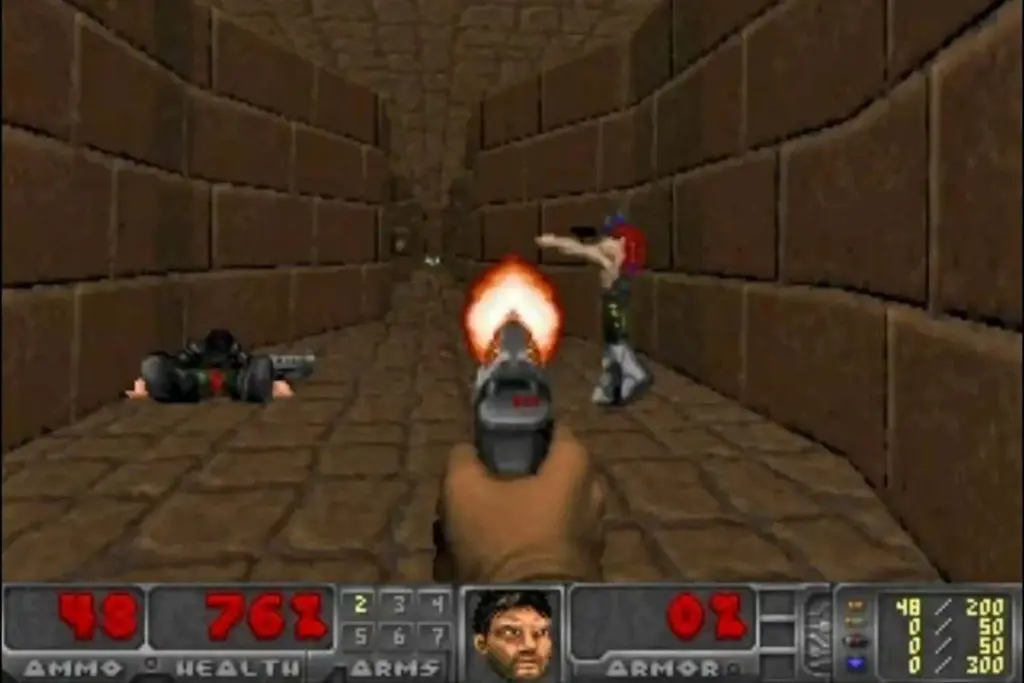
Human brain cell cultures have demonstrated the ability to play the classic video game Doom. While their performance does not rival that of human players, this development signifies a step closer to practical applications for biological computing, potentially including robotic arm control.
In 2021, Australian firm Cortical Labs initially showcased neuron-powered computer chips playing Pong. These chips comprised assemblies of over 800,000 living brain cells cultivated on microelectrode arrays capable of bidirectional electrical signaling. Researchers undertook a rigorous training process to enable these chips to operate the paddles on the game’s screen.
Cortical Labs has since engineered an interface that streamlines the programming of these chips through the widely used Python language. An independent developer, Sean Cole, subsequently utilized Python to instruct the chips in playing Doom, a task he accomplished within approximately one week.
“Unlike the Pong experiments conducted a few years ago, which entailed years of meticulous scientific endeavor, this particular demonstration was achieved in mere days by an individual with limited prior experience directly engaging with biological systems,” stated Brett Kagan of Cortical Labs. “This accessibility and flexibility are what make this advancement truly remarkable.”
The recent neuronal computer chip, employing roughly a quarter of the neurons used in the Pong demonstration, exhibited a superior performance in Doom compared to a randomly operating player. However, it still fell significantly short of skilled human play. Nevertheless, the chip acquired skills at a rate faster than conventional silicon-based machine learning systems. Kagan suggests that its performance should improve with the integration of newer learning algorithms.
Kagan emphasized that direct comparisons between these biological chips and human brains are not entirely appropriate. “While it is indeed alive and biological, its primary function is as a material capable of processing information in unique ways that silicon cannot replicate,” he explained.
“Doom presents a considerably greater level of complexity than prior demonstrations,” noted Andrew Adamatzky from the University of the West of England in Bristol, UK. “Successfully interacting with it underscores substantial progress in controlling and training living neural systems.”
Steve Furber of the University of Manchester, UK, acknowledged that Doom represents a significant escalation from Pong. However, he pointed out that a considerable amount remains unknown regarding how these neurons are executing the game. Questions persist about how the neurons ascertain their expected actions or how they perceive the screen without the presence of eyes.
Despite these unknowns, the enhanced capability is a source of excitement, according to Yoshikatsu Hayashi at the University of Reading, UK. He believes this development moves us considerably closer to practical, real-world applications, such as controlling robotic arms with biological computers. Hayashi and his colleagues are actively pursuing this with a similar computer constructed from a hydrogel material. “Playing Doom can be seen as a simplified version of controlling an entire arm,” Hayashi commented.
“The truly exciting aspect is not merely the capacity of a biological system to play Doom, but its ability to effectively manage complexity, ambiguity, and real-time decision-making,” Adamatzky observed. “This aligns much more closely with the challenges that future biological or hybrid computing systems will need to address.”