
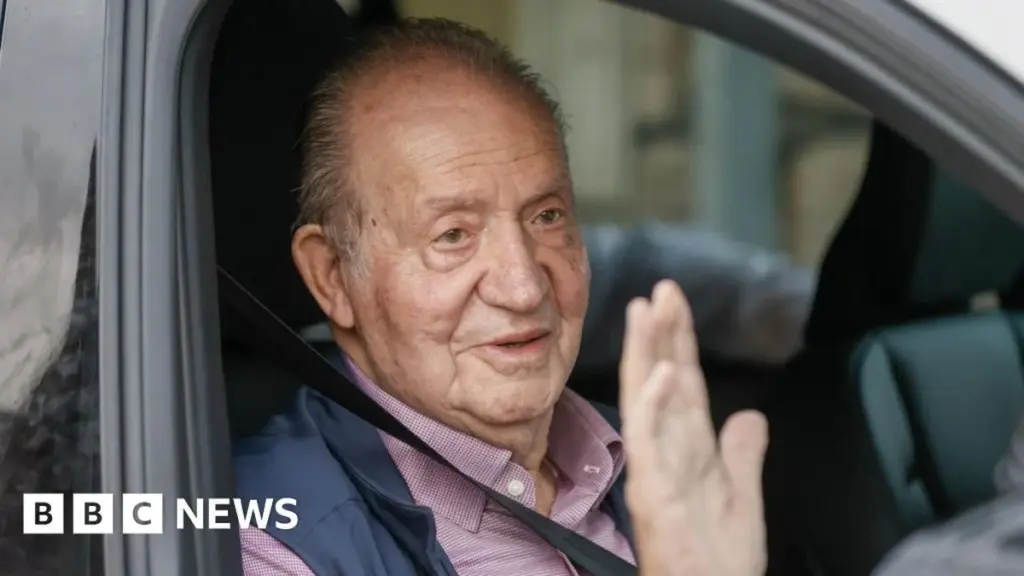
The leader of Spain’s primary opposition party has publicly called for the return of the disgraced former King Juan Carlos, who has been living in self-imposed exile. This proposition is largely attributed to his significant role in Spain’s transition to democracy almost fifty years ago.
Alberto Núñez Feijóo, at the helm of the conservative People’s Party (PP), stated on social media, “I think it would be desirable that the king emeritus return to Spain.” He acknowledged the former monarch’s past indiscretions, noting, “He himself has acknowledged undeniable mistakes in his past.” However, Feijóo added, “he who contributed to sustaining our democracy and our freedoms in a key moment should spend the last stage of his life with dignity in his own country.”
Juan Carlos, now 88 years old, ascended to the throne in 1975 following the death of Francisco Franco, the dictator he served. During his reign, he played a pivotal role in guiding Spain toward a parliamentary democracy. His decisive actions are credited with thwarting a 1981 coup attempt by pro-Franco factions, a move that solidified his popularity among many Spaniards for decades.
His public standing began to erode in 2014 when he abdicated. This decision followed revelations that he had been on an elephant hunting trip in Botswana with Corinna zu Sayn-Wittgenstein-Sayn, who was his mistress, during a period of economic hardship for Spain. Further controversies emerged later, including reports of a $100 million payment from the late King of Saudi Arabia and the existence of an offshore fund in Jersey.
In August 2020, Juan Carlos departed Spain to reside in the United Arab Emirates, his current location. His son and successor, King Felipe, supported this move, which has largely kept the former king out of public view. His appearances have been limited to infrequent visits to Spain for events such as sailing regattas and other social gatherings.
The recent declassification by the government of approximately 150 documents pertaining to the 1981 coup attempt brought renewed attention to Juan Carlos’s actions during that period. This event appears to have directly prompted Núñez Feijóo’s call for his return.
While the PP has voiced similar sentiments regarding the former monarch previously, this particular appeal is considered notably bold. Its timing has reignited the discussion around Juan Carlos’s future in Spain.
The socialist-led government, which has been critical of Juan Carlos individually but remains supportive of the monarchy as an institution, has sought to disassociate itself from the matter. Justice Minister Félix Bolaños stated, “The decision of the king emeritus depends on him, it’s up to him and the Royal Household, it’s not up to the government or the opposition.”
Challenges and Considerations for a Potential Return
While many, particularly on the political right, favor the idea of the former king concluding his exile, his repatriation would not be without complexities. In his memoir, published last year, Juan Carlos detailed the strained relationship with his son, King Felipe, that arose after his abdication.
Juan Carlos recounted a conversation with King Felipe, stating, “‘Don’t forget that you inherit a political system that I built.'” This exchange occurred after the former king’s income as head of state was withdrawn, and his son opted to refuse his inheritance. He continued, “‘You can exclude me on a personal and financial level, but you cannot reject the institutional inheritance in which you have grown up.'”
A potential return would introduce logistical hurdles. These include determining his residence, managing his financial affairs, and clarifying his domestic situation with Queen Sofía, to whom he remains married, though she continues to reside in Spain.
Ana Romero, an author with extensive knowledge of Spain’s monarchy, commented on the necessary conditions for his return. “For him to return he would need to want to return in the only way possible, which is accepting the rules that his son sets him: to behave in a transparent and exemplary way,” she said.
Romero suggested that Juan Carlos’s homecoming would be contingent upon him “putting in order his marriage and his financial affairs.”
The Royal Household affirmed that the decision to return rests solely with Juan Carlos. However, it also stipulated that to protect the “image and reputation” of both the former king and the monarchy, “Juan Carlos should have his tax domicile in Spain.”