
The 1980s, a decade remembered for its distinctive music, bold fashion, and vibrant makeup trends, also harbored a technological promise that seemed set to redefine computing: superconducting circuits. In 1980, IBM, a titan of the technology industry, placed its faith in this technology, envisioning a future of exceptionally efficient and revolutionary computers. The widespread interest was palpable, even gracing the cover of the popular science magazine Scientific American in May of that year.
However, the anticipated revolution in computing faltered, leaving superconducting chips seemingly relegated to the same historical footnotes as popular hairstyles and clothing styles of the era. Despite this setback, one company persisted in nurturing the research. A recent visit to SEEQC’s headquarters and its quantum chip foundry in upstate New York revealed a company actively reviving this dormant technology. Sprouting in part from IBM’s discontinued superconducting computing program, SEEQC harbors ambitions of superconducting chips playing a pivotal role in the next wave of technological advancement – the quantum computing revolution.
Within SEEQC’s fabrication facility, the environment is dominated by large machinery and technicians clad in full-body protective suits. In controlled cleanroom settings, ultrathin layers of niobium, a superconducting metal, are meticulously deposited onto dielectric materials, forming a sophisticated, layered structure. Elsewhere, lithography devices employ light to etch intricate circuit designs onto these substrates. Every minute detail, from the smallest trench to the deepest groove, is critical for the quantum processes that enable these chips to function. The entire facility hums with activity, bathed in a yellow light chosen for its minimal interference with the chip-manufacturing process.
During a discussion in an adjacent conference room, SEEQC’s chief executive officer, John Levy, presented a sample of the company’s superconducting chip. Its unassuming, small, and square form factor contrasted sharply with its ambitious aim to reshape an already futuristic industry.
The Challenge of Efficient Electricity Transmission
Superconductors possess the unique ability to transmit electricity with perfect efficiency, a stark departure from the materials typically used in electronic devices. When a phone is charged, the associated heat generated by the charging cord or adapter represents a loss of energy that would otherwise power the device. This inefficiency is so significant that, in 2017, computer scientist Michael Frank wryly observed, “A conventional computer is, essentially, an expensive electric heater that happens to perform a small amount of computation as a side effect.”
A computer incorporating superconducting components would bypass this energy dissipation issue. The primary obstacle, however, lies in the operational requirements of all known superconductors. They demand either extreme cold or immense pressure to function effectively. Consequently, a superconducting computer would necessitate operation at temperatures just a few degrees above absolute zero. Historically, these stringent conditions proved prohibitively expensive and impractical, leading IBM to cease its superconducting computing research in 1983. Conventional, heat-producing computers ultimately prevailed. Ironically, the energy expenditure for computing has only escalated since then, climbing dramatically in recent years, largely fueled by the burgeoning AI boom.
Yet, superconductors found a resurgence several decades later. In 1999, a research team in Japan developed the first superconducting quantum bit, or qubit, the foundational element of a quantum computer. This represented a fundamentally different approach from earlier research endeavors. Instead of attempting to replicate conventional computing using superconducting materials, this breakthrough opened the door to an entirely new paradigm of computation, utilizing devices that process information through mechanisms entirely absent in traditional computers.
Quantum computing has advanced considerably since then, with superconducting qubits playing a role in this progress. Leading companies like Google and IBM utilize them to power some of the most advanced quantum computers currently available. These machines have begun to address complex scientific problems with notable success. Several demonstrations of “quantum supremacy” over classical computers remain uncontested, reinforcing the notion that these devices operate on fundamentally different principles than any previous computational hardware.
Despite these advancements, quantum computers have yet to fully realize their transformative potential. They have not yet succeeded in breaking widely used encryption methods, discovering novel pharmaceuticals, or revolutionizing industrial chemistry, among other ambitious goals. The path to achieving these milestones remains fraught with significant technical hurdles and engineering challenges.
SEEQC’s Novel Approach to Quantum Computing Architecture
John Levy from SEEQC believes that a solution might be found by revisiting the technologies of the 1980s. His team is developing digital superconducting chips aimed at enabling quantum computers to achieve greater scale, enhanced power, and improved error resilience simultaneously. Researchers at SEEQC are in the process of testing chips within specialized refrigeration units. Their objective, as Levy explained, is not merely to introduce another component but to replace numerous parts that currently contribute to the bulkiness and inefficiency of quantum computers.
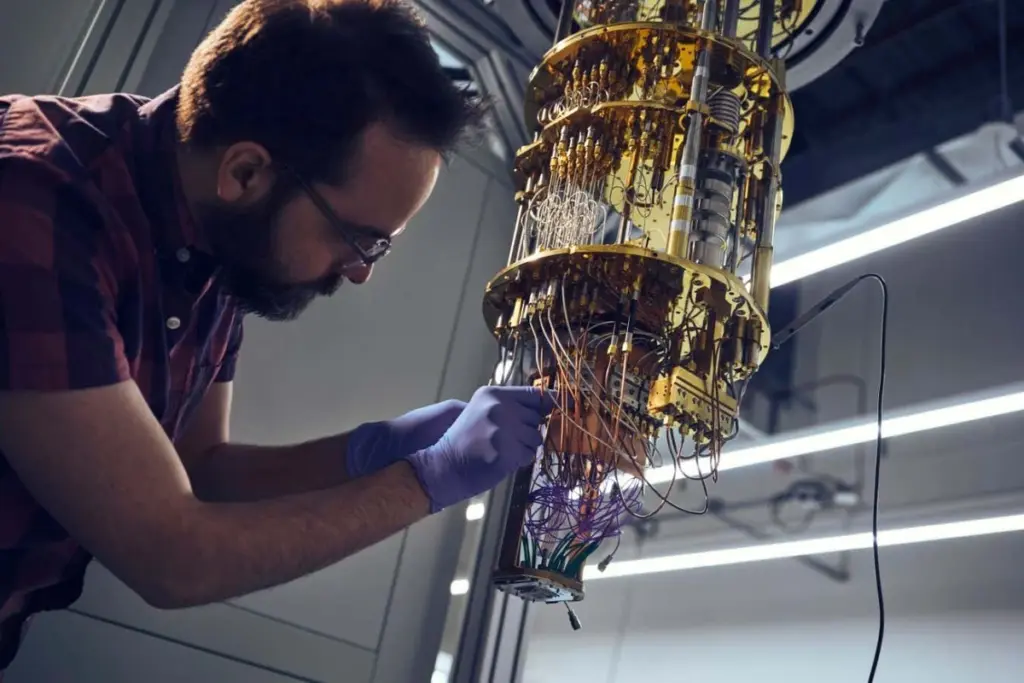
At its core, a superconducting quantum computer comprises a chip populated with superconducting qubits housed within a cryogenic refrigerator. Externally, such a system might appear as a single, sleek rectangular unit, often comparable in height to a person. However, the complexity extends far beyond this visible component. Qubits require precise control and continuous monitoring. Information must be fed to them from a conventional computer, and their computational outputs must subsequently be retrieved. Qubits are also inherently fragile and prone to errors; therefore, they necessitate error-correction algorithms. These algorithms demand sophisticated control systems capable of monitoring and adjusting numerous qubits concurrently in real time. Consequently, the non-quantum elements of a quantum computer are crucial for its operation, yet they occupy considerable space and consume substantial energy. Typically, alongside the refrigerator housing the qubits, numerous additional cabinets are required, filled with racks of energy-intensive conventional devices. A vast network of cables connects these quantum and non-quantum segments.
Increasing the number of qubits, a prerequisite for enhancing computational power, leads to a proportional increase in cabling. “Physically, you can’t just keep adding cables forever,” notes Shu-Jen Han, SEEQC’s chief technical officer. This constraint not only creates space limitations within the refrigerator but also introduces heat via each cable, which can disrupt qubit performance. The intricacies of qubit interconnection, control, wiring, and packaging, while seemingly mundane, have emerged as significant obstacles impeding the maturation of quantum computers.
The SEEQC chip, recently handled by the author, offers a potential solution to many of these challenges.
Visually, it resembles a conventional computer chip, small and flat, featuring a metallic rectangle atop a slightly larger one. Levy elaborated that the smaller rectangle houses the superconducting qubits, while the larger, a superconducting conventional computing chip, provides digital control over these qubits. As both components are superconducting, they can be integrated within the same refrigerator, obviating the need for many of the room-temperature devices that currently characterize quantum computer architectures.
Beyond the elimination of extraneous heat within the refrigerator, the superconducting control chip significantly reduces power consumption. SEEQC projects the potential for a billion-fold improvement in a quantum computer’s energy efficiency. Estimates from the Quantum Energy Initiative suggest that some designs for large-scale, fault-tolerant quantum computers could surpass the energy requirements of current conventional supercomputers—massive systems that fill entire rooms—with classical computing components being a major contributor to this energy demand.
The proximity of the quantum computing chip and its classical control counterpart facilitates reduced latency in transmitting instructions to the qubits. This integration also streamlines the readout of computational results and the application of error correction. Levy further indicated that the chip’s digital signal architecture is expected to minimize “crosstalk,” or unintended interactions between qubits, thereby reducing error rates.
In 2025, David DiVincenzo, whose seven conditions for building a working quantum computer, proposed nearly two decades prior, remain a guiding principle for researchers, shared his vision. He describes a powerful and useful quantum computer as a million-qubit device that could occupy entire rooms, resembling particle-collider facilities more than personal laptops or data center racks. SEEQC’s team is actively working to avert this projection of excessive scale, aiming for a design more akin to the Mac than the ENIAC for computing enthusiasts.
Currently, the SEEQC team is evaluating its chips in various configurations, utilizing qubits developed both internally and by external quantum computer manufacturers. Levy stated that initial tests have demonstrated consistent performance across different setups, highlighting the chip’s adaptability. However, these tests have been limited to a small number of qubits, typically fewer than ten, which is several orders of magnitude smaller than the scale anticipated for practical quantum computers in the future that the company aims to enable.
The inherent physics of superconductors also presents challenges. Under the influence of nearby magnetic fields, such as those used for qubit tuning, superconductors can develop tiny quantum vortices. SEEQC’s chief science officer, Oleg Mukhanov, described the company’s innovative method for mitigating this issue: the vortices are dispersed by an auxiliary electromagnetic field. This interaction evoked memories of graduate school lectures on superconductor physics, underscoring how even the most advanced technologies remain subject to fundamental quantum phenomena.
Could the resurgence of superconducting circuits propel us even further back in time? The present moment may indeed be opportune for the 1980s to re-emerge in the quantum computing landscape, albeit with the hope that fashion trends like shoulder pads remain firmly in the past.