
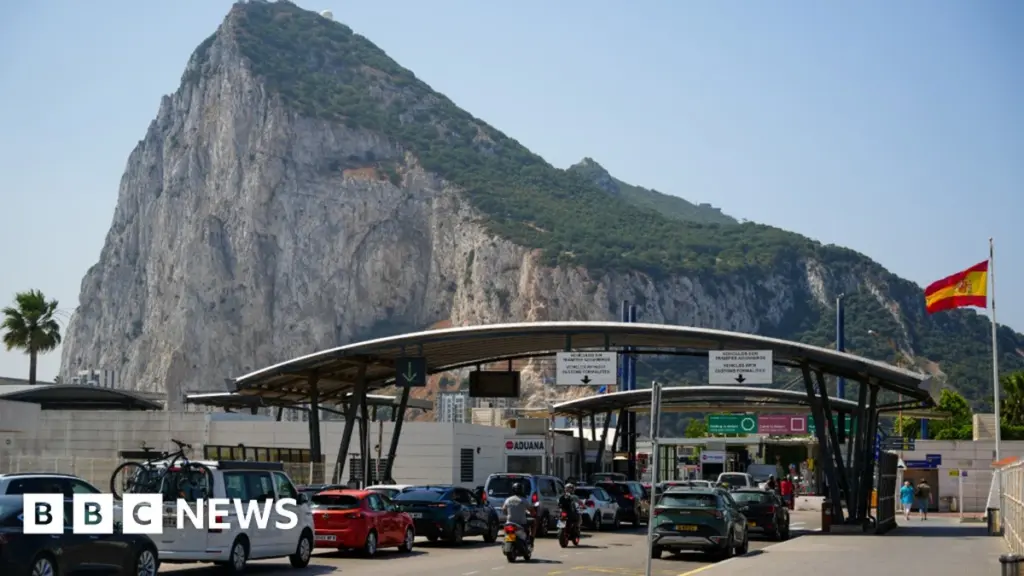
Under a new accord with the European Union, British travellers arriving in Gibraltar will be required to present their passports to Spanish border officials. This measure is part of an agreement to eliminate physical checks at Gibraltar’s land border with Spain.
Details of a Dual-Check System Confirmed
Specifics regarding a new framework for joint inspections at Gibraltar’s airport and port have been outlined in a draft treaty released on Thursday. The agreement aims to provide stability for the British overseas territory, which has faced uncertainty regarding its status for nearly a decade following the UK’s vote to leave the European Union.
Significant pressure to finalize a deal had been building as April approached, marking the full implementation of new passenger entry procedures for the passport-free Schengen zone. Gibraltar itself will not officially become a member of this zone, which encompasses 29 European countries, including Spain.
Spanish Role in Border Control
Instead, Spanish authorities are set to conduct “second line” checks, mirroring Schengen standards. These will take place within a designated area following initial border inspections performed by Gibraltarian officials. The draft treaty grants Spanish guards the authority to detain, search, and question travellers when deemed necessary for border control procedures.
This arrangement is expected to eventually lead to the dismantling of border infrastructure at the land crossing between Gibraltar and Spain. This particular border is a daily crossing point for approximately half of Gibraltar’s working population.
Analogy to Existing Transit Systems
The UK government has drawn a parallel between this new system and the operational model at London’s St. Pancras International station. There, Eurostar passengers undergo checks by both British and French immigration officers before boarding their journeys to continental Europe.
Tourism and Border Dynamics
British nationals constitute a substantial portion of tourists visiting Gibraltar. Data from the territory’s latest tourism survey indicates that in 2024, they accounted for 86.5% of all departures from Gibraltar’s airport.
Addressing Concerns Over ‘Operational Overreach’
Since Brexit, Spain has permitted residents of Gibraltar to cross the border without passport stamping. However, Gibraltar has periodically reported instances of tightened checks by Spanish police.
The original plan for April was for Spain to implement the EU’s new automated border system, which includes biometric screening, at its border with Gibraltar. The UK government previously stated that such measures would severely damage Gibraltar’s economy.
Political Reactions and Future Scrutiny
Gibraltar’s Chief Minister, Fabian Picardo, has expressed satisfaction with the agreement, noting that it provides “the certainty our people and businesses need.” In a statement to the House of Commons, Foreign Office minister Stephen Doughty highlighted the deal as an embodiment of a “new era of co-operation” with the EU since the Labour party assumed office.
Conversely, Conservative shadow minister Wendy Morton called for “proper scrutiny” of the treaty, raising concerns about preventing potential “operational overreach” by Spanish police.
Customs Procedures and Trade Implications
The government also indicated that a majority of goods headed for Gibraltar will be processed by EU customs offices located in Spain. This aspect of the arrangement is designed to eliminate the necessity for customs checks at the land border. Gibraltar was not included in the UK’s 2021 trade agreement with the EU, and it has previously been described by the UK as the “last piece of the EU exit jigsaw.”
Ratification Process Ahead
The draft treaty formalizes a political understanding reached between the UK and the EU in June of the previous year. It details how the new arrangements will function in practice. This version has been published for review while legal teams finalize their assessments and translations of the text. Ultimately, the treaty will require ratification by both the UK and European Parliaments.