
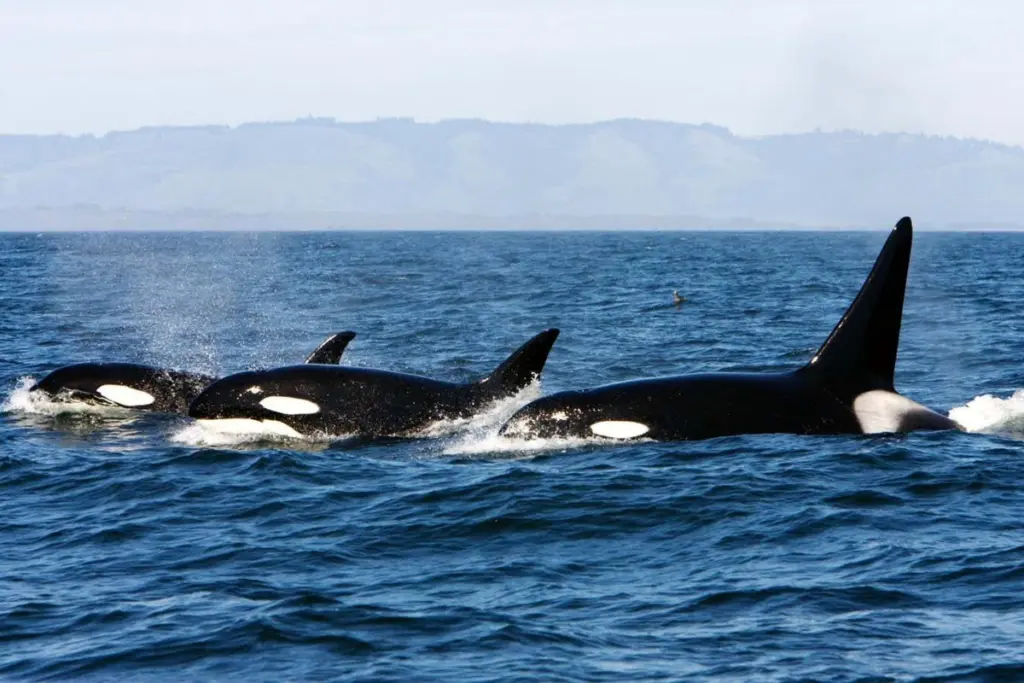
Biologists have observed instances of orca-on-orca predation in the North Pacific, a phenomenon that may offer an explanation for why certain orca populations travel in large family units.
Orca Subspecies and Social Structures
The North Pacific is home to two distinct subspecies of orcas, scientifically known as Orcinus orca. These are the transient or Bigg’s orcas and the resident orcas. Transient orcas, true to their name, are nomadic. They gather in adaptable hunting pods, coordinating to pursue prey such as seals, dolphins, and other whales. In contrast, resident orcas form large, stable groups centered around maternal lineage, remaining bonded with their original family throughout their lives. These residents typically disperse to feed on fish individually, reuniting for rest or travel.
Observations of Violent Encounters
While it is generally believed that these two subspecies rarely interact, Sergey Fomin of the Pacific Institute of Geography in Russia has documented evidence of aggressive encounters. During his observations along the beach of Bering Island in eastern Russia, Fomin frequently found gnawed dorsal fins from Baird’s beaked whales and minke whales, species that are common prey for orcas. However, in the summer of 2022, he was surprised to discover an orca’s dorsal fin on the beach, marked by blood and distinct tooth impressions. A similar finding occurred two years later.
Subsequent genetic analysis confirmed that these fins belonged to southern resident orcas. Fomin and his colleagues hypothesize that these whales were likely preyed upon by Bigg’s orcas.
The Enigma of Resident Orca Social Structure
Most toothed whale species exhibit social organization similar to transient orcas, forming pods whose composition can change over time. The reason for the southern residents’ propensity to form extensive family groups has long been a scientific puzzle. Olga Filatova at the University of Southern Denmark noted, “I was wondering about the social structure for a while because it’s quite unique, and there are not that many species that have something like this.”
A Hypothesis for Large Family Groups
Upon learning about the two dorsal fins and the potential for cannibalism, Filatova conceived an idea: perhaps resident orcas maintain large group formations primarily for safety in numbers. Collaborating with Fomin and Ivan Fedutin, she has published research outlining this concept.
Orca Social Dynamics and Aggression
As apex predators, orcas are seldom subjected to bullying. However, they have been observed being harassed and driven away by coordinated groups of smaller pilot whales. Intraspecific aggression is also documented; in 2016, Jared Towers of the marine research firm Bay Cetology in Canada witnessed a pod of Bigg’s orcas pursue and kill a newborn orca. Towers suggests this act may have been intended to induce sexual receptivity in the mother, as the calf was not consumed.
Towers concurs that the resident orcas’ distinctive social structure likely serves a defensive purpose. However, he expresses less certainty regarding the cannibalism hypothesis for the Bering Island fins. Researchers cannot definitively rule out that the fins were detached by sparring pod mates or that the whales died and were scavenged post-mortem. This latter scenario is considered less probable, given that deceased orcas tend to sink.
Potential Drivers of Orca Cannibalism
Speculation persists regarding the reasons why orcas might resort to cannibalism. Filatova posits that it could simply be a matter of opportunistic behavior driven by food availability. On Bering Island, the primary food sources are fur seals and sea lions. When these populations are scarce, orcas may seek alternative prey. Filatova commented, “If they can’t find any food, and there’s a young tasty resident killer whale alone, why not?”
Journal reference: Marine Mammal Science DOI: 10.1111/mms.70142