
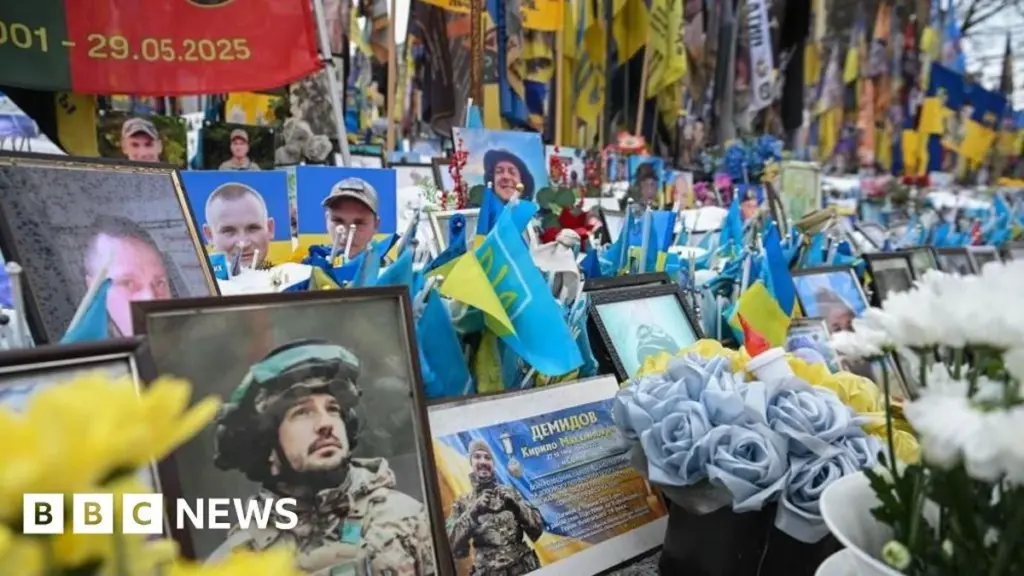
Ukraine is remembering its fallen citizens and soldiers as the full-scale invasion by Russia enters its fifth year. Commemorative events are being held across the country to honor those lost since February 2022.
The Ukrainian military continues its determined resistance against Russian forces, yet the conflict exacts a heavy toll, with mounting casualties on both sides. Ukrainian cities endure near-daily aerial attacks, a stark reminder of the ongoing hostilities.
President Volodymyr Zelensky addressed the nation, stating, “Ukraine never chose this war. We have defended our independence; we have not lost our statehood.” His remarks underscore the nation’s resolve in its fight for self-determination.
Meanwhile, the Kremlin, which had anticipated a swift victory, acknowledged that its war objectives “haven’t been fully achieved yet.” Russian authorities indicated their intention to persist with military operations in Ukraine. Spokesman Dmitry Peskov reiterated a common Kremlin narrative, asserting that Western support for Ukraine has escalated the conflict, transforming it into a “confrontation between Russia and the West.”
Currently, Russia occupies less than 20% of Ukrainian territory. Despite this, the Ukrainian military has successfully prevented Moscow from seizing the entirety of the eastern Donbas region.
Moments of Reflection and Solidarity
On a day marked by solemnity, President Zelensky was joined by prominent European allies, including Finland’s Alexander Stubb, Sweden’s Ulf Kristersson, and European Commission President Ursula Von der Leyen. A nationwide minute of silence at 10:00 AM brought Kyiv to a standstill, fostering a palpable sense of solidarity among its citizens.
In Kyiv’s Maidan square, a growing collection of flags has served as a memorial since the start of the full-scale invasion. On this day, banners were bowed, and heads were lowered, as individuals stood in quiet contemplation.
In Bucha, a town west of the capital that experienced some of the most brutal accounts of the full-scale invasion in 2022, a steady stream of people paid their respects by laying flowers at the headstones of fallen soldiers. Valentyn, visiting the graves of former comrades, reflected, “The war has taken a lot of lives. Unfortunately for us, it’s too many. No one thought it would last this long.”
The war’s impact resonates deeply across Ukraine. It has brought about immense loss on the battlefield, fragmented families, and forced citizens to seek warmth and light amidst Russia’s winter bombardment campaigns.
A Nation’s Resilience in Shadow
In a lengthy morning video address, President Zelensky appeared walking through subterranean corridors of the presidential palace in central Kyiv. These underground passages, adorned with pipes and cables, drew comparisons to Winston Churchill’s World War Two offices in London.
Acknowledging Ukraine’s immense sacrifice, Zelensky stated, “We have every right to say: we have defended our independence; we have not lost our statehood. Ukraine exists not just on the map.” The video offered a rare glimpse into the protected environment where the president and his staff have spent a significant portion of their time since February 2022.
Initially, many predicted a swift collapse of Zelensky’s government and the fall of Ukraine. However, four years later, Ukraine continues to hold its ground against advancing Russian troops, albeit at a substantial and increasing cost in manpower and resources for Moscow.
International Support and Diplomatic Stalemates
A meeting of the “Coalition of the Willing” took place on Tuesday, with numerous leaders participating remotely. This coalition, spearheaded by Britain and France, now comprises approximately 35 nations. Several member states have expressed readiness to deploy troops to Ukraine to ensure the stability of any potential ceasefire.
UK Prime Minister Sir Keir Starmer, addressing the leaders via video link, asserted it was a mistake to believe Russia held the advantage. He highlighted that over the past year, Russia had gained only 0.8% of Ukrainian territory, incurring a severe cost of half a million losses.
French President Emmanuel Macron, however, expressed skepticism regarding the prospects of achieving peace in the short term. “Let’s be lucid,” he stated. “There is no willingness on the Russian side to have a peace, and by the way, to have a robust and solid peace as we see it on our side.”
Despite multiple rounds of US-brokered negotiations involving Russian and Ukrainian delegates, a significant breakthrough remains elusive. Moscow’s insistence on Ukraine ceding sovereign territory in the east—territory for which thousands of Ukrainians have fought and perished—is unacceptable to many.
“When it comes to talks, there’s one person standing in the way of progress,” Sir Keir commented. “And that is Putin, and nobody but Putin.”
A joint statement from G7 leaders, including US President Donald Trump, reaffirmed their steadfast support for Ukraine, its territorial integrity, and its right to exist. This marked their first collective declaration on Ukraine since Trump’s re-election.
Challenges in Securing Peace
Ukrainian negotiators have spoken positively about American efforts to mediate a ceasefire and facilitate peace in Ukraine. Nevertheless, in the past year, Trump has frequently appeared to exert pressure on Ukraine to accept less favorable terms. His evident impatience with the lack of progress toward a ceasefire has led many to question his underlying convictions.
Kyiv believes that Moscow would only acknowledge American security guarantees, positioning these guarantees as crucial elements for any future peace agreement.
In his video address, President Zelensky reiterated his hope that the current occupant of the White House would one day visit Kyiv. “I know for certain,” he declared, “only by coming to Ukraine and seeing with one’s own eyes our life and our struggle, only then can one understand what this war is really about. And because of whom.”
Earlier that day, Zelensky emphasized Ukraine’s urgent need for interceptor missiles from the US to complement its American-made Patriot air defense systems. Russia’s aerial assaults in January and February appear to have depleted Ukraine’s missile reserves, leaving cities and energy infrastructure vulnerable during the harshest winter since the invasion began.
Human Cost of the Conflict
The number of both military and civilian casualties continues to escalate. The BBC has identified over 186,000 Russian soldiers killed in the war, though the true death toll is widely believed to be significantly higher, as many battlefield casualties go unrecorded.
UK Armed Forces Minister Al Carns described the war’s impact on Russia as “almost unimaginable.” He stated that UK Ministry of Defence estimates suggest Russia has sustained 1.25 million casualties overall, a figure he deemed likely conservative and exceeding the total US casualties from World War Two.
Last month, President Zelensky officially reported 55,000 Ukrainian soldiers killed on the battlefield. However, other Ukrainian sources, cross-referenced by the BBC, indicate that the number of Ukrainian fatalities could be as high as 200,000. Many of these individuals are now interred in the extensive military cemeteries now spread across Ukraine.