
The ongoing attritional conflict between Russia and Ukraine is now fundamentally defined by drone technology. Russia employs long-range kamikaze aircraft, while Ukraine counters with specialized interceptors. The battlefield has transformed from an artillery duel to a domain of first-person-view drone combat. Increasingly, ground-based robots are integral to delivering ammunition and supplies, launching offensive actions, and facilitating the evacuation of wounded personnel.
In the four years since Russia’s full-scale invasion, Ukraine has rapidly established a comprehensive industry and operational ecosystem dedicated to the design, manufacture, and deployment of a diverse array of sophisticated drones. New Scientist gained unique access to the pilot schools, research laboratories, and manufacturing facilities that constitute the operational core of this burgeoning sector. Kyiv’s ambition is not only to win the war but also to cultivate a profitable enterprise, exporting its expertise and hardware to Western nations once hostilities cease.
From Streetlights to Ground Robots: The Story of Ratel Robotics
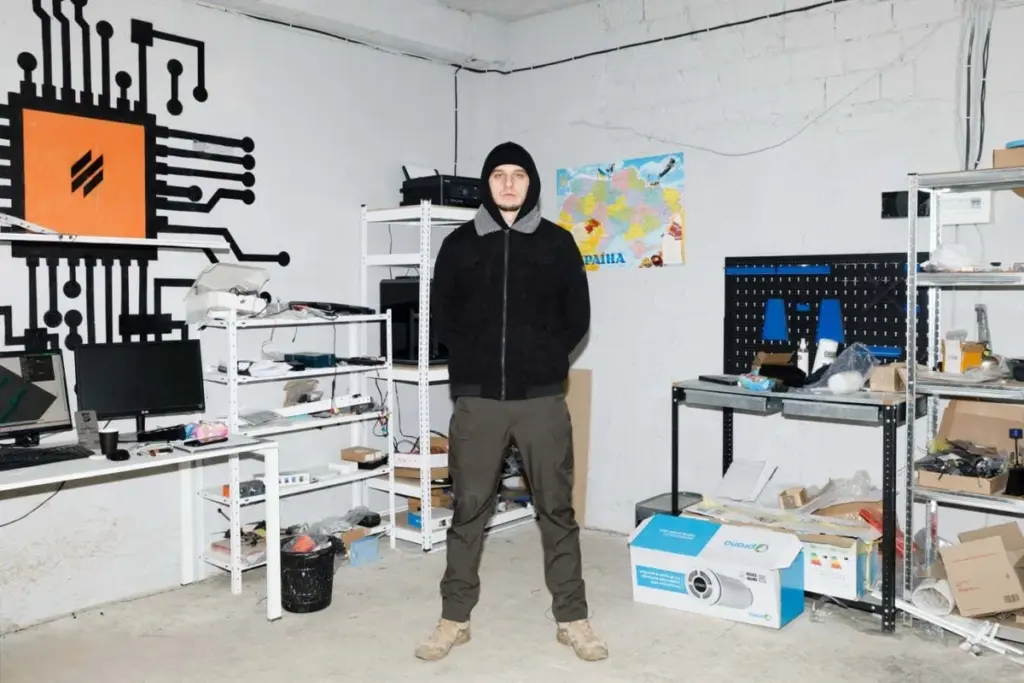
Taras Ostapchuk’s swift pivot from civilian entrepreneurship to military service reflects a common narrative in contemporary Ukraine. Prior to the conflict, he managed a company specializing in street lighting. He enlisted in the army in 2022, subsequently becoming an aerial drone pilot. An injury in 2024 curtailed his military career, but his drive to contribute persisted. He then founded a new venture focused on manufacturing drones, drawing knowledge from online resources like YouTube and various internet forums. His company, Ratel Robotics, now employs over 300 individuals and offers a range of ground drones designed for diverse tasks, including mine clearance, the evacuation of injured soldiers, and the transport of supplies and ammunition.
The author’s observation took place in an unassuming field on the outskirts of Kyiv, punctuated by the distant sound of machine gunfire from a nearby military training area. Early that morning, a van carrying a trailer arrived, and three individuals disembarked. Within minutes, two robotic machines, comparable in size to ride-on lawnmowers, were maneuvering under remote control.
The four-wheeled Ratel M and its larger, six-wheeled counterpart, the Ratel X, demonstrate surprising agility despite their size and are capable of executing 360-degree turns in place. The bigger model can transport up to 600 kilograms at a speed of 12 kilometers per hour over distances exceeding 100 kilometers. Its flat platform design allows for versatile cargo hauling, delivering essential supplies and ammunition while minimizing the exposure of human personnel and valuable vehicles to danger. Many forward positions are currently so susceptible to drone attacks that conventional petrol or diesel trucks, with their heat-emitting engines easily detectable by infrared cameras, represent easy targets.
Ratel’s drones are fully electric and operate almost silently at low speeds, emitting a soft whir as their velocity increases. Witnessing them ascend steep inclines, traverse muddy terrain, and engage in maneuverability exercises across the field was informative. A brief ride aboard one of these robots with two Ratel engineers demonstrated its responsiveness, effortlessly navigating the training ground despite the added weight. The potential relief offered by such machines arriving with critical supplies, or their role in evacuating wounded soldiers, is readily apparent. Furthermore, operators can manage these drones from kilometers behind the front line, or even from remote locations, utilizing Starlink satellite internet connections for a secure operational base.
Currently, 100 of these specific drone models are deployed on the front lines. While the precise details of their missions remain classified, one unit reportedly continued to function effectively even after sustaining damage to two of its wheels. Ostapchuk recounted an instance where one of his drones, loaded with 400 kilograms of explosives, silently approached a building occupied by Russian soldiers before detonation.
The destructive potential of a single unit is significant, yet its acquisition cost is remarkably modest. The six-wheeled Ratel H is priced at $55,000, a package that includes a trailer, a Starlink dish, a laptop, and a controller. Ostapchuk stated that a comparable system from a European manufacturer costs €350,000 and, during testing, proved less capable. Additionally, that European model relied heavily on components sourced from China, presenting a security concern that Ratel is actively addressing by developing its own motor technology. Ostapchuk emphasized the global implications of China’s role in manufacturing, suggesting that European nations should take responsibility for developing their own weaponry and robotic systems for future conflicts.
Ostapchuk noted a distinct advantage for Ukrainian defense firms: their direct engagement in active combat. This provides unparalleled opportunities for daily testing and immediate feedback, a powerful incentive for rapid research and development that surpasses any other motivation. The pressing threat of Russian advances serves as a constant impetus for innovation.
Warfare Ascends Skyward: The Dominance of Aerial Drones
While ground drones, such as those produced by Ratel, are gaining importance for Ukraine’s military, aerial drones are the primary instruments of the conflict. A military source based in Kyiv indicated that approximately 60 percent of all casualties on both sides are attributed to first-person-view (FPV) drones, operated by individuals viewing the battlefield through onboard cameras.
Among Russia’s most concerning armaments are the Iranian-manufactured Shahed drones. These unmanned aerial vehicles possess a hybrid appearance, resembling a cross between a missile and a small aircraft. One such drone, measuring 2.6 meters in length, was observed upright in a military hangar, evoking an imposing presence. Although visually intimidating, Ukrainian civilians have become accustomed to the persistent threat posed by waves of these drones, intentionally launched in large numbers to overwhelm air defense systems and strike homes, workplaces, and schools with their 15-kilogram payloads.
A woman encountered on a train to Kyiv described the nightly dilemma of whether to seek shelter during drone raids. She articulated the agonizing choice between prioritizing rest and ensuring survival, a decision that varies with each passing night. Social media channels provide updates on the type of bombardment occurring and identify targeted regions. From a hotel in the capital, the author heard multiple Shaheds intercepted by Ukrainian defenses, alongside others that penetrated the defenses, causing damage to nearby residences. Recalling the woman’s words, the author deemed the perceived distance of the strikes sufficient to remain in bed.
A scientist in northern Ukraine recounted the visual spectacle when machine gun fire from near the border intercepts a wave of Shahed drones. The scene is described as “like Star Wars,” due to the use of tracer ammunition with varying colors. Any Shahed drones that evade ground defenses face a final line of Ukrainian interceptor drones. To gain insight into these systems, the author met with Marko Kushnir from aerial drone manufacturer General Cherry at a cafe in Kyiv. Kushnir led the author to an unassuming office building housing a research, manufacturing, and testing facility. The precise locations of these factories are closely guarded, with General Cherry operating several similar sites across Ukraine. Kushnir shared that one facility was recently damaged by a Russian Shahed drone, whether through design or accidental targeting.
The company produces over two dozen drone models, each specialized for distinct roles. Several of these are specifically designed to intercept Shahed drones en route to Ukrainian cities. The “Bullet,” an interceptor drone that Kushnir highlighted, is shaped reminiscent of a 1950s science fiction spacecraft. It launches vertically like a conventional drone before transitioning to a horizontal flight path, reaching speeds of up to 310 kilometers per hour. Kushnir described its function as akin to a “drone missile” or “little rocket.”
General Cherry’s manufacturing facility presents a stark contrast to traditional defense company stereotypes, exhibiting the vibrant atmosphere of an internet startup. The workforce is predominantly young, occupying brightly decorated offices. The communal break room features amenities like a pool table, foosball, a game console, and a large television. However, the primary activity involves assembling components, attaching propellers, and installing batteries. The factory dispatches thousands of drones daily to support Ukrainian forces.
One sound-insulated room houses 90 3D printers operating continuously, seven days a week. These printers produce propellers, chassis, and various other components, consuming 500 kilograms of plastic filament weekly. Efforts are underway to install an additional 15 printers in this room, presenting a spatial challenge. In-house manufacturing of such parts not only reduces dependence on foreign suppliers but also allows General Cherry to rapidly implement design changes based on battlefield feedback.
Every available space within the factory is occupied by a vast array of drones, numbering in the thousands. Kushnir confirmed that these are manufactured, tested, and dispatched daily. While exact production figures are confidential, he stated that hundreds of thousands of FPV drones are consumed monthly, either by crashing into enemy targets or being detonated. He mentioned one group of 15 pilots that utilizes 25,000 drones each month.
“Two years ago, this felt like science fiction,” Kushnir remarked. “Three years ago, we had only three desks and produced 20 FPVs monthly; now, we manufacture over 80,000.” General Cherry currently employs hundreds of individuals across Ukraine, many of whom had no prior experience with drones before the war.
In a final section of the General Cherry facility, a netted enclosure serves as the testing ground for every drone. Two teenagers are stationed at an opening in the net. One systematically powers up each drone, establishing a connection with its controller and launching it into the enclosure. The other then subjects the drone to a rigorous 20-second test, involving rapid movements across the enclosure, spins in all directions, and a precise landing. This constitutes the initial flight of only two planned flights for these drones, as they are typically repurposed into shrapnel within days of reaching combat zones.
Inside Ukraine’s Drone Schools
The operation of these advanced drone systems necessitates skilled human operators. Many such individuals receive their training at the nation’s primary drone pilot school: the 3rd Assault Brigade’s “Killhouse Academy.” Following arrangements for a discrete observation, the author was escorted to an abandoned factory. A brigade member, identified only as “Radio,” explained that the academy, established just under two years prior as a basic drone pilot school, has evolved into a comprehensive training center. It takes new recruits, both civilian and military, and trains them as skilled pilots, ground drone operators, or engineers within a matter of weeks.
A variety of courses are offered, with multiple proficiency levels within each specialization. Student pilots begin in conventional classroom settings, mastering drone flight simulation using laptops or goggles, a process typically taking about a week. More advanced training occurs in a large warehouse configured with assault courses. These include simulated Russian tanks, mannequins dressed as soldiers, and numerous tires and hoops suspended to represent the confined and vulnerable spaces within bunkers or tanks that drones must target.
Subsequently, students transition to realistic mock-ups of bunkers, mirroring those utilized by drone operators on the front lines. They then practice flying actual drones outdoors, viewing their progress on video screens that are deliberately subjected to interference to simulate Russian electronic jamming effects.
The agility and speed displayed by these high-performance drones stand in stark contrast to the leisurely flight of commercial drones often seen capturing footage of tourist attractions. They launch, bank sharply, and accelerate towards the horizon with astonishing rapidity, often disappearing from view seconds after takeoff. An experienced pilot can navigate intricate obstacle courses at breathtaking speeds.
Shark, the head of the Killhouse Academy’s research and development laboratory, explained that effective drone pilots require sharp reflexes and an excellent memory. This allows them to retain information about enemy positions, areas prone to signal jamming, and optimal routes for navigating the front lines.
Shark elaborated on the rapid evolution of drone technology, with new innovations emerging every few months that fundamentally alter the nature of drone warfare. Examples include the implementation of fiber-optic cables to combat electronic jamming and the utilization of relay drones to extend the range of radio control signals. The latest advancement involves large “mothership” drones that transport and deploy several smaller, more agile drones closer to the front line, thereby enhancing their operational range and effectiveness.
It was within this facility that Shark identified a practical application for inexpensive commercial video broadcast screens as rudimentary drone detectors. Operating on common frequencies, these screens can alert soldiers to the presence of nearby Russian FPV drones. If they see their own image appear on the screen, it signifies an immediate threat.
Trusta, a 25-year-old diplomacy graduate, is currently undergoing repairs at the Killhouse Academy. She has concluded that diplomatic solutions are insufficient to resolve the ongoing war and intends to become a drone pilot, enlist in the army, and deploy to the front lines. She reports having completed nearly all available courses and is now awaiting the necessary paperwork for deployment. Trusta emphasizes that dedication to training and practice is paramount for aspiring drone pilots.
Historically, warfare has involved large, standardized armies equipped with uniform gear. However, Ukraine has adopted a markedly different strategy. Various army brigades and corps actively compete for funding and recruits, operating much like commercial enterprises and possessing the autonomy to procure and employ equipment that best suits their needs.
Drone warfare transcends matters of life and death, encompassing crucial economic considerations. If Russia expends $50,000 to launch a Shahed drone attack on Kyiv, Ukraine must intercept it using its own drones at a significantly lower cost. Failure to do so creates an incentive for Russia to sustain its aerial bombardment. By employing technology to render attacks ineffective or unsustainable, Ukraine can achieve periods of reprieve.
To ensure access to essential military equipment, the Ukrainian government established an innovative organization named Brave1. This program gathers frontline data on the performance of existing equipment, identifies shortcomings, and highlights operational gaps. It subsequently provides companies with intelligence, strategic guidance, and financial grants.
Brave1 also manages an online marketplace where various items, including machine guns, drones, electronic jammers, and body armor, are reviewed and available for purchase. Potential buyers can engage in discussions through Ukraine’s “situation awareness” software, Delta, which facilitates intelligence sharing among military personnel, security agencies, foreign intelligence services, and political figures. These exchanges focus on optimal deployment strategies and the capabilities of Brave1-provided equipment.
An unusual system rewards army units with “e-points” for verified destruction of Russian equipment or personnel. These points are tabulated in league tables and can be redeemed for new equipment. The point values for different targets are regularly updated, and Brave1 reportedly refrains from publicly disclosing the current list. However, recent social media posts suggest that eliminating an enemy tank currently yields 20 points, while a soldier is worth 12.
This gamification of warfare, while potentially appearing to trivialize the brutal conflict at first glance, represents a highly pragmatic approach to optimizing Ukraine’s limited resources against overwhelming adversaries. Individuals who excel at gaming often translate into proficient drone pilots, and gamification serves as a powerful motivator. Shark commented that gamers find the transition to drone piloting significantly easier.
Andrii Hrytseniuk, the head of Brave1, stated that at the onset of the full-scale invasion in 2022, only seven companies manufactured aerial drones in Ukraine. Currently, the department engages with over 500 such entities. Hrytseniuk affirmed Brave1’s commitment to meeting the military’s requirements, while maintaining a preference for product diversity rather than rigid standardization. He believes a wide array of innovative products reaching the market empowers soldiers to identify the most effective solutions. “Our strong conviction is that we do not need to coordinate,” he asserted. “The army units themselves determine their genuine needs.”
Brave1 collects extensive footage of drone attacks from across the conflict, subsequently analyzing it with artificial intelligence. Given that nearly every drone is equipped with cameras, this war is likely the most extensively documented conflict in history, despite the classification of most footage. Hrytseniuk explained their process: “We analyze the ‘why,’ question past decisions, and formulate new strategies to enhance effectiveness. While 155-millimeter artillery can remain relevant for decades, the lifecycle for drones is entirely different. A state-of-the-art drone designed today may have significantly reduced effectiveness within six months. The current innovation cycle is measured in months, sometimes even weeks, not years.”
Ukraine is responding to an initiated conflict by cultivating an entire industry it would prefer not to develop. Nevertheless, indicators suggest that upon the war’s conclusion, Ukraine could emerge as a global leader in a novel form of warfare, a domain currently being scrutinized intensely by Western governments. Every company interviewed reported active communication and negotiation with foreign states, and some mentioned European companies testing their equipment within Ukraine.
A prevailing sentiment indicates that Western nations are closely observing developments in Ukraine, recognizing that future conflicts will differ substantially from past experiences. A think tank analyst hinted that a European intelligence agency is diligently studying the software and hardware employed by both sides, seeking to gain valuable insights and practical experience.
“Europe and the civilized world are not prepared,” Hrytseniuk stated. “Only Ukraine and Ukrainian companies understand the mechanics and the necessary actions.”
He perceives an opportunity for Ukraine to assist Western governments by sharing its hard-won experience, technological advancements, and established processes. In March, Brave1 is scheduled to embark on a two-week tour of the United States, showcasing domestic drone companies to potential investors, with the ultimate goal of securing capital injections to further accelerate production.
Ostapchuk had initially intended to cease operations at Ratel once Ukraine achieved victory. However, the company has become a significant employer, and discussions are underway with firms in Europe and the United States, as well as governmental bodies in European nations, regarding shared manufacturing and knowledge transfer. “I am uncertain about the future after we win,” Ostapchuk admitted. “Currently, Ukraine is the only country in the world with the expertise to neutralize Russians, and we will instruct European nations on how to achieve this.”
Kushnir indicated that General Cherry has no plans to close its operations post-war. “These products offer a degree of hope for a positive future, not only for us but for every European country,” he said. “We understand the operational procedures, we can execute them rapidly, and we can establish factories exceptionally quickly – potentially in less than a month, resulting in a production facility with various lines. Globally, perhaps with the exception of Russia, this capability is unmatched.”