
The question of what it is truly like to engage in peace talks with Russia, especially amid the ongoing conflict in Ukraine, is one that many find themselves pondering. This concern gains particular relevance following numerous rounds of negotiations, which, four years after Russia’s full-scale invasion, have yielded limited tangible results.
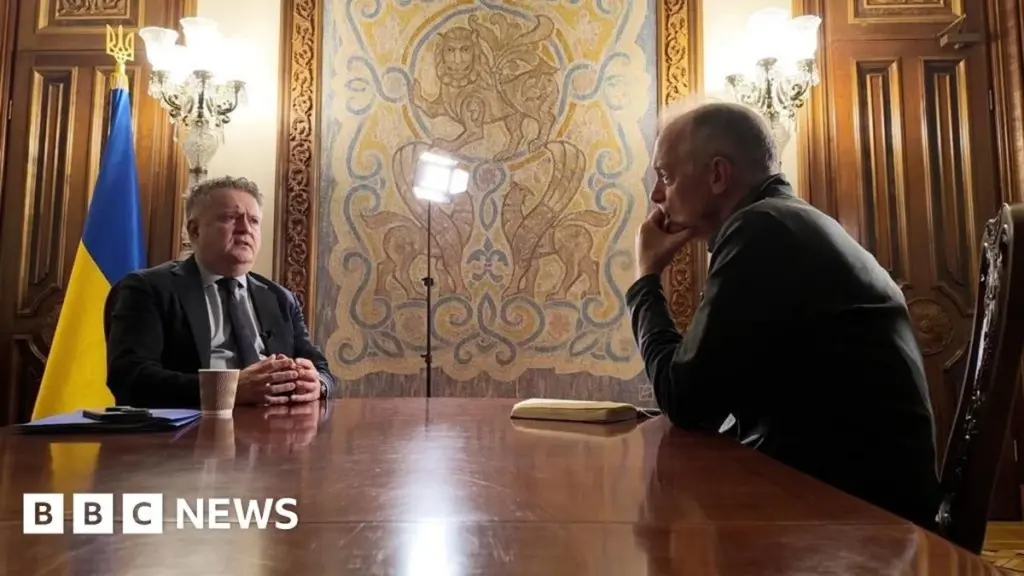
Another session of US-brokered discussions is anticipated in Geneva later this week. In anticipation, the BBC spoke with Serhii Kyslytsia, a member of Ukrainian President Zelensky’s delegation. Kyslytsia has participated in recent military-to-military discussions, offering a unique insight into these exchanges.
A Business-Like Approach Amidst Conflict
According to Kyslytsia, these interactions are largely business-oriented, conspicuously lacking the political and historical rhetoric often displayed by Moscow in other forums. He noted that military officials tend to possess a clearer grasp of the battlefield realities. “The military has a better understanding of what is going on in the battlefield,” he stated during a meeting at the presidential palace.
However, he also raised questions about the Russian side’s capacity to relay information accurately. “It’s another thing whether they [the Russians] are capable, or not, of reporting [back] directly…without cooking or changing the information,” he added. The complexity of ending a war is further amplified by the nature of the eastern Ukrainian battlefield. Thousands of drones patrol this vast “grey zone” between the two forces, while approximately 200,000 Ukrainian civilians remain in the heavily fortified cities of the Donbas. These conditions make the technical process of disengagement exceptionally challenging.
“You have to have a clear set of rules and protocols,” Kyslytsia emphasized, “and a way to verify and monitor.” He indicated that significant progress has been made on these fronts, largely due to the substantial involvement of US officials. This support includes figures such as General Alexus Grynkewich, NATO’s top commander in Europe, and Secretary of the Army Dan Driscoll.
American Engagement and Assistance
While it is not in Ukraine’s strategic interest to criticize representatives of the Trump administration, Kyslytsia’s praise for the US delegation’s efforts appeared sincere. “We have to credit the Americans for their commitment and their patience,” he remarked. “because they sit in the meetings non-stop. They don’t only observe…they put questions and they listen to our answers.”
Kyslytsia also expressed positive sentiments regarding the contributions of Donald Trump’s son-in-law, Jared Kushner, whom he described as “not a novice.” He was similarly complimentary about billionaire envoy Steve Witkoff, characterizing him as “a much wiser person than the caricature image you see in the media.”
The United States is positioned to play a crucial role in overseeing any future ceasefire, leveraging advanced monitoring capabilities such as satellite technology. “We need someone who will play the role of adjudication, because if there is a violation there should be a third party that is solid [and] authoritative,” Kyslytsia explained.
Lessons from Past Monitoring Efforts
For eight years preceding Russia’s full-scale invasion in 2022, the Organisation for Security and Cooperation in Europe (OSCE) undertook this monitoring role. However, the organization’s limited resources and inadequate enforcement mechanisms largely prevented it from curbing escalation. “It was quite an achievement [for them] just to have two UAVs flying over the territory,” Kyslytsia commented, contrasting it starkly with the present situation. “It’s kind of the Flintstones era compared to what we have today.” Recent reports suggest that up to 12,000 drones may be operational over a single city like Pokrovsk at any given time.
Personal Resolve in High-Stakes Diplomacy
As a former UN ambassador, Kyslytsia was asked how he managed to negotiate with representatives of a leader willing to incur substantial human cost to achieve objectives in Ukraine. He explained that years of prior diplomatic engagement had prepared him. “I saw much worse. I spent five years in New York, three of them before the full-scale invasion. I would sit in the room with the enemy on a regular basis.”
A particularly stark memory for him is February 23, 2022. During an urgent UN Security Council meeting concerning the unfolding crisis in Ukraine, he received confirmation that his country was under attack. Simultaneously, seven time zones to the east in Kyiv, the initial distant explosions signaled the commencement of Russia’s full-scale assault.
In the midst of that critical period, Kyslytsia attempted to urge Russia’s ambassador, Vassily Nebenzia, to contact Foreign Minister Sergei Lavrov to secure assurances against an invasion. Nebenzia’s response, according to Kyslytsia, was dismissive: “I’ve already said everything I know today. I’m not going to wake Minister Lavrov at this time.” This moment marked a profound shift for everyone. Kyslytsia remained at the UN for another three years before returning to Kyiv.
Should the delegations reconvene in Geneva on Thursday, Kyslytsia will be present, continuing to work on the technical aspects of a ceasefire. However, he acknowledges that the ultimate resolution hinges on a decision from the highest levels. “The war could be stopped by just one call of one person to his military chief of staff,” he stated. “But apparently, the Kremlin dictator [Russian President Vladimir Putin] is not up to stopping the war for the time being.”