
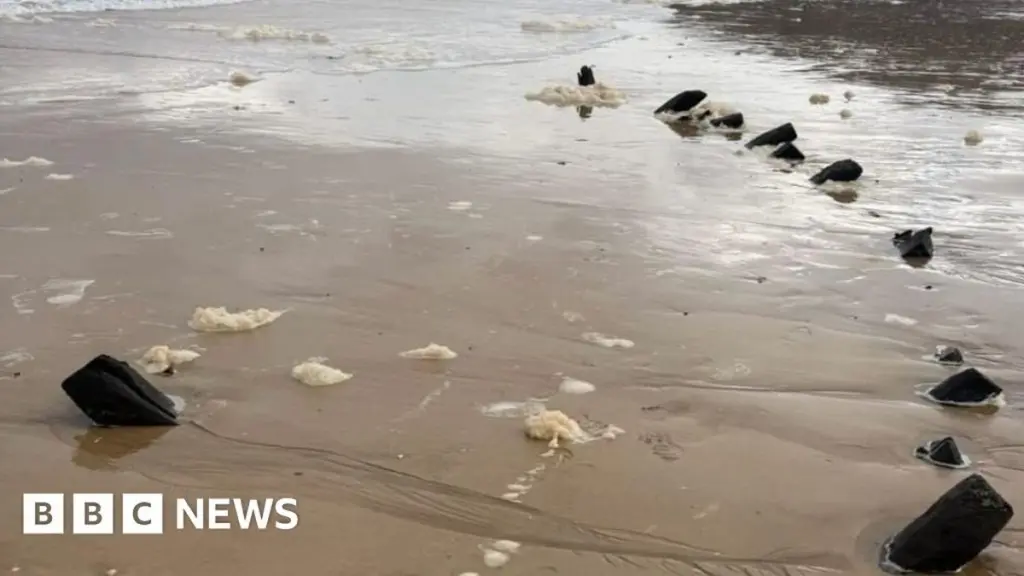
A potential discovery in County Donegal could unearth the final resting place of a Royal Navy frigate that sank over two centuries ago. In December 1811, the HMS Saldanha met its end off the coast, and the long-standing mystery of its exact location may finally be nearing a resolution. Recent powerful winds have reshaped the sands at Ballymastocker Bay in Lough Swilly, revealing what many believe to be remnants of the lost vessel.
The ship was last seen navigating a storm near Fanad Head before disappearing. Accounts from the time suggest all 253 crew members perished, with some newspaper reports from the period humorously noting only the captain’s parrot survived. Now, a wooden structure has appeared on the beach close to Portsalon, prompting an investigation to confirm its identity and its connection to the ill-fated Saldanha.
Discovery and Initial Investigations
Photographic evidence of the wooden structure emerged in recent weeks, as initially reported by the Tirconaill Tribune. Local archaeologist John O’Raw has a long-standing interest in the HMS Saldanha. His fascination began in 2000 when he and others discovered fragments of the ship while diving in the Donegal coastal waters. This led him to pursue an MSc in Maritime Archaeology at Ulster University. His postgraduate research included an in-depth study of shipwrecks, with the Saldanha being a significant focus.
O’Raw highlighted that historical accounts of the Saldanha might not be entirely precise. “Much of what was originally written about the Saldanha may not have been entirely accurate due to misinterpretations in newspapers from the time,” he explained to BBC News NI. “But now we know a lot more and it’s possible to unearth the truth.” He further detailed the ship’s final moments, stating, “We now understand the Saldanha entered the lough in hurricane-like conditions, impacted onto the cliffs south of Portsalon, and drifted up onto the beach in two separate main pieces.” He also noted that while locals and Crown forces recovered much of the ship in the days following the disaster, sections submerged below sea level remained beyond recovery.
According to O’Raw, the recently photographed wreckage could be a section of the ship’s starboard bow. He believes the visible timbers protruding from the sand are likely futtocks, which are individual curved pieces forming the structural ribs of a wooden ship’s hull.
Collaborating with fellow researchers, O’Raw is working with the National Monuments Service, the relevant authority, to formally identify the discovered structure.
The Fate of HMS Saldanha
HMS Saldanha was a British frigate, a 36-gun vessel that patrolled the Irish coast during the tumultuous Napoleonic Wars. The ship, accompanied by HMS Talbot, was en route from Buncrana. Their mission was to enforce a naval blockade against France in the North Atlantic when the maritime disaster occurred. On December 4, 1811, the vessel encountered severe storm conditions.
While attempting to seek refuge in Lough Swilly, the ship struck the elements. All 253 servicemen on board, including Captain William Pakenham, never returned. The loss of the HMS Saldanha directly led to the construction of Fanad Lighthouse. This navigation aid, first illuminated on Saint Patrick’s Day in 1817, has since guided vessels through the waters of Lough Swilly.
Local Interest and Commemorations
Journalist Anne Cadwallader, whose cottage is situated near Ballymastocker Bay, has been instrumental in organizing memorial tributes for the crew lost in the HMS Saldanha disaster. She shared with BBC Radio Foyle’s North West Today programme that very little of the ship was ever recovered. “The anchor is in Fort Dunree across in Inishowen, but very little other than that. She was smashed to bits on the rocks,” Cadwallader stated.
“Then recently, very bad storms and gales have exposed these timbers on the beach, and it has caused a huge amount of interest locally… that these timbers on the beach could be part of the Saldanha,” she added. “We’re all waiting to hear, to get confirmation of that.”
In 2011, the local community on the Fanad peninsula raised €1,500 to erect a monument near the wreck site. The following year, a commemorative plaque bearing the names of the crew was unveiled, utilizing information sourced from the National Archives in London. Cadwallader observed that aside from Captain William Pakenham, the remaining crew members were likely buried without individual ceremony in mass graves, believed to be an area now occupied by the Portsalon Golf Club.
“This happened in 1811, and all this time later people are still drawn to the story and the mystery,” Cadwallader reflected. She emphasized the harrowing experience of the sailors, noting, “The men entered the freezing cold water and blustering gales. One can only imagine the horrors they went through, and not a single one of them survived.” The profound tragedy, she concluded, naturally fostered numerous stories and legends surrounding the wreck of the Saldanha.
Next Steps for Identification
The National Monuments Service reported conducting an inspection of the suspected wreck site on February 7. This inspection involved “rapid recording” and the acquisition of precise location details. A spokesperson indicated that this data is being integrated into their Wreck Inventory of Ireland Database for review against existing wreck records in the vicinity. At present, they cannot confirm the identity of the wreck or provide a positive identification, as further assessment and dating analysis of the timbers are required.
The organization plans to return in March for more comprehensive recording. This follow-up visit is contingent on tidal conditions and weather, aiming for the most optimal on-site time for their work.