
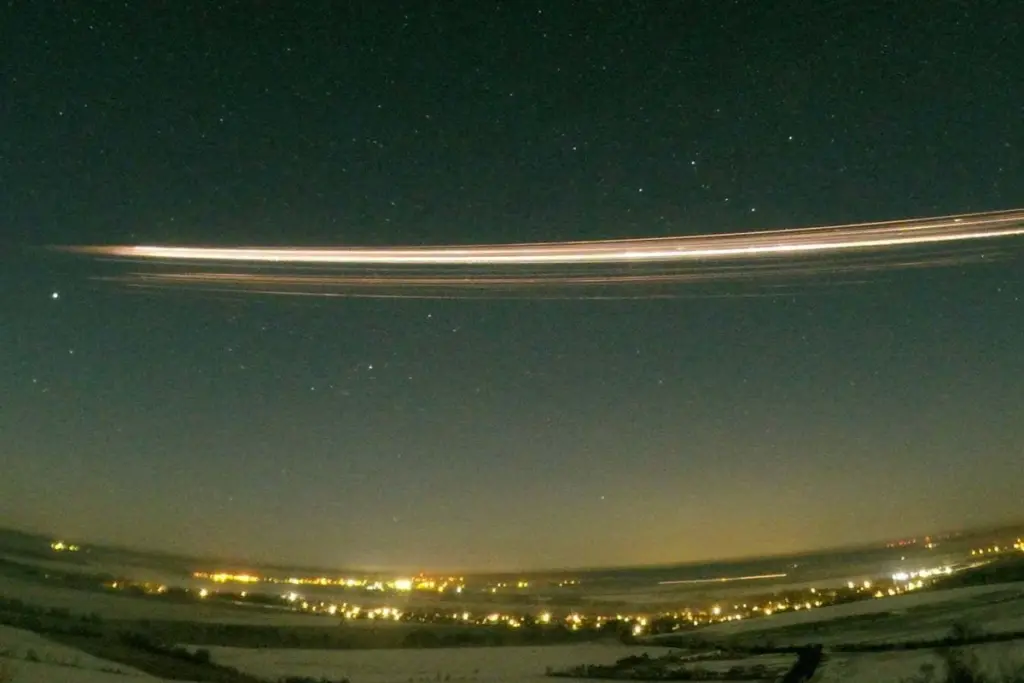
A SpaceX rocket, which disintegrated upon returning to Earth’s atmosphere, disseminated a significant plume of vaporized metals across Europe. This new form of atmospheric pollution is anticipated to escalate as the number of spacecraft and satellites continues to grow.
The upper stage of a Falcon 9 rocket, originally intended for a controlled splashdown in the Pacific Ocean to facilitate potential re-use, experienced an engine failure. This malfunction led to a loss of control in February 2025, causing the stage to descend from orbit over the North Atlantic.
Eyewitnesses across Europe observed streaks of fiery debris traversing the sky, with some fragments reportedly landing near a warehouse in Poland. Upon learning of these events, Robin Wing and his colleagues at the Leibniz Institute of Atmospheric Physics in Germany activated their lidar instrument, a device used for atmospheric observation. Within twenty hours, their equipment registered a tenfold increase in lithium levels within the upper atmosphere. This surge was attributed to the plume of vaporized metal as it drifted over their location. Lithium is a primary component in the construction of rocket hulls.
Atmospheric modeling conducted by the researchers indicated that this metallic plume had traveled approximately 1600 kilometers from the initial re-entry point of the Falcon 9. This study marks the first instance of high-altitude pollution being definitively traced back to the re-entry of a specific spacecraft.
Wing noted that these minuscule metal particles possess the potential to accelerate ozone depletion, contribute to cloud formation in the stratosphere and mesosphere, and alter the manner in which sunlight propagates through the atmosphere. However, he emphasized that these potential effects remain largely understudied.
Concerns regarding this category of pollution are intensifying due to the rapid increase in commercial space launches and the expansion of vast satellite constellations, such as SpaceX’s Starlink and Amazon’s Kuiper project. Currently, around 14,500 satellites are operational in orbit. In a recent development, SpaceX submitted an application to launch an additional one million satellites, a move aligned with Elon Musk’s objective to establish orbital data centers that would power artificial intelligence applications.
To mitigate the risk of a cascading series of collisions that would generate ever-increasing amounts of space debris, satellites are typically directed to descend and burn up at the conclusion of their operational lives. Experts project that the quantity of space debris particles could increase by a factor of fifty within the next decade, potentially surpassing 40 percent of the mass currently introduced into the atmosphere by meteoroids.
Daniel Cziczo, affiliated with Purdue University in Indiana and not involved in the study, pointed out a common misconception: that space debris simply disintegrates upon atmospheric entry and vanishes. He urged a more cautious approach, stating, “Let’s tap the brakes here, and let’s really do some thorough analysis of what effect this material could have.”
The plume generated by the Falcon 9 contained an estimated 30 kilograms of lithium. However, considering the alloy compositions of rocket hulls, a considerably larger quantity of aluminum would have been present.
The Growing Impact of Space Debris as a Pollutant
With the unprecedented number of satellites in orbit, their disintegration during atmospheric re-entry contributes to a novel form of air pollution. Emerging evidence now sheds light on the potential consequences and strategies for addressing this issue.
When vaporized, aluminum reacts with oxygen present in the atmosphere, forming aluminum oxide particles. These particles act as a surface upon which chlorine compounds can more readily break down. The resulting chlorine radicals then engage with and degrade ozone molecules within the stratosphere.
Researchers estimate that the burn-up of spacecraft releases approximately 1000 tonnes of aluminum oxide into the atmosphere annually, a figure that is projected to rise. This trend poses a threat to the recovery of the southern hemisphere’s ozone hole, which has been gradually shrinking due to international efforts to phase out ozone-depleting refrigerant gases. A diminished ozone layer could permit increased penetration of the sun’s ultraviolet radiation, a known cause of skin cancer.
Eloise Marais, from University College London, commented that in terms of metallic pollution, humanity is entering a new phase where the upper atmosphere is increasingly influenced by human-generated substances rather than natural origins. She further stated that space debris is beginning to counteract the progress made in healing the ozone hole.
The metal oxide particles can also function as condensation nuclei for water vapor, leading to the formation of ice crystals and the development of cirrus clouds in the upper troposphere. These clouds have a tendency to trap heat.
Scientists have indeed detected particles originating from burnt-up spacecraft within cirrus clouds. If these particles are indeed promoting cirrus cloud formation, it could exacerbate global warming, although this effect would likely be minor in comparison to that of greenhouse gases such as carbon dioxide.
Cziczo highlighted the growing body of scientific evidence suggesting detrimental effects on our atmosphere from these materials. He stressed that the current scientific imperative is to determine the precise nature of these effects and their severity.
Potential solutions are being explored, including the construction of satellites from alternative materials, such as wood. However, even such materials might release black carbon soot during re-entry. Another proposed method involves de-orbiting satellites into remote, high-altitude “graveyard orbits” at the end of their functional lifespan.
Wing emphasized the need for careful consideration of the consequences before widespread implementation, stating, “We need to take a little bit of time and think about what we’re doing before we do it.” He characterized the current surge in satellite launches as extremely rapid, with an incomplete understanding of the resulting impacts.