
The ‘Feedback’ section of New Scientist often highlights peculiar findings in science and technology news, inviting readers to contribute their own amusing discoveries by emailing [email protected].
Astrenomers and Misinterpreted Predictions
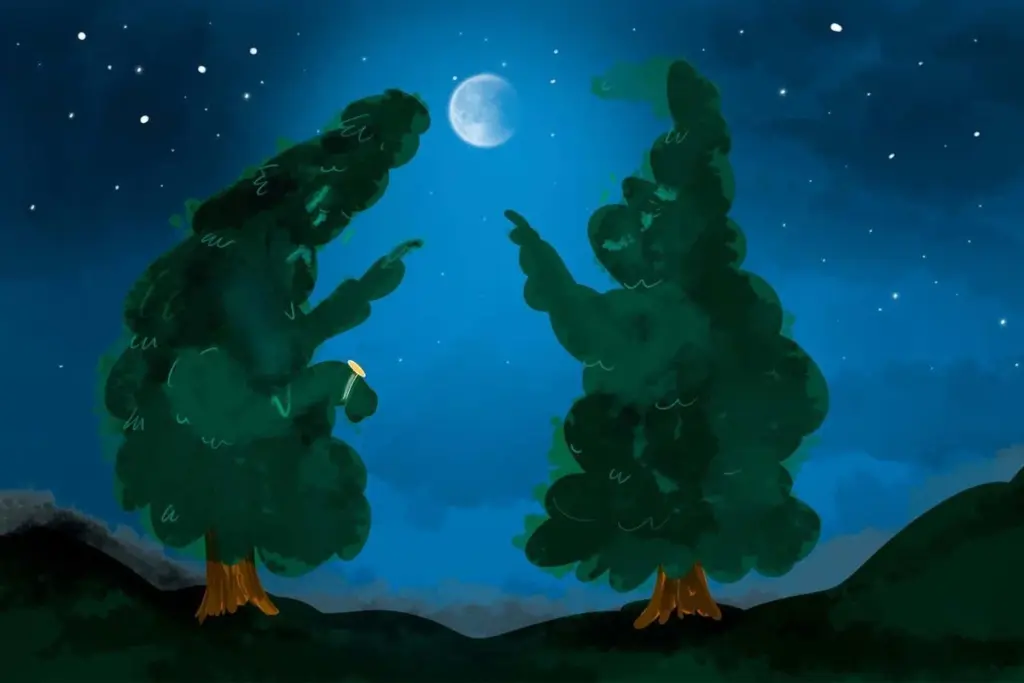
Feedback expressed surprise upon learning that a group of Norway spruce trees in northern Italy were not, in fact, capable of predicting a solar eclipse. This notion, while seemingly far-fetched, apparently gained traction among some individuals.
The solar eclipse in question occurred on October 25, 2022. Prior to this event, botanists, under the leadership of Alessandro Chiolerio, had placed electrodes into several Norway spruce trees. Their objective was to monitor the trees’ bioelectrical activity. In April 2025, they published their findings, claiming that “Trees anticipated the eclipse, synchronizing their bioelectrical behaviour hours in advance. Older trees displayed greater anticipatory behaviour with early time-asymmetry and entropy increases.”
However, this interpretation was met with skepticism. A counter-argument was published in Trends in Plant Science on February 6 by Ariel Novoplansky and Hezi Yizhaq, brought to Feedback’s attention by reporter Matthew Sparkes. They argued that the reduction in sunlight during the partial eclipse was too minor to influence the trees, as their leaves remained fully illuminated. Furthermore, they pointed out that eclipses of this nature occur on a cycle of just over 18 years. Considering the oldest trees in the study were approximately 70 years old, they would have only experienced three such cycles. This limited experience seemed insufficient for them to learn and anticipate a pattern, especially given the varying paths eclipses take across the Earth’s surface.
Feedback noted that the original study focused on a very small sample size: just three trees and five stumps. While sample size doesn’t always dictate the entire story, its significance in statistical analysis is undeniable. The paper also included a considerable section dedicated to “Quantum field theory theoretical analysis.” The authors explained that “Trees are open, and hence dissipative, systems, continuously exchanging (releasing and receiving) matter and energy in various forms with their environment.” They further elaborated that these are “aging systems, the origin in the time of their life cannot be moved and their time evolution (the arrow of time) cannot be inverted…” While extensive, Feedback admitted a personal disinclination to delve deeply into this aspect.
The article further explores the coincidence of the trees’ electrical activities synchronizing in the 14 hours preceding the eclipse. Novoplansky and Yizhaq proposed a potential explanation: a significant number of lightning strikes occurred between October 22 and 25, 2022, with three strikes recorded within 10 kilometers of the study site and within the 14-hour window before the eclipse. This meteorological event may have influenced the trees’ electrical responses.
Don’t Spill the Tea on Health Claims
Continuing a theme of questionable press releases, Feedback received an announcement concerning the health benefits of tea. The release stated, “The latest scientific research reveals that drinking a cup of tea daily benefits the heart, as well as growing evidence to support cholesterol levels, blood pressure, inflammation and blood clotting.” This news was received positively by Feedback, given their frequent tea consumption, and even more so by Mrs Feedback, for whom tea constitutes a significant portion of her daily fluid intake.
The source of this information was the Tea Advisory Panel. Feedback was unfamiliar with this group, but its website indicated that it is “supported by an [sic] restricted educational grant from the UK TEA & INFUSIONS ASSOCIATION, the trade association for the UK tea industry.” The panel’s stated purpose is to “provide media with impartial information regarding the health benefits of tea.”
The press release concluded with claims such as, “Previous research has shown that the sweet spot is four cups of tea a day… Yet, only a third of Brits (35%) said they drank three to four cups of tea a day … Therefore, our challenge as tea experts and nutrition scientists is to ensure the message about the heart health benefits of tea is clearly communicated to the general public.” Feedback, after relaying this information, expressed a sudden desire for an espresso.
Universal and Free Construction Kit
In an ongoing effort to identify exemplary and problematic technical acronyms, Feedback discovered a noteworthy initiative from researchers at Carnegie Mellon University in Pennsylvania. The fundamental concept revolves around the common issue of interoperability among construction-based toys like Lego and Stickle Bricks, where pieces from different systems typically cannot be connected.
Golan Levin and Shawn Sims developed open-source, 3D-printable adapters designed to bridge this gap. These adapters allow users with access to a 3D printer to download the designs for free and create their own combined toy components. This project aims to facilitate “radically hybrid constructive play, the creation of previously impossible designs, and ultimately, more creative opportunities for kids,” serving as “a public service unmet – or unmeetable – by corporate interests.”
Feedback believed this kit deserved widespread adoption. However, they speculated that its appeal to parents might be somewhat curtailed by the creators’ choice to name it the Free Universal Construction Kit.
Share Your Stories
If you have a story for Feedback, you can send it via email to [email protected]. Please remember to include your home address. This week’s and past Feedback articles can be found on the New Scientist website.