
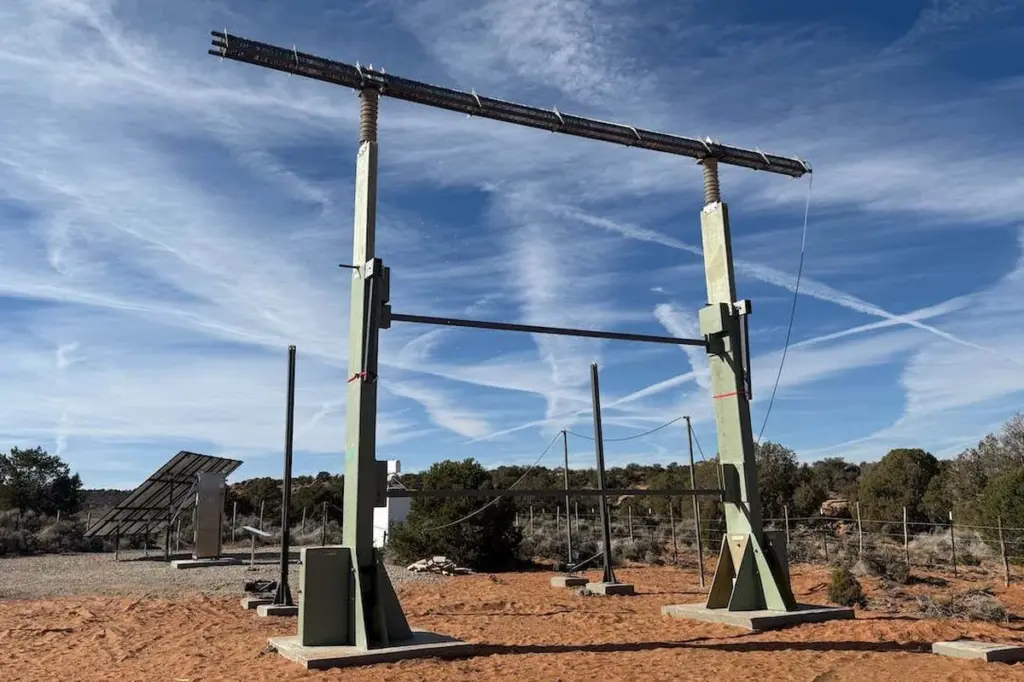
Western states like Utah are grappling with an alarming snow drought, sparking concerns about increased wildfire risks and critically low water levels in the vital Colorado River. Amidst this challenge, a startup company, Rain Enhancement Technologies, has introduced a novel approach: releasing negatively charged aerosols into the atmosphere, which they claim has led to a 20 percent increase in snowfall within a specific Utah mountain range.
The company conducted a comparative study across the La Sal mountains and the Abajo mountains, located 70 kilometers apart. Over five recent winter seasons characterized by a lack of snow, the La Sal mountains reportedly received an additional 9 centimeters of snow when Rain Enhancement Technologies operated its high-voltage ionizing array to the upwind side of the range in January. This observation is based on the snowfall recorded in the Abajo mountains during the same periods.
Scientific Scrutiny and Methodological Considerations
Despite these claims, the scientific community urges caution. Researchers note that such findings could be coincidental, emphasizing that it is premature to definitively assess the technique’s efficacy. “Cloud-seeding operations have been active for quite some time, and we are offering another means of enhancing precipitation… but one which doesn’t involve any chemicals,” explained Jeff Chagnon, meteorologist for the company. He further highlighted the operational advantages: “We also don’t have to fly into clouds… We can just flip a switch from anywhere in the world and operate for about 48 hours at a time.”
The broader context of water scarcity is significant. The United Nations has warned of a global “water bankruptcy,” projecting that up to three-quarters of the world’s population could face water shortages or contamination. Nations like Iran have resorted to aerial spraying of salts, such as silver iodide, in attempts to induce rainfall, a measure that has been met with unrest due to water scarcity. Similarly, nine U.S. states currently operate cloud-seeding programs.
Addressing Public Concerns and Technological Principles
However, the widespread use of silver iodide has drawn public concern regarding potential health impacts and has fueled mistrust due to conspiracy theories surrounding weather modification. Consequently, ten U.S. states have either banned or are considering banning cloud-seeding practices.
Rain Enhancement Technologies’ method involves passing 10,000 volts of electricity through a coiled wire situated between two 8-meter pylons. This process ionizes airborne aerosols—minute particles like dust, soot, or salt—by imparting electrons as they pass near the electrified wire. These electrified particles are then transported by wind into clouds.
In the natural process, water vapor within clouds condenses onto aerosols, forming droplets. For precipitation to occur, these droplets must grow and collide, eventually becoming heavy enough to fall. Often, however, droplets do not coalesce sufficiently and remain too small to overcome upward air currents, thus staying aloft.
The company’s central claim is that electrically charged droplets exhibit a stronger tendency to aggregate. According to Chagnon, when water droplets form around the negatively charged aerosols produced by their system, the electrostatic attraction between these charged particles accelerates the rate of collision and coalescence, thereby enhancing rainfall. This method, he clarified, does not create the upward air currents necessary for cloud formation but rather increases the water yield from existing clouds.
Historical Precedents and Ongoing Research
Evidence from the Cold War era suggested a link between atmospheric electrical charge and the growth of cloud droplets. A 2020 analysis indicated a 24 percent increase in rainfall over the Shetland Islands on days when widespread ionization occurred due to nuclear bomb tests.
Furthermore, a Rain Enhancement Technologies trial in Oman between 2013 and 2018 reportedly resulted in a 10 to 14 percent rainfall increase, depending on the statistical methods applied. An independent experiment in China, which dispersed negative ions from a comparable array, also reported an approximate 20 percent boost in precipitation.
Nonetheless, the World Meteorological Organization has voiced reservations, stating that while winter cloud seeding with salts has demonstrated effects on precipitation, the ionization technique still lacks robust scientific validation. Edward Gryspeerdt from Imperial College London commented, “It’s interesting that they have seen something that is consistent with a modification of clouds. But because precipitation, snowfall, rainfall is incredibly variable, there is always a significant chance that the effect they’ve seen has just happened by chance.”
Jeff French, from the University of Wyoming, suggested that the five dry years used by Rain Enhancement Technologies to establish a baseline in Utah might be insufficient to fully contextualize observed snowpack variations across different seasons. Similarly, Ibrahim Oroud at Mutah University in Jordan advised, “I would wait for further experimental studies and for more years to confirm the validity of ionisation as a catalyst for additional snow.”