
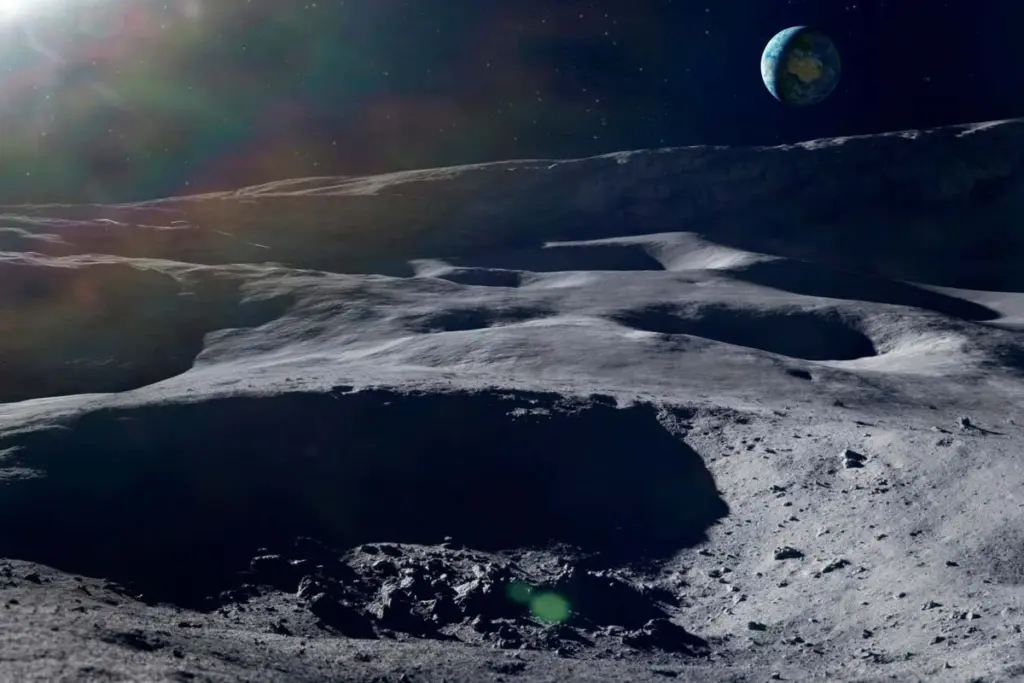
Scientists are exploring the possibility of constructing a laser within one of the Moon’s perpetually frigid craters. This laser aims to enhance precise navigation for lunar landers and rovers.
The Importance of Ultrastable Lasers
Ultrastable lasers are fundamental to timing and navigation systems that demand exceptionally high accuracy. Their operation relies on bouncing a beam of light between two mirrors housed within a cavity. The key to their stability lies in maintaining a consistent length for this cavity, which in turn keeps the light beam’s reflection rate highly precise. To achieve this, the mirrors are typically encased in a vacuum and kept at extremely low temperatures, shielded from external disturbances.
Lunar Cold Traps: An Ideal Environment
The Moon’s polar regions feature numerous craters that are permanently shadowed, meaning they never receive direct sunlight due to the Moon’s minimal axial tilt. These permanently shadowed regions (PSRs) are extraordinarily cold, with some craters estimated to reach temperatures around -253°C (20 Kelvin) during the lunar winter.
A Proposed Lunar Laser System
Jun Ye at JILA in Boulder, Colorado, and his team have put forward a proposal suggesting that these exceptionally cold lunar environments, combined with the Moon’s inherent lack of vibrations and nearly non-existent atmosphere, could make these craters an ideal setting for an ultrastable laser. Such a laser might achieve a level of stability surpassing anything achievable on Earth.
“The entire environment is stable; that is the crucial factor,” Ye stated. “Even as the Moon experiences its summers and winters, the temperature only fluctuates between 20 to 50 Kelvin. This represents an incredibly stable environment.”
Technical Aspects and Potential Capabilities
The laser device envisioned by Ye’s team would be analogous to optical cavities they have successfully developed in JILA’s laboratories. These devices feature a chamber, typically made from silicon, containing two mirrors.
Currently, the most advanced optical cavity lasers on Earth can maintain coherence—where the laser’s light waves remain synchronized—for only a few seconds. However, the researchers anticipate that a laser deployed on the Moon could maintain coherence for at least one minute. This enhanced duration would enable it to serve as a reference for a variety of lunar operations. These could include establishing a lunar timekeeping system or coordinating formations of satellites that employ lasers for precise distance measurements between them.
Ye further suggested its potential utility for Earth-based activities. Given that a laser beam takes just over a second to travel from the Moon to Earth, it could function as a reference point for terrestrial applications as well.
Expert and Implications for Lunar Exploration
Simeon Barber from The Open University in the UK commented that while implementing such a system presents challenges, the underlying concept is sound and holds significant promise for future lunar landings. “We have observed several recent lunar polar landings that encountered suboptimal conditions due to illumination, which impairs the effectiveness of vision-based landing systems,” Barber noted. “Utilizing a stable laser to support positioning, navigation, and timing could significantly improve the success rate of landings at high latitudes.”