
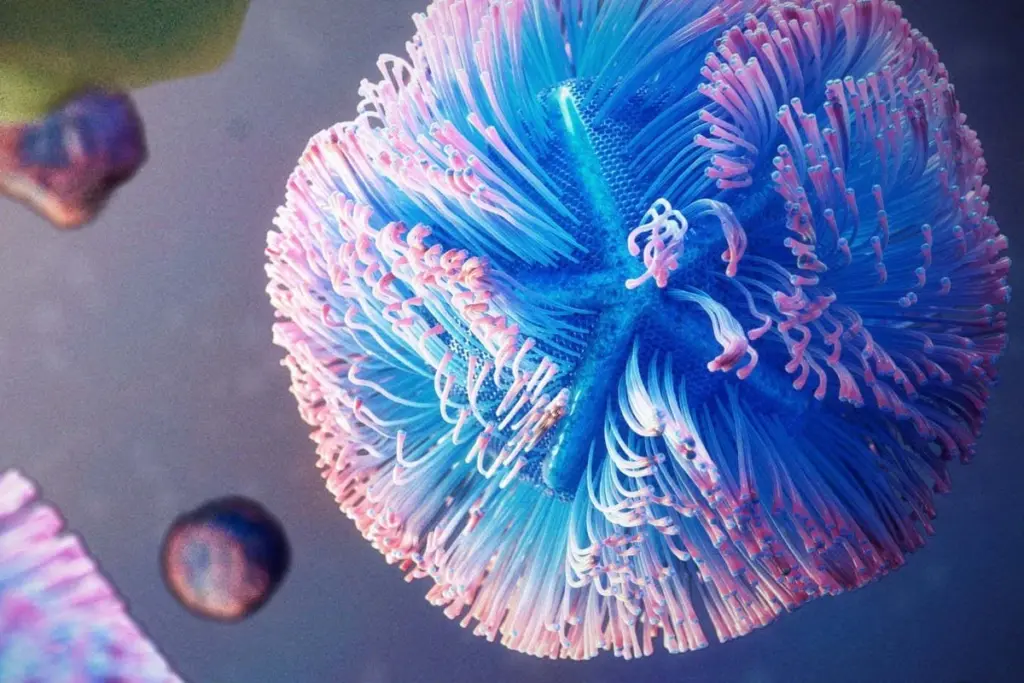
Viruses typically depend on their host cells’ molecular machinery to manufacture proteins. However, some giant viruses possess a unique capability: they encode crucial components of this protein-synthesis machinery within their own genetic material. This allows them to effectively commandeer the host cell, compelling it to produce more viral proteins.
This remarkable discovery further blurs the established definitions of life, presenting giant viruses as entities that occupy a space between the distinctly living and the inert.
Since 2003, giant viruses have captured significant scientific interest. That year marked the identification of a “mimivirus,” a microbe discovered in Bradford, UK, which infects amoebae. These viruses can exceed the size of many bacteria, exhibit complex structures, and carry hundreds of genes.
Among these numerous genes are those responsible for translation. Translation is the fundamental biological process that converts genetic code into functional proteins. Within cells, this process is orchestrated by complex molecular structures known as ribosomes and initiated by specific protein assemblies called initiation complexes.
To investigate whether giant viruses possess a comparable protein-synthesis system, researchers led by Max Fels at Harvard Medical School focused on the events occurring within infected amoebae. Their objective was to understand how the mimivirus manipulates the host cell’s machinery once an infection takes hold.
The research team isolated ribosomes from infected amoebae. They then meticulously identified viral proteins that were closely associated with these ribosomes. “This observation provided the initial indication that these viral components might be the factors we were searching for,” Fels commented.
Further experimentation involved inactivating the genes responsible for producing the viral translation complex. This was achieved by substituting the original DNA sequences with altered versions, thereby preventing the virus from manufacturing the corresponding proteins.
The consequences of this genetic manipulation were profound. Viral production plummeted by as much as 100,000-fold, and the subsequent formation of new infectious viral particles was severely hindered.
These collective findings strongly suggest that the viral translation complex plays a critical role in redirecting the host cell’s protein-synthesis machinery during infection. This redirection ensures the efficient and large-scale production of viral structural proteins. The experiments also indicated that this viral system can function effectively even under adverse conditions, such as nutrient scarcity and oxidative stress. These are precisely the environments that typically suppress protein synthesis in host cells.
This groundbreaking discovery opens up a significant evolutionary question: how did these giant viruses acquire such an advanced functional capacity? Current hypotheses suggest two main possibilities. One line of thought proposes that giant viruses are descendants of ancient cellular life forms that have since disappeared. Alternatively, some researchers believe they originated as conventional viruses that actively acquired genes from their host organisms.
“Giant viruses have incorporated a diverse array of cellular machinery from their eukaryotic hosts throughout their evolutionary history,” stated Frank Aylward of Virginia Tech, who was not directly involved in this particular study. Gene transfer is a known phenomenon during viral infections, and over vast geological timescales, natural selection can favor the retention of genes that offer a survival or reproductive advantage.
Giant viruses frequently infect single-celled organisms like amoebae. The cellular environment within these hosts can be highly variable, fluctuating far more than the relatively stable tissues found in multicellular organisms. Consequently, maintaining flexible control over protein synthesis could offer a significant selective advantage, according to Aylward.
Despite these advancements, several key questions remain unanswered by the current research. The mimivirus genome contains approximately 1000 genes, yet the precise functions of most of these genes are still unknown. For instance, the exact mechanisms by which these viruses regulate protein production throughout a single infection cycle are not yet fully understood.
“For a considerable period, viruses have been largely regarded as rather passive participants in the broader evolution of life,” observed Hiroyuki Ogata from Kyoto University in Japan. “This research fundamentally challenges that perspective, demonstrating that giant viruses possess the capacity to actively modify molecular systems that are otherwise remarkably stable and conserved across all major domains of life.”