
Lyudmila Navalnaya, the mother of the late Russian opposition figure Alexei Navalny, has stated that recent findings confirming her son died from poisoning validate her long-held belief that he was murdered.
On Saturday, the United Kingdom and its European allies issued a joint statement asserting that Navalny, who passed away in 2024, was killed using a poison derived from dart frog toxins. The statement specifically pointed to “only the Russian state” as possessing “the means, motive and opportunity to deploy this lethal toxin.”
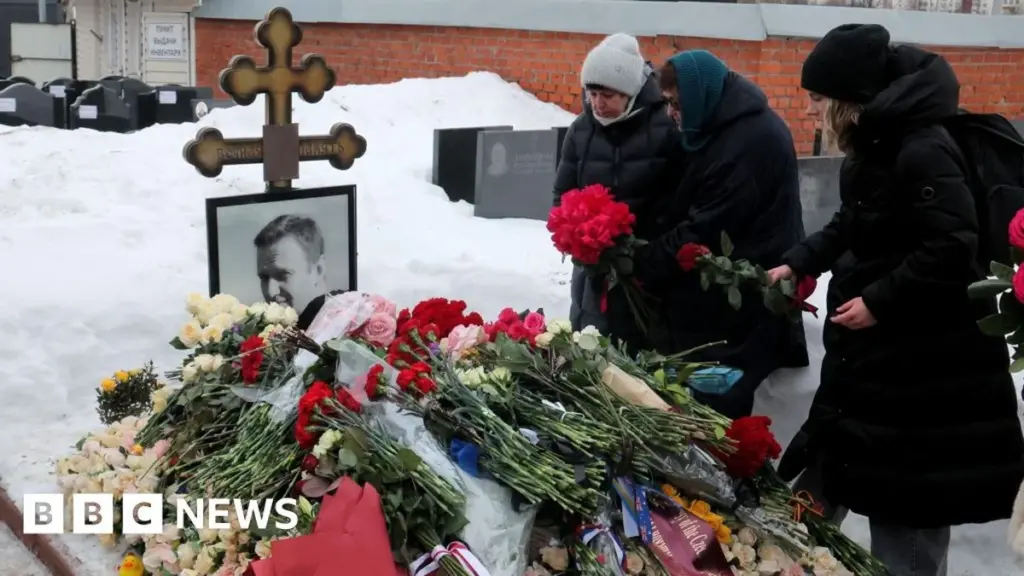
Addressing the pronouncements, Lyudmila Navalnaya visited her son’s gravesite in Moscow on Monday, the second anniversary of his death. “This confirms what we knew from the very beginning,” she stated. “We knew that our son did not simply die in prison; he was murdered.”
The Russian government has firmly rejected these allegations.
Kremlin spokesman Dmitry Peskov responded on Monday, stating, “Of course, we do not accept such accusations. We disagree with them, we consider them biased and unfounded. And, in fact, we resolutely reject them.”
Yulia Navalnaya, Alexei’s widow, also marked the second anniversary of his death. She posted on social media, “We have achieved truth and we will achieve justice one day too.” Earlier, she had indicated that analyses of smuggled biological samples, conducted by laboratories in two countries, revealed her husband had been “murdered.” She had challenged these facilities to release their findings at the time, a request the Kremlin did not address.
Dozens of Moscow residents, alongside several foreign diplomats, paid their respects at Borisovskoye cemetery on Monday, laying flowers on Navalny’s grave. A note left at the site read, “Alexei, we remember you every day.”
Alexei Navalny was 47 years old when he died. He was serving a 19-year sentence for “extremism” at the time of his death, in a Siberian penal colony.
A prominent and charismatic critic of President Vladimir Putin, Navalny led campaigns that exposed high-level corruption within the government. These efforts twice drew hundreds of thousands of people to the streets and established him internationally as Russia’s primary opposition figure.
He previously survived a suspected poisoning with the Novichok nerve agent in 2020, undergoing treatment in Germany. Navalny returned to Russia the following year, articulating a desire not to “give up either my country or my beliefs.”
Upon his arrival back in Russia, police arrested him. He died just over a year later in the Polar Wolf penal colony, located above the Arctic Circle.
At that time, the Kremlin maintained that Navalny had died of natural causes. Authorities initially withheld his body, but it was eventually released and he was buried in Moscow in March 2024.
His funeral was attended by thousands of mourners, who gathered despite potential risks of police action. This event marked the last significant public assembly for like-minded Russians.
Repression within Russia has steadily increased in recent years, particularly after Moscow’s invasion of Ukraine in February 2022. New punitive laws have been enacted, and acts of anti-government sentiment, whether through protests or online commentary, frequently result in lengthy prison sentences.
Many individuals associated with Navalny have either been imprisoned or have fled Russia. His widow, Yulia, who now leads Navalny’s Anti-Corruption Foundation, also faces potential arrest and resides abroad with their two children.
The Russian opposition in exile is characterized by political fragmentation and has encountered difficulties in presenting a unified front, with various factions experiencing public disagreements.