
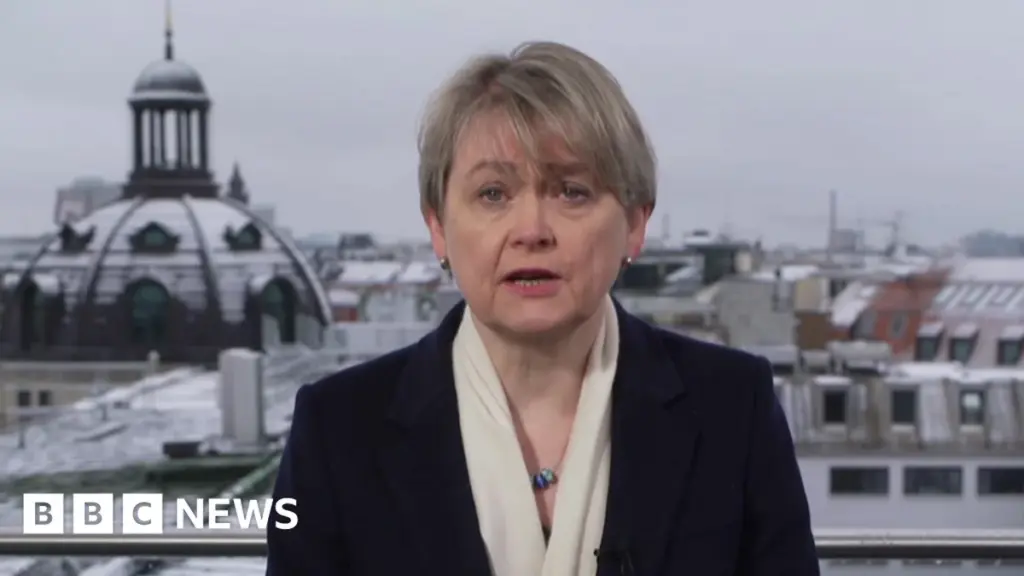
The United Kingdom is calling for concrete actions to be taken against Russia, following the emergence of evidence suggesting the state was responsible for the death of political prisoner Alexei Navalny, according to Foreign Secretary Yvette Cooper.
Navalny, a prominent critic of President Vladimir Putin, died two years ago while imprisoned in Siberia. He was reportedly held on unsubstantiated charges.
Recent findings from European laboratories have now confirmed that Navalny succumbed to a rare poison. Cooper stated that the Russian government possesses the exclusive “means, motive, and opportunity” to have administered such a substance.
Speaking to the BBC, Cooper described the identification of the toxin as a “clear breach” of international regulations regarding chemical weapons. She emphasized the UK’s desire to see “action” taken, which could potentially involve the continuation and expansion of coordinated sanctions.
Cooper is currently attending the Munich Security Conference with Prime Minister Sir Keir Starmer. During the conference, both leaders have urged European allies to bolster their readiness for conflict, particularly in response to threats emanating from Russia.
Confronting Russian Aggression
Addressing the potential consequences following evidence implicating the Kremlin in Navalny’s death, Cooper appeared on the “Sunday with Laura Kuenssberg” program. From a snowy rooftop in Munich, she articulated that Britain and its allies must prepare to counter Russian aggression, which she noted includes “the use of lethal toxins against their own citizens.”
“We have been pursuing the truth on this since Alexei died in prison,” Cooper stated, highlighting an effort to carry forward Navalny’s mission to “tell the truth, spread the truth” about the Russian administration under Putin. She asserted that this dissemination of truth is “the most dangerous weapon of all.”
“He is no longer able to do that, but that is why we are continuing to do that for him, and for his widow as well,” she added.
Moscow’s Denial and European Investigation
Moscow has consistently maintained that Navalny died of natural causes. However, Navalny’s widow, Yulia Navalnaya, has consistently asserted that her husband was “murdered” through poisoning.
The critical tests were conducted by five European nations using samples obtained from Navalny’s body, which were covertly brought out of the prison. These analyses revealed the lethal substance to be derived from a toxin found in Ecuadorian dart frogs.
The Russian embassy in London has refuted any involvement in Navalny’s death. In response to the announcement, the embassy characterized the claims as the “feeble-mindedness of Western fabulists” and accused critics of engaging in “necro-propaganda.”
Cooper, however, informed Kuenssberg that the use of poison constitutes “evidence of the aggression that is unfortunately going to be continuing” against Europe, and stressed the imperative to “be ready to respond to that.”
“A group of European ministers has now reported this to the Organisation for the Prohibition of Chemical Weapons for them to pursue because we see this as a clear breach of the chemical weapons international rules and convention so we do want to see action there, holding some accountability,” she explained.
Potential UK Actions and Broader Geopolitical Concerns
When questioned about specific actions the UK might take, Cooper indicated a continued focus on “co-ordinated action, including increasing sanctions on the Russian regime.”
“As you know, we have been pursuing this as part of our response to the brutal invasion of Ukraine, where we are also coming up to the fourth anniversary of that invasion as well,” she stated.
“We believe that it is the partnerships that we build abroad that make us stronger at home. It is by acting alongside our European allies, alongside allies across the world, that we do maintain that pressure on the Russian regime.”
In related commentary, senior Conservative MP Dame Priti Patel issued a warning about an “axis of authoritarianism” confronting the UK and other Western nations.
Speaking to Sky News’s “Sunday Morning With Trevor Phillips” before delivering a speech at the Munich Security Conference, the shadow foreign secretary outlined the geopolitical landscape. “We face major challenges on the axis of authoritarianism – that is Russia, China, North Korea and Iran,” she said.
Dame Priti further noted that the United States remains a “natural ally” and a “partner” for European powers.
Russian Embassy Reiteration of Denial
A statement released by the Russian embassy in London reiterated its complete denial of any role in Navalny’s death. The embassy declared: “There is no reason whatsoever to credit such ‘findings’ by Western ‘experts’.”
“As with the Skripal case, there are strident accusations, media hysteria, zero evidence, and a host of questions the accusers would rather ignore.”
“So what was it in the end – poison derived from the skin of a South American frog or Novichok?” the statement questioned.
The embassy’s statement continued: “We have become accustomed to the feeble-mindedness of Western fabulists. One must ask what kind of person would believe this nonsense about a frog.”
“Yet what truly shocks is the method now favoured by Western politicians – necro-propaganda. This is not a quest for justice but a mockery of the dead.”
“Even after the death of the Russian citizen, London and the European capitals cannot allow him to rest in peace – a fact that speaks volumes about those who instigated this campaign.”