
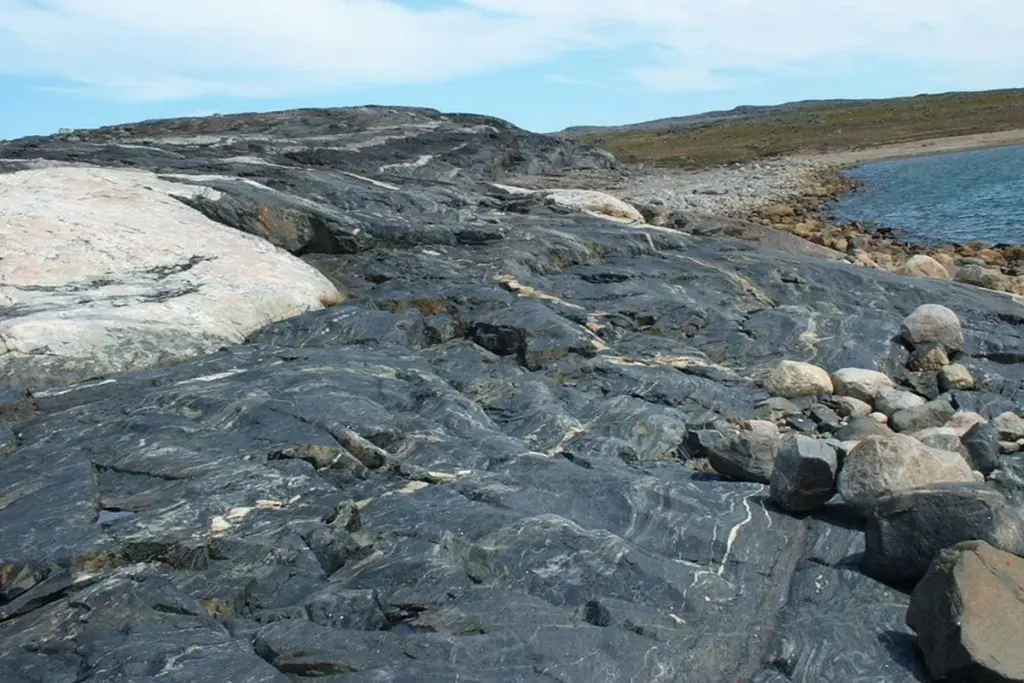
Approximately 4 billion years ago, molten rock from Earth’s mantle forced its way into a rupture within the planet’s nascent crust. Over subsequent eons, almost all of this early crust reabsorbed into the mantle. However, a small region surrounding that initial fracture managed to persist, surviving to the present day.
This narrative emerges from a recent analysis of radioactive isotopes found within this rock formation. Accessible on the surface as part of the Nuvvuagittuq Greenstone Belt, located along the shores of Hudson Bay in Canada, this material is the focus of a long-standing geological debate. The central question is whether it represents the world’s oldest rock, or simply an incredibly ancient one.
The contention began with a 2008 study by Jonathan O’Neil at the University of Ottawa and his colleagues. Their estimation placed the age of rocks surrounding this intrusion at around 4.3 billion years. Such an age would indeed designate them as the world’s oldest, forming during the Hadean Aeon, mere hundreds of millions of years after Earth’s formation itself.
While older mineral grains have been identified, complete Hadean rocks would provide an unprecedented view into Earth’s earliest history. They could potentially illuminate long-standing geological mysteries, such as the origins of plate tectonics and the composition of Earth’s initial oceans.
However, the radiometric dating method employed in the initial research proved controversial. Conventionally, very ancient rocks are dated using zircon, a resilient mineral that retains its original chemical structure over vast timescales. These particular volcanic rocks, unfortunately, did not contain zircon. “We can’t date these rocks using that technique that everybody loves,” O’Neil commented.
Instead, his team measured the abundance of neodymium and samarium isotopes within the rock. Samarium undergoes radioactive decay, transforming into different isotopes of neodymium at predictable rates. The ratio of these samarium and neodymium isotopes present in the rocks acts as a chronological marker, indicating the time elapsed since the rock crystallized from magma. The study utilized two samarium isotopes, each decaying at a different rate, effectively providing two independent age indicators.
The challenge arose because these two isotopic clocks yielded inconsistent age estimates for the rock. This discrepancy led many researchers to question the initial claim that the rock was indeed Hadean. Richard Walker, a researcher at the University of Maryland, noted, “I don’t think a majority of the early-Earth-studying community was convinced.”
A New Approach and a Refined Estimate
In response to these doubts, O’Neil and his colleagues have now analyzed neodymium and samarium isotopes in rocks that have intruded into the layer previously identified as potentially 4.3 billion years old. By geological definition, intrusive rock bodies are younger than the strata they penetrate. Therefore, dating the intrusion would establish a minimum age for the surrounding, older rock.
Significantly, within this intrusive rock, the two isotopic clocks provided concordant results. The rock dated to approximately 4.16 billion years old. “Both clocks are giving the exact same age,” O’Neil stated. This consistency lends stronger support to the hypothesis that the surrounding rock originated during the Hadean Aeon, potentially making it the sole surviving fragment of Earth’s primordial crust.
Graham Pearson of the University of Alberta in Canada remarked, “I think they make as good a case as you can make.” Similarly, Jesse Reimink at Pennsylvania State University suggested, “The simplest explanation for this data is that these are the oldest rocks in the world.” Nevertheless, he cautioned that definitive conclusions in this field are rare, adding, “When dealing with the oldest rocks and minerals, there’s no such thing as settled.”
Journal reference: Science DOI: 10.1126/science.ads8461