
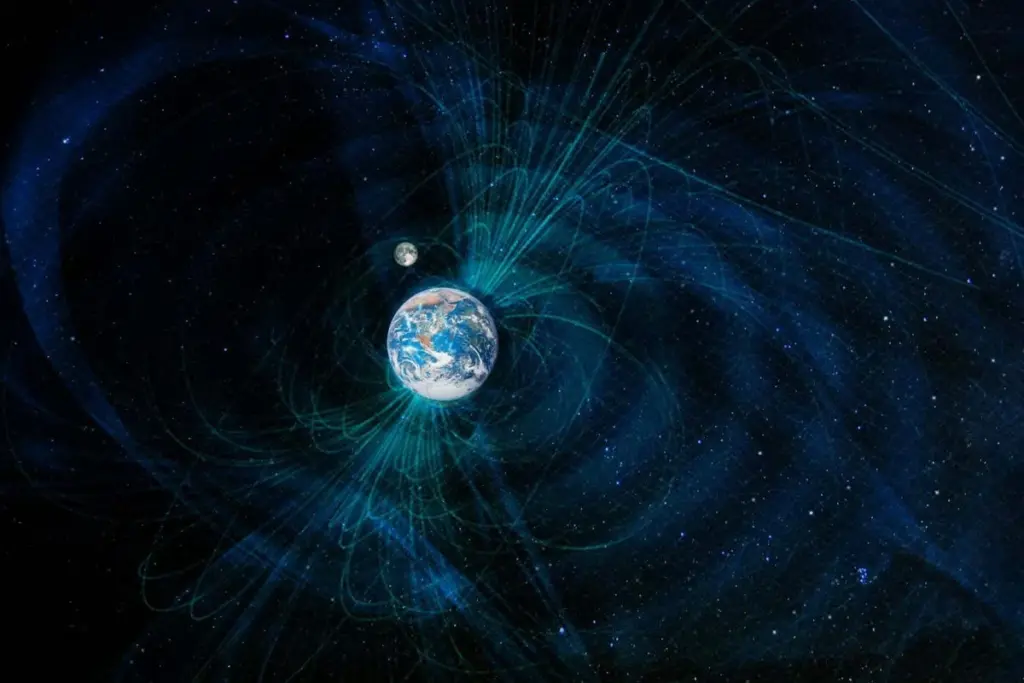
Two immense, enigmatic masses of superheated rock situated deep within Earth’s core are strongly implicated in the generation and long-term asymmetry of our planet’s magnetic field. For a considerable duration, scientists have been aware of these two colossal, continent-sized rock formations. One resides beneath the African continent, while the other is located under the vast Pacific Ocean.
These geological features extend vertically for approximately 1,000 kilometers, bridging the gap from the outer core to the overlying rocky mantle. Their distinct composition, differing from the surrounding material, is evidenced by the slower propagation of seismic waves passing through them. However, their extreme depth has historically made precise measurement and definitive identification of their unique characteristics challenging.
Andrew Biggin, along with his research colleagues at the University of Liverpool in the UK, turned their attention to Earth’s magnetic field for potential insights. This field, which has been a constant presence for billions of years, is a direct result of the turbulent motion of molten iron within our planet’s core. It extends tens of thousands of kilometers into space, providing a crucial shield against harmful solar winds and cosmic radiation.
The precise configuration and strength of this magnetic field are intrinsically linked to the amount of energy—specifically heat—transferred from the scorching core to the cooler regions of the planet’s exterior. Biggin and his team hypothesized that by meticulously examining historical shifts in the magnetic field, they could deduce information about the patterns of heat flow within Earth’s deep interior.
Reconstructing Earth’s Magnetic Past
To reconstruct the historical behavior of Earth’s magnetic field, the researchers compiled data from ancient volcanic rocks. These rocks, through processes of solidification, effectively record the direction of the magnetic field at the time of their formation. By analyzing samples from various geological periods spanning hundreds of millions of years, they were able to compile a detailed timeline of the magnetic field’s evolution.
Following this data collection, the team conducted intricate computer simulations. These simulations modeled the flow of heat through Earth’s core and mantle and the resulting generation of a magnetic field. Crucially, these simulations were run in parallel, with one set incorporating the presence of the massive, hot rock blobs and another set omitting them. The outcomes of these simulated magnetic fields were then rigorously compared against the actual historical magnetic field data derived from the volcanic rocks.
The results were compelling. The simulations that included the planet-sized rock formations demonstrated a far superior alignment with the ancient magnetic field records. Biggin explained that, “These simulations of the convection that’s happening in the core, that’s generating the magnetic field, can reproduce some of the salient features of the [magnetic] field, but only when you impose this strong heterogeneity in the amount of heat that’s flowing out of the top of the core.”
Essentially, this suggests that these particular regions have likely been significantly hotter than their surrounding areas for extended periods, possibly hundreds of millions of years. This elevated temperature would have impeded the natural flow of heat between the core and the mantle. According to the team’s simulations, this altered heat flow pattern was instrumental in both generating and maintaining the stability of Earth’s magnetic field.
Asymmetry in Earth’s Ancient Magnetic Field
For a long time, the prevailing geological assumption has been that Earth’s magnetic field has historically maintained a largely symmetrical form, comparable to the simple dipole of a bar magnet found in a compass. However, Biggin and his team’s analysis of historical magnetic data revealed a different picture. They found that, on average, the ancient magnetic field was not symmetrical. Instead, it exhibited persistent, systematic deviations that spanned millions of years.
These prolonged asymmetries appear to be a direct consequence of the presence of these two massive rock formations within the core. The implications of this finding are significant for geological science. It could necessitate revisions in how geologists reconstruct the movement of ancient rocks and offers new insights into the long-term evolution of Earth’s deep internal structures.
Should the team’s conclusions prove accurate, the temperature variations observed within these core blobs might also be present at specific interfaces within Earth’s outermost core. Biggin suggests that such temperature differences could potentially be detected using seismic wave analysis. However, this endeavor presents considerable technical hurdles.
Sanne Cottaar, a geophysicist at the University of Cambridge, expressed cautious skepticism regarding the feasibility of directly observing these deep core variations. “I have my doubts,” she remarked. “It’s very challenging for us to map variations within the core, given we have to look through so much mantle material before we see it.” The substantial thickness of the mantle acts as a significant impediment to detailed observation of the core’s inner workings.
Journal reference: Nature Geoscience DOI: 10.1038/s41561-025-01910-1