
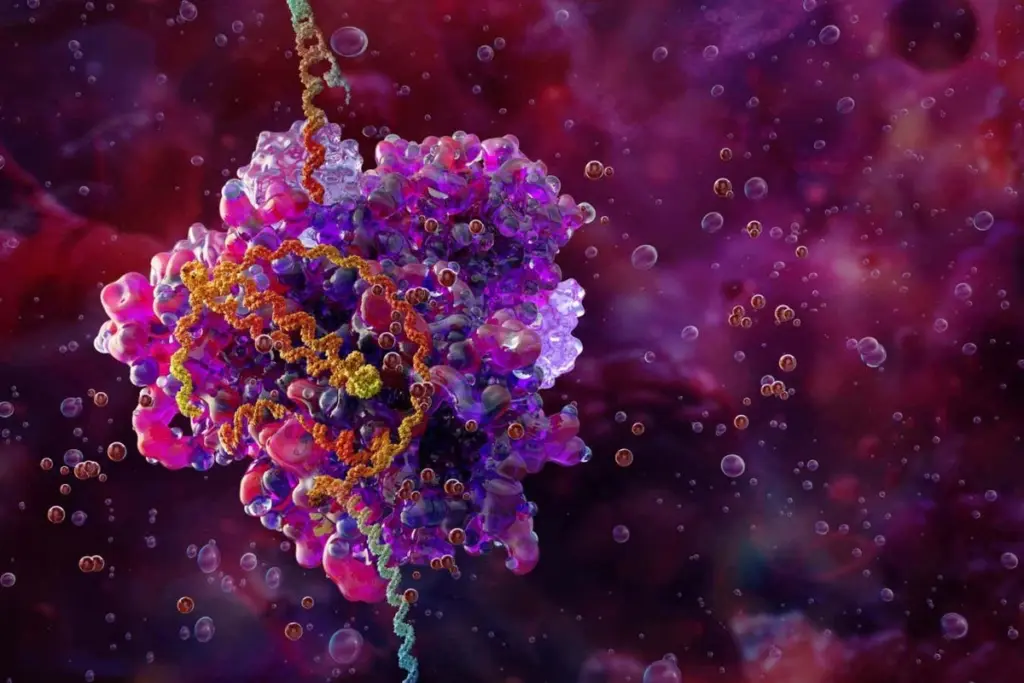
Imagine a postal worker delivering leaflets. Instead of reaching each home individually, they could hand one batch to a volunteer on each block. This volunteer would then make photocopies and distribute them to their neighbors. This method would dramatically increase the number of homes receiving the leaflets. Scientists are now exploring a similar strategy to enhance gene editing’s effectiveness in treating a wide array of diseases.
The core concept involves a single cell, the initial recipient of the gene-editing machinery, producing numerous copies of this technology. These copies would then be disseminated to neighboring cells, amplifying the therapeutic effect. The ultimate goal is to enable disease-correcting modifications to be made in a greater number of cells within the body.
In recent experiments conducted on mice, researchers at the University of California, Berkeley, including CRISPR gene-editing pioneer Jennifer Doudna, achieved a threefold increase in the number of liver cells successfully edited. Wayne Ngo, a lead researcher on the project, explained the process.
“Essentially, we are instructing the first cell that receives our instructions to create a small lipid particle that encapsulates [the CRISPR machinery]. This transforms the initial cell into a factory capable of distributing these tiny packets to other cells,” Ngo stated.
The first CRISPR treatment to receive approval, aimed at sickle cell disease, requires the extraction of an individual’s blood stem cells. These cells are then edited externally before being reintroduced into the patient. This personalized approach, however, comes with significant costs. Currently, several clinical trials are investigating direct in-body cell editing using gene editors designed for broad applicability across many patients.
A significant hurdle in this field is developing methods to deliver the CRISPR machinery to a sufficiently high proportion of targeted cells within the body. Ngo highlighted the challenge: “To cure sickle cell disease, we need to edit approximately 20 percent of [blood] stem cells. Achieving this 20 percent has proved extremely difficult.”
The potential impact of local amplification is substantial. If an initial delivery manages to reach only 10 percent of blood stem cells, but this effect can be amplified to cover 30 percent, it could represent the critical difference between a treatment’s success or failure.
To achieve this amplification, Ngo’s team investigated a protein known for its role in viral budding from cells. Once produced within a cell, these proteins assemble with the cell membrane and with each other, forming a small sac, or vesicle. This vesicle detaches from one cell and can subsequently fuse with others.
When these viral proteins are physically linked to the CRISPR Cas9 gene-editing protein, the Cas9 protein, along with the guiding RNA that directs it to its intended DNA sequence, becomes packaged within these vesicles. These vesicles then act as carriers, transporting the gene-editing components to other cells.
For experimental validation, the team engineered DNA that codes for both Cas9 and the viral proteins. When this DNA was introduced into the livers of mice under pressure, it successfully entered four percent of cells. Crucially, gene editing was observed in twelve percent of the liver cells overall, demonstrating a tripled amplification effect.
Ngo clarified that for human applications, the gene-editing technology would be delivered through different means, with the injection method serving solely as a proof of principle. “While not particularly efficient, it does demonstrate that our system makes a tangible difference,” Ngo commented. “A threefold amplification is an excellent starting point. I believe it enhances the effectiveness of some of our existing delivery systems to a level suitable for treating certain diseases. We are also actively pursuing strategies to further improve these amplification capabilities.”
Beyond enhanced efficiency, amplifying gene editing could also allow for the use of lower drug dosages, potentially leading to safer treatments for patients.
Gaetan Burgio from the Australian National University in Canberra noted that scientists have studied vesicle-budding mechanisms for decades. However, he suggested that Ngo’s team might be the first to demonstrate its efficacy in animals for gene editing purposes. Burgio also emphasized the need for further research to definitively confirm these findings, stating, “Rigorous controls and measurements are necessary to fully substantiate their claims.”
The concept of self-amplifying mRNA vaccines already exists, where delivered mRNAs instruct cells to produce more copies of the vaccine mRNA. This approach aims to make mRNA vaccines safer and more cost-effective by reducing the required dosage. In those instances, however, the additional mRNA remains within the cells where it is synthesized.