
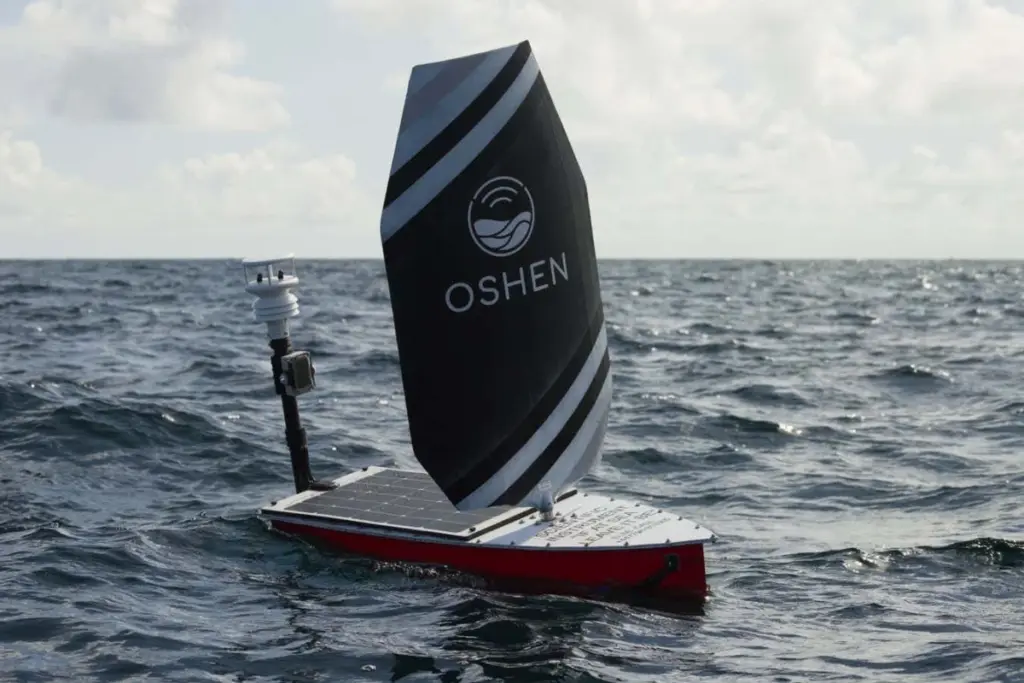
The United Kingdom’s Royal Navy is contemplating a strategic shift back to sail-powered technology, evidenced by a recent demonstration featuring a flotilla of small, wind-propelled robot vessels. These innovative crafts, known as C-Stars, are developed by Oshen in Plymouth, UK.
Measuring just 1.2 meters in length and weighing approximately 40 kilograms, the C-Stars are equipped with solar panels to power their navigation, communication, and sensor systems. Propulsion is provided by a sail. When deployed as a synchronized group, these diminutive vessels function as an extensive wide-area sensor network. Oshen CEO Anahita Laverack describes C-Stars as “self-deploying, station-keeping ocean buoys.”
These boats possess the capability to navigate at about 2 knots, covering roughly 50 miles daily. Alternatively, they can utilize wind power to maintain their position, preventing drift. The mission parameters for C-Stars do not necessitate high speeds. Laverack emphasizes, “Speed is not important when you are a CCTV network. The idea is to position sensors everywhere you need them.”
Demonstration and Operational Capabilities
The demonstration, announced this month, involves a larger robotic vessel tasked with transporting three C-Stars and deploying them in a designated target area. Subsequently, these C-Stars will relay acoustic signals to and from an uncrewed submarine. A substantial number of these vessels would be utilized in a live operational scenario.
Laverack explains the strategic advantage: “If you only have one, then the adversary can tell the general area of the submarine it is communicating with. If you have a hundred, the submarine could be anywhere, under any of them.”
The uncrewed boats are designed for prolonged deployment, capable of remaining at sea for six months or more and withstanding severe sea conditions. Notably, last year, C-Stars achieved a milestone by becoming the first uncrewed vessels to transmit live data from within a category 5 storm. This occurred during a research project collaboration with the US National Oceanic and Atmospheric Administration.
Potential Future Applications
Should the naval demonstration prove successful, these robot sailboats could be assigned to a variety of crucial roles. Beyond facilitating communication with submarines and gathering data from seabed sensors, they could establish picket lines to detect incoming ships, missiles, or drones attempting to evade radar detection.
C-Stars also present a promising alternative to disposable sonar-equipped buoys for submarine detection, given that such buoys only offer a few hours of operational life. The C-Stars can employ their hydrophones to detect submarines or capture reflected sonar pings originating from external sources, such as warships. In such a configuration, a ship’s sonar would effectively illuminate an area, enabling the C-Stars to identify any nearby activity.
Expert Perspective on Autonomous Systems
Blair Thornton, a researcher at the University of Southampton, UK, notes the growing acceptance of solar- and wind-powered uncrewed vessels over the past decade, with approximately 100 such craft currently in service. He underscores the critical importance of autonomy for managing an entire fleet of these vessels.
Thornton states, “It isn’t only the platform costs, but it is how much oversight they need for their operations. The combination of long endurance, robust operations with minimal need for human interaction can be a major advantage and allow large fleets of autonomous systems to operate.”
Integration and Future Development
The current demonstration is designed to confirm the C-Stars’ ability to integrate seamlessly with existing naval systems. Oshen has indicated its capacity to supply 1,000 boats with a nine-month lead time should the navy proceed with an order.
Laverack outlines the next phase of development: “The next level will involve software refinements so we can see more detail and achieve better coverage of a wider area with fewer C-Stars.”