
The “Feedback” section of New Scientist offers a weekly curated selection of intriguing, amusing, or peculiar news items from the realms of science and technology. Readers are encouraged to submit their own discoveries, believed to entertain the publication’s audience, via email to [email protected], providing the opportunity for public sharing of peculiar scientific and technological tidbits.
Weighing the Heavens: A Canine Comparison
A novel unit of measurement has recently been introduced, with the phrase “raining cats and dogs” proving surprisingly apt. A reader, Alan Baker, encountered a weather report from CBS News in Austin, Texas, detailing a warning for freezing rain. Meteorologist Avery Tomasco projected that central Texas might experience up to half an inch of freezing rain. This accumulation would inevitably solidify into ice upon contact with surfaces.
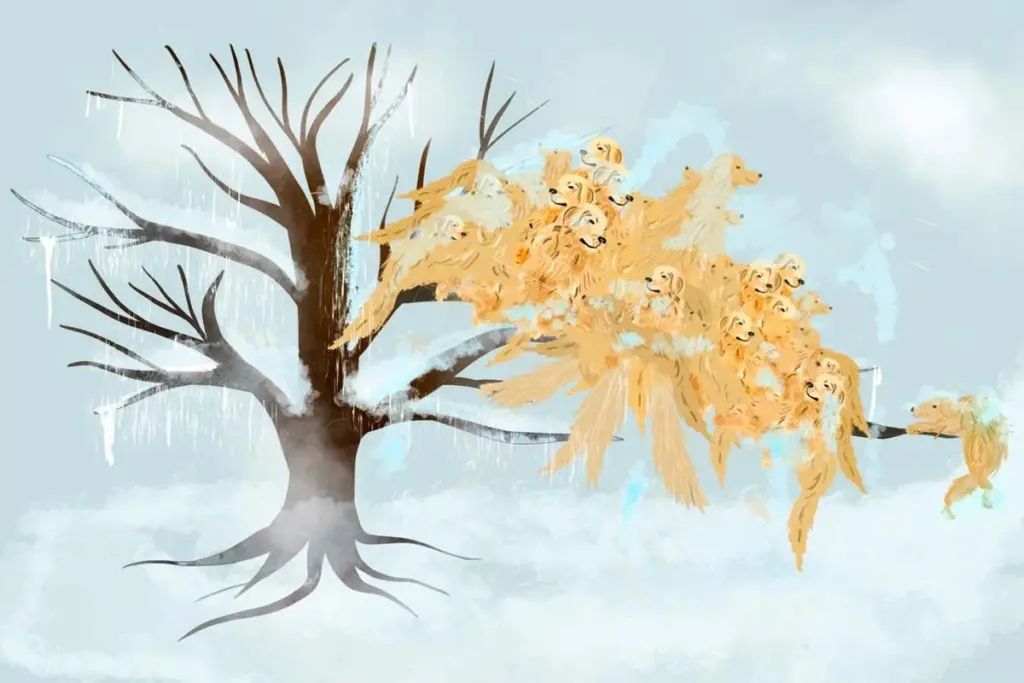
To illustrate the potential severity, Tomasco explained the significant weight associated with such icing. He noted that ice possesses considerable mass and can readily cause tree branches to fall onto power lines. Even a modest half-inch layer of ice, he elaborated, represents a substantial burden. His calculation stated that on a tree 30 feet wide, this would amount to over 7,000 pounds of ice, a figure he equated to approximately 109.5 fully grown golden retrievers.
This comparison conjures an image of a considerable number of affectionate, fluffy canines descending upon a tree. While “Feedback” questions the efficacy of this vivid depiction in truly conveying the dangers of freezing rain to the public, the publication refrains from dismissing the attempt outright.
However, a point of contention arises with the phrase “roughly 109.5.” This quantity lacks any approximation; instead, it presents as a strikingly precise figure for golden retrievers to be situated on a single tree. The precision becomes mildly unsettling when one contemplates the peculiar circumstances that might lead to one of the dogs being bisected, resulting in such an exact, fractional count.
AI’s Cartographical Calamity and Granular Grasp
Within the continuously unfolding landscape of Artificial Intelligence errors, the apparent erasure of Canada from global awareness stands out as a significant misstep. An inquiry posed to an AI, asking “how many countries end with ‘nada’,” reportedly elicited the response that “There are no countries in the world whose official English name ends with the letters ‘nada’.” The AI further elaborated that while Canada contains the sequence “nada,” its name officially concludes with the letter “a.”
This oversight also neglects the existence of Grenada. To be fair, the AI’s output reportedly included a disclaimer stating that “AI responses may include mistakes.”
It is important to note that this account is based on a screenshot shared on social media, and thus its veracity cannot be definitively confirmed. Nevertheless, the logo visible in the screenshot belonged to Reddit, a platform that features an AI-driven tool named Reddit Answers. “Feedback” subsequently posed the identical question to this AI.
The response received was: “There are no countries that end in ‘nada’. This question seems to be based on a misunderstanding or a playful trick… It seems that the question is designed to highlight the limitations or quirky responses of AI, rather than to seek a factual answer about country names.” This response, while perhaps more astute than the initial one, proved equally unhelpful in establishing definitive facts.
In a display of meticulousness, one of “Feedback’s” editors observed that the original question had been phrased with subtle differences. Consequently, “Feedback” posed the precise original question to the AI once more. The AI maintained its initial stance, insisting that “There are no countries that end with ‘nada’.” However, it did offer a concession (Readers are invited to identify the issue within this statement): “there are a few countries that end with ‘anada’ and ‘ada’.”
This time, the AI managed to recall the presence of Canada and Grenada among its examples. It also correctly identified Granada, noting that while it shares the requisite ending, it is a city in Spain, not a country. The AI’s performance was showing improvement.
However, the AI then asserted that Uganda is another country ending in “ada.” To further complicate matters, it provided a “Fun Fact”: the existence of “a fictional country from the Marvel universe” named “Wakanada.” For those unfamiliar with Marvel’s narratives concerning the superhero Black Panther, his homeland is identified as Wakanda. The nature of “Wakanada” remains unclear, but its pronunciation suggests a possible attempt to articulate Oaxaca.
From this series of AI-generated inaccuracies, “Feedback” draws a singular, pragmatic conclusion: when an AI suggests it has a fun fact to impart, the ensuing information is unlikely to be either enjoyable or factually accurate.
The Enigma of “6-7” and Existential Queries
Similar to many global trends, “Feedback” experienced the peculiar 2025 phenomenon where children would wave their hands and playfully chant “six seven” in a sing-song manner whenever these numbers appeared. Having now passed, this trend has faded, allowing for a discussion of its origins. The entire purpose of “6-7,” it seems, was its inherent meaninglessness. Its roots trace back to a song titled “Doot Doot (6 7)” by the American rapper Skrilla. The specific meaning of the phrase within the song remains obscure; “Feedback” speculates Skrilla simply required a placeholder, deeming “la la la” insufficient for the lyrical rhythm.
Subsequent uses of the phrase were often perplexing and devoid of discernible logic. “Feedback Jr,” the publication’s foremost, and indeed sole, authority on matters concerning individuals under the age of twenty, confirms that the phrase carries no inherent meaning.
However, a potential explanation for the true significance of “6-7” has emerged. This insight comes from a screenshot of what appears to be an Instagram post, although its exact location could not be pinpointed. Readers may recall Douglas Adams’s “The Hitchhiker’s Guide to the Galaxy,” where a supercomputer named Deep Thought spent millions of years calculating the answer to the ultimate question. The computer ultimately declared the answer to be 42, identifying the primary challenge as discerning the correct question.
This narrative seems to inform the Instagram post, which states: “The ultimate question of life, the universe, and everything, is ‘what the fuck is 6 7’ The computer, sadly, misinterpreted the space as multiplication.” This particular scenario, if accurate, would represent an ultimate AI blunder, surpassing all others.
Do you have a story for Feedback? Please send your submissions to [email protected], including your home address. Previous and current editions of Feedback are available on the New Scientist website.